
Exhausted but wide awake: why burnout wrecks your sleep
By Chris Wilson
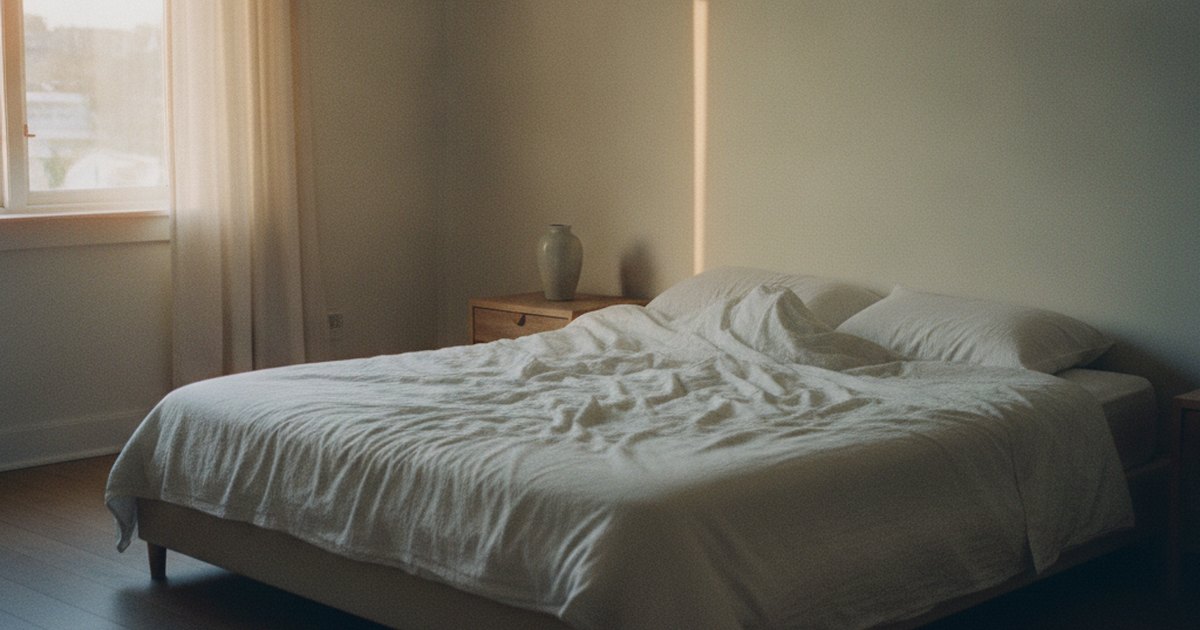
In burnout, one of the cruellest tricks is being too tired to function and still unable to sleep. You lie down shattered, and your mind switches on. There is a name for that state. Kathryn Pinkham, who runs one of the UK's leading insomnia services, calls it hyperarousal: the body stuck in a threat response, wired even when it is exhausted. It is not a character flaw, and it is not proof that something is permanently broken. On her account it is a pattern the body has learned, and a learned pattern can be relearned.
I know that state well. For three years I could not sleep without a tablet, and I had quietly decided that was just how I was now.
Exhausted but wide awake is a real state, not a personal failing
Kathryn's distinction is the part that reframed it for me. Ordinary stress, she explains, causes a small amount of sleep disruption, and that is normal. Going through a hard week, a loss, a deadline, most of us will sleep badly for a while and then, as the stressor passes, sleep drifts back to its old shape on its own.
Burnout sleep is different because it does not pass on its own. When the nervous system has been sitting in a chronic threat state, running on adrenaline through the day, that same alertness is still switched on at night. So you get the exact combination that feels like a contradiction: depleted and wired at the same time. Hearing it described as a mechanism rather than a weakness did something for me before I had changed a single habit. It moved the problem out of the category of things wrong with me.
Why the usual sleep advice was not enough
I had done all the obvious things. Darker room, no screens late, a longer wind down, the various gadgets and teas. Kathryn is careful about this, and so am I: those things are not useless, they just work around the edges. They can help you relax. What they cannot do on their own is change a pattern the body has learned over months or years.
Her point is that you have to get underneath the habits and reset the body clock, and reduce the vigilance that has built up around being awake. That was the piece I had never actually done. I had been trying to sleep harder, which is a bit like trying to relax on command. The effort was part of the problem.
There is a companion idea to this that I have written about before: rest is not something you can aim at. Sleep turned out to be the same. You cannot point yourself straight at it and force it to arrive.
What actually helped me was relearning sleep, not chasing it
So I ran an experiment on myself and filmed it. I worked through the programme Kathryn runs, Sleep Well, Live Better, which is built on cognitive behavioural therapy for insomnia, the approach she describes as the one the NHS recommends first for long-term sleep problems. I should be plain about the arrangement here: I received the course and Kathryn's support from The Insomnia Clinic in exchange for documenting my experience honestly, and I receive no commission from it. I am telling you about it because it is what I actually did, not because I am selling it.
What the work looked like, in ordinary terms: I kept a real sleep diary. I did the counter-intuitive part, going to bed later and getting up at the same time every morning to rebuild the pressure to sleep, rather than lying in bed hoping. And I did the cognitive side, which was mostly about loosening the grip of the thoughts that showed up at 3am. None of it was dramatic. It was small, repeated, slightly uncomfortable, and it added up.
Coming off the tablets, slowly and with support
The part I was most nervous to document was coming off the medication. I want to be careful about how I put this, because it matters more than anything else on this page. Everything here is my own experience, not advice, and every change I made to medication was made under the supervision of my psychiatrist. Kathryn is equally clear in the episode: coming off sleep medication is something you do with your prescriber, not alone.
With that in place, I tapered down over the weeks of the programme, and by the end I had done something I genuinely did not believe was possible at the start: fourteen nights with no tablet at all. I am not holding that up as a finish line or a formula. I am holding it up because for three years I would have told you it could not happen, and I was wrong about that.
The one line I keep coming back to
Near the end of our conversation Kathryn said something I have not been able to shake. "The fact that you're awake right now is not evidence that there is something permanently wrong with you."
If you have spent enough nights awake, you will know how much that runs the other way in your head. Every bad night feels like more proof that you are broken, and the proof makes the next night worse. Hearing a specialist say the wakefulness is not the verdict, that the system is intact and has simply learned a pattern, was the thing that let me stop fighting my own body long enough for anything else to work.
If this is where you are
You do not have to fix this tonight. If you are reading this at 3am, wired and exhausted and quietly certain something is wrong with you, the most useful thing I can offer is the reframe that helped me: this is a pattern, not a life sentence, and being awake is not evidence against you. Noticing that, and being a bit kinder to the version of you that is awake, is enough for now.
Where I'm At is based on lived experience, reflection, and educational support. It is not therapy, counselling, crisis support, or professional advice. Please consult a qualified professional for individual medical, psychological, legal, financial, employment, or specialist support where relevant.
If any of this brought something up for you, consider speaking with a licensed clinician or a trusted professional. If you are in immediate distress or thinking about harming yourself, please contact local emergency services or your country's crisis line right away.
The RESET phase in Where I'm At Community is where this ground gets covered, at whatever pace suits where you actually are. The community is moving onto a platform we run ourselves, on EU servers, and it reopens on Tuesday 3 November. It stays free to join. Leave your email and you'll be among the first invited.
Sources
- Share. Inspire. Explore. (2026). Why You Can't Sleep, and What Actually Fixes It, with Kathryn Pinkham. Season 2, Episode 10. https://youtu.be/rSF44wUh4zs
- The Sleep Experiment: CBT-i, Sleeping Tablets, and 8 Weeks of Honesty (2026). Chris Wilson, Where I'm At. https://www.youtube.com/playlist?list=PLFAtdhFZHkKA