Understanding Burnout from an HR Perspective, Part 1 — Martina Teufner
Prefer to watch? This episode is on YouTube and the show is on Spotify.
About this episode
Corporate burnout is a workplace problem long before it becomes a personal one, and HR sits right in the middle of it.
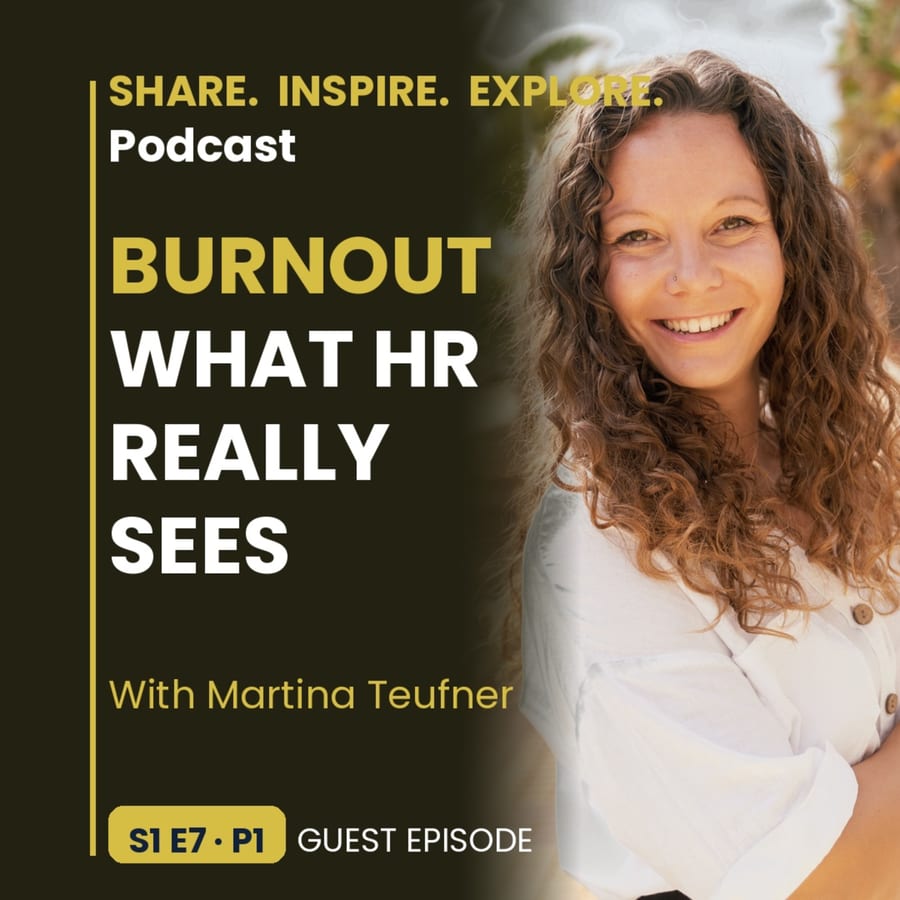
HR consultant Martina Teufner joins Chris Wilson for a two part conversation about what burnout looks like from inside the function that is expected to fix it. Martina brings twelve years in HR and her own burnout, and she is candid about the position that puts her in: able to see absenteeism, dropping performance and a culture shifting, but not able to diagnose anyone, and often unsupported herself.
Part 1 covers what burnout actually is, how it spreads through a team, and where HR's role genuinely ends.
Why employees hesitate to go to HR, and what that trust gap costs What the return to office debate reignited, and why flexibility is prevention The emotional position of being HR inside a culture you cannot fix
Season 1, Episode 7
Connect with Martina Teufner: https://www.linkedin.com/in/martina-teufner/
Share. Inspire. Explore. is the podcast from Where I'm At, honest conversations on burnout, career change, and what comes next for working professionals.
Join the Where I'm At Community, free to join: https://community.whereimatcommunity.com/store/product/membership Website: https://www.whereimatcommunity.com
Where I'm At is based on lived experience, reflection, and educational support. It is not therapy, counselling, crisis support, or professional advice. Please consult a qualified professional for individual medical, psychological, legal, financial, employment, or specialist support where relevant.
Read the full transcript4,336 words
Automatically transcribed, so it may contain errors and does not identify who is speaking. It follows the conversation in order.
Welcome to the Share, Inspire and Explore podcast, the voice of the where I'm at burnout community. I'm Chris Wilson. And after my own journey through burnout and depression, I'm here to share real stories, inspire personal transformation and explore the path from burnout to balance. Each episode brings honest conversations with burnout survivors, mental health experts,
and mindset coaches offering lessons, strategies and hope. Whether you're recovering, curious or searching for motivation, this is your space to grow. Let's dive into today's episode. Welcome to the Share, Inspire and Explore podcast.
Today, we're kicking off a special series exploring burnout and HR's role in addressing it. To start, we're answering a critical question. How do HR professionals view burnout and how do they identify it in employees? I'm joined today by Martina Teufner, an experienced HR consultant,
business coach, founder of Resource Minds Consulting, founder of HR Business Friends and awarded one of LinkedIn top HR voices in 2024. Welcome, Martina. That's quite an introduction. Well done on your achievements since we last worked together. Can you share a little bit about your background in HR and how burnout has become a key concern in your work?
Hi, Chris. I'm happy to be here. So I have been working in HR for more than 12 years now. I started as an intern in a big corporation and worked my way up to head of HR in several companies across several industries. And today I'm a self-employed HR consultant, like you already said.
And I have the honor to work with a lot of different companies and get a lot of different viewpoints on all the HR topics that are out there. And to be completely honest, burnout was not one of my main topics up to several years ago when I experienced it myself. But the first time I came across burnout was in my first job when a colleague mentioned that she had burnout in the past. And honestly, I never felt that it's a big HR topic until the day where I felt that I have burnout myself and where I went through it myself. And now I'm a bit more curious and I'm very happy that we're talking about it
today and I can share my perspective on it. Interesting. Interesting. I think I mentioned off air, I saw a LinkedIn post today, there is no HR for HR. So how did that feel when you had burnout? It must've been very isolating.
Yes, it is. So for me, these are two topics. First of all, there is no HR for HR. That's true. So when HR has an issue, where do they go to? The second thing, my personal burnout was a bit different because it was during COVID and during a very personal crisis because my husband had a big accident that time. And I still worked through it somehow. And honestly, I didn't tell anyone. I just did what I had to do. And then I took a year off to get back on my feet. So yes, it's weird that HR has no HR, to be honest. Well, thanks for sharing that, by the way. And I guess we'll get through that in the topics. Let's kick off
those topics. Burnout through the HR lens. When HR professionals talk about burnout, what do they mean? And how does it differ from regular workplace stress? Yeah. So I think one important thing is that HR professionals are not medical doctors. So we can never diagnose a burnout. But of course, we talk about it. And when do we talk about it is when we see an employee has burnout. Because this is something you might see when a person is still working in the company. Or you see when the person tells you that they go on sick leave because they have a burnout. So those are the points where you start talking about it. And then of course, you talk about a sickness and illness
because the person cannot work anymore. And this is normally the point where HR gets informed. So it differs from normal workload or normal stress at work as that normal stress at work happens every day. And this is something that happens now has a peak and then the people can recover from it. And maybe they complain about it. But in the end, they are okay. But with burnout, they are not okay. And they never get this rest. And I think that is what we're talking about when the stress gets too much. And when it leads to an illness where you cannot work anymore, I think that's the point about what HR is talking.
Yeah, it plays out in many ways and through illness. You know, sometimes it's unexplained what's going on when you're experiencing it. I guess we'll cover the science in more detail. Why is burnout a workplace concern? I mean, from a HR perspective, why is it a serious issue? And
what impact does it have on employees and companies from your experience? So this is quite easy to answer because from an HR perspective, burnout is a quite serious issue. It affects the employee as an individual, but also the company. When it affects the individual, it's mostly about their health, but also when they're having your concern with their health, it's about their performance. And that, of course, affects the company's performance. Because if an individual is not able to do the work they were hired for, the company might lose money or might lose quality in the work they perform. And so it's an issue for all the parties involved, to be honest. And that's why also it's a topic for HR to see that employees don't have burnout, even though the impact
of HR is not too big on this issue. So it affects employees and the company because the employee is on sick leave cannot perform anymore. Maybe they start complaining. Maybe it also concerns the colleagues of this employee. Because if one person starts complaining a lot about things, also the company culture and the team performance might be worse. And so it affects a lot of people. And it makes absolutely sense to take care that you don't have burnout in your company and that you support employees that they stay healthy as far as you can. That's interesting, how'd you say that, that this ripple effect, that negativity. I mean, there's always something burning underneath. And if that's not addressed, it's just, I can say,
I was with I was that person, it really turns you into a negative person. And your lunch colleagues have to listen to you. And it's just generally not, not so nice. Yes. And this has an effect on everybody who is in contact with you, of course. I mean, since COVID, this is when, you know, the intensity, for me went up. How did you see burnout play out at this time? And, and since the restrictions were lifted and, and now this drive to get employees back to the office in a hybrid or full time. There's, there's constant debates on LinkedIn now. We could talk for hours, but what, what's your opinion on, on the effects of COVID?
I mean, during COVID, this was a major crisis for everyone, of course. And there was a very high pressure, on employees to suddenly perform the work under different circumstances, but still companies expected them to work, right? No matter where they sit, how they sit, if they sit in the living room, they had to meet their deadlines and do the work. So there was still this normal work pressure under different circumstances. And on the same time, people were lonely, except especially people who were living alone. They were suddenly alone all day long. And I think burnout and depression really rose in those times. And then afterwards, I think people were happy. Okay. Now, I mean, we managed this crisis somehow, we can go back to work. We don't have to, we're more flexible now. So for,
I don't know, half a year, a year, it was fine. I think things got better. And now we have this back to office pressure again. And I don't think that this is a good thing. Because what COVID brought us
is more flexibility in working hours and also in more flexibility for employees to choose where they want to work from, when they want to work. And so for people, it's easier to integrate work and their private life, if they have the possibility to be a little bit flexible, you know. And I think this
could take off a lot of pressure from people. But of course, if you tell them now, come back to the office, it's another change, again, working in different circumstances. And so this will, again, produce pressure. And if you put pressure on people, of course, they might get stressed out. And burnout might be one of the things that come out of this. So from my perspective, we should keep up with the flexibility and rather promote hybrid work environments and give people the option to choose where they can work best from and when they can work best. Because this also means that they are a bit safer from work stress because they can integrate work better in their life.
Yeah. I mean, just in terms of focus, you know, the big open-planned offices, from my experience, very distracting. No privacy. It's very hard to, you know, sit down and do certain tasks. Whereas that hybrid approach gives you the chance to shuffle your calendar so that you're optimizing your work and your to-dos effectively. My experience with the return to the office is you're in the office environment working virtually. It just doesn't make sense. You're losing, as you've said, this flexibility,
doing some sport in the morning. You know, that's definitely a prevention mechanism for burnout because you're, you're moving, your body's moving. And so it's, it's a big challenge. I definitely feel it's geared towards lack of trust from certain management. And that's kind of sad because, you know, it should, you should be able to trust employees. During COVID, the trust was there and employees outperformed expectations because you were just looking to, to add value. I speak for myself here. Um, but of course my story is, is well documented on this. There will be, uh, where that led, but it's, um, but it's a good, also, I have to admit I was full-time home office advocate, but now I see
the benefits of hybrid, but it's better to organize the teams in a way that it's designed for more social and team building, uh, and more maybe creative brainstorming as opposed to sitting in an office, an empty office with the bad lighting expected to just work virtually. Yeah. Absolutely. And I would even go as far as saying every team should have their own structure and they should discuss together. Okay. Who wants to work more in the office? Who wants to work more at home?
How can we keep creativity and innovation flowing? How can we make sure that we meet each other so that everyone's needs are meet, are met? And I think that's very important to have this discussion within a team and to see, um, how can we help every individual in one team to meet their needs? And this is a very big thing, but I think it would help to start the conversation.
It's very helpful. The new way, new way of working was a buzz topic. Absolutely. I think we're going off piste here, uh, on today's episode, but that, that's fine. Uh, maybe we can cover that, uh, in a, in a further episode, uh, an ideal workplace. Um, but let's get back to, to burnout, obviously. So what, what does HR, you know, look for in terms of the common burnout indicators, you know, how to identify it and employees, are there any strategies you want to share?
Um, honestly, HR doesn't do that. So we don't go to work and say, okay, today I'm gonna, uh, see how I can identify if employees have burnout or not. Why? Because we cannot diagnose anyone. We are not medical professionals. So we will never diagnose anyone. And if an HR professional would do this, this would be very unprofessional. But of course we are human beings and we are the colleagues of these people, right? So we might identify early warning signs, or we might see some indicators where we think, oh, this person might be stressed out or here it might need a bit more attention. And this could be, um, for example, if someone is on sick leave regularly. So for example, there are people who
who are always sick on Mondays. And this could be a topic where you can talk to them and, and ask what happened. Or, um, you see behavioral changes, or maybe you get some feedbacks. You hear people complain about stress at work or you have service in place. Some companies do ask the employees on a regular basis, how they are feeling, how satisfied they are at the workplace. And all of these small things can be indicators and HR might see it, but HR will never diagnose an employee and say, oh, I think this person has burnout. So the, and this shouldn't be the case because they're not medical professionals to ever make this. Absolutely, yeah. I have some, some questions on what you just said there. Maybe you
can start with, I mean, the behavioral changes that you've seen employees. Can you give some examples there? Um, sure. So I think one of the main examples is that people start complaining about work. So if a colleague who never complains suddenly starts complaining on a regular basis, it might be a sign that there is a change happened and you might want to look closer, but it could also be that the performance is reduced. Someone who always had a high quality of work, suddenly the work quality gets worse. Something might have happened or people are start not taking work seriously or, or it seems like that, or they start being late at work. So this all might be things that if someone changes their behavior, it
could also be that the person who is normally very outgoing, suddenly doesn't raise their hand or doesn't say anything. It gets quiet. So things like that, I would say.
That's great. I mean, the next one is about employee surveys. I have very skeptical views on anonymous employee surveys. You know, typically, typically I never wanted to rock the boat, but in terms of burnout, are they built in a way that, you know, these surveys can raise some flags?
Yes and no. So first of all, first of all, normally these surveys are really anonymous and you can, as an employee, if you see that your company has an external consultant on this, or they use an external tool, you can be quite sure that it's really anonymous.
It might not be anonymous. If you have an internal tool there, people could maybe see, but only maybe. But in the end, these surveys are normally quite straightforward. You ask the questions you want to ask. And if you do such a survey, you might ask your employees, not, hey, do you have burnout? Because what kind of question is that? But you would rather ask, how satisfied are you with your job? How high is your stress level? How are you feeling when you come into work? Things like that. And of course, if you do this service on a regular basis, like every three months or every six months, you see a development. And then you could see if, for example, in one department, job satisfaction
goes down and down and down. And then you see, okay, there is something wrong. We have to investigate that. We have to take a closer look. This doesn't tell you, oh, there might be a case of burnout.
But these surveys tell you, okay, in this area, there might be a problem and you should have a look at it. So I would rather see it like that. But there are no secret or hidden questions that would raise some flags. Oh, this guy probably has burnout. Normally, that's not the case. I guess, yeah, you can identify maybe some toxic work, working practices. And that can obviously lead to this feeling of lack of control, all of which I think have contributed to me sitting here today. But, you know, if you're discussing with employees who appear to have, you know, problems, what is the HR stance there? Is it on the side of the employee or management or both? Can you explain if there's
any biases towards either? Because it's a super hard question. Maybe it's a bit of a loaded question. No, it's okay to ask this question. And I think there is a lot of confusion across HR professionals, across management and employees about this topic. And I have a very clear view on this because HR
is not a neutral authority in a company. HR is a department in a company and HR has to work towards the benefit of the company. So in theory, HR will always be on the side of the employer will always be on the side of the company, if there are even two sides, if you see it like that. So that's the role. We have to play our part in the value chain of the company. And that's not always a fun role. And that's not always an easy role. But if HR has to pick a side from the role that HR has, it would be the side of the company. So that means it would be the side of the employer, the side of the management. But
people who work in HR are, first of all, we are humans. And most of us work in HR because we like people. And if you talk to HR professionals, most of them are quite nice. And a lot of them want to help people. So this is like an internal conflict when you work in HR, that you have to be on the side of the company, even if the company does things you don't like. But you want to help all the employees that make everyone happy. And then it depends how HR or this one person in HR defines their role. Of course, I can decide to take my stand against the company. But I'm also just an employee. And I might
endanger my job. And I think sometimes people forget that about HR that we're also humans, we're also employees. And we're not like the rulers of the company. We are not the decision makers. We are mostly part of the system. And we have to play our role. So I think most HR people will try to take a neutral role. They will try to meditate between employer and employees. Or mediate. Mediate. Mediate. Thank you. Although it would actually help in a certain situation. Actually help, yes. In some situations, it might be a good idea, too. So that's what they would try to do. But if you look at the role of HR, it's just a department in a company that's there to add to the value
chain. And it's not like the works council, because the works council is there to be the representative of the employees to be there for them. Still, HR will try to be there for employees, because that's who we are. And that's also part of the role. So like a trade union in some other countries. And it depends on the size of the company. Every company has such systems in place. This was a huge surprise to me. You know, we talked a few weeks ago, because you're welcomed when you join a company by HR. Open arms, you get some presents and some swag gifts. And it's all just very welcoming. And to think, oh, this is this is a department I can call
upon if I have issues myself. And as you mentioned, actually, the company that we work, we both work, I use this as a benchmark on how HR should behave from my experience at that time, which is one of the the first burnouts. And then rolling forward to more recent times, I had the opposite side of the scale. Nevertheless, my perception of HR still remains, they should be there for the employees, because if it's about optimizing performance, and instead of it felt like a complete discard,
I was seen as a high cost. Maybe it was my age, maybe it was the burnout. These are obviously my assumptions. But it left things a bit bitter. And for me, ideally, HR would be somewhere in the middle. And I know, you've mentioned, you also are humans. And that's great. And I think most people in HR obviously are people and culture people. But yeah, it just depends on where you're working and what, but I guess you know yourself how things might play out. If I say this, or if I declare I'm feeling burnt out, how will that? How will that play out? Because it's a big thing, because you don't want people to know, you still want to maintain this, this, this, this shield of power or whatever it may
be. Absolutely. But it's not the case, you're broken underneath. And it's very fragile situation. And for me, it was my body was taken over that, because it couldn't trust my head. So it was playing out in various symptoms. Yeah. But that's interesting. HR, do you think it makes any difference if HR is external consultants in the role of HR? Are they more likely to be more independent and be able to have a more impartial view? Or does it not make any difference because they're both paying
either the salary or... Probably an external HR consultant can be way more straightforward in telling the company or the owner of the company that they are doing something wrong. Because honestly, the work stress doesn't come from HR, it comes from bad leadership or bad culture or bad environment, whatever. And so as an HR professional, if I try to raise awareness, I endanger my own job, maybe, depending on the management team you have, depending on the company owner. As an external consultant, I can just go there and say, Hey, you have a toxic work environment. If I were you, I would change it, because your employees will get sick, you will lose your employees, and this will cost you money.
So I can argue way more straightforward than an internal employee can. I mean, in some companies, they can, and they can raise awareness. And not every company is the same, but in some companies, it might help to have someone external to raise these issues and to openly talk about it. It's easier. And also I have the experience that management rather listens to external consultants than to internal ones. So I have the experience that there are really good HR people in a company and they tell the management team, Hey guys, here is something going on. We have to take care of this. You cannot do it this or that way. And they don't listen. And then they hire an external consultant. The consultant says exactly the
same. And they say, Oh yes, you're right. We have to change. And it's weird. I cannot explain this to be honest, but this is also the case in some companies. And it's very hard. If you look at it from an employee level, where, as you said, you're welcome by HR and everyone is so nice and everything seems so perfect. And from an employee level, it's very hard to see that. Of course, because who would talk about it, who would explain to you on your very first day, Oh, we're super happy that you're here. But
yeah. And like I said before, also HR people, they really, or most of them, of course, not all of them, but most of them really want to be there for employees. So they try to do their best. We've covered a lot of ground in this first part from what burnout really is, how the pandemic intensified it to the complicated position HR professionals are in when trying to support both employees and the business. But the conversation doesn't end here. In part two, we dive deeper into practical strategies, how HR can approach employees who might be struggling, what behavioral signs to look out for, and how to open up meaningful, constructive conversations about burnout.
We also explore the challenges HR faces when expectations are high, but resources are limited. That's all coming up in the next episode. I'll see you there. That's it for today on the share, inspire and explore podcast. I hope something resonated with you. A moment of clarity, encouragement, just a reminder that you're not alone. If you find this helpful, share it with someone who might need it. Hit follow or subscribe to join us for future episodes.
If you're new here, please check the link in the description to join the community. Burnout is tough, but it's also a chance to heal and rediscover what matters. Thanks for being a part of this journey. Until next time, take care and keep exploring what's possible.
I'm Chris Wilson, and that's where I'm at.