
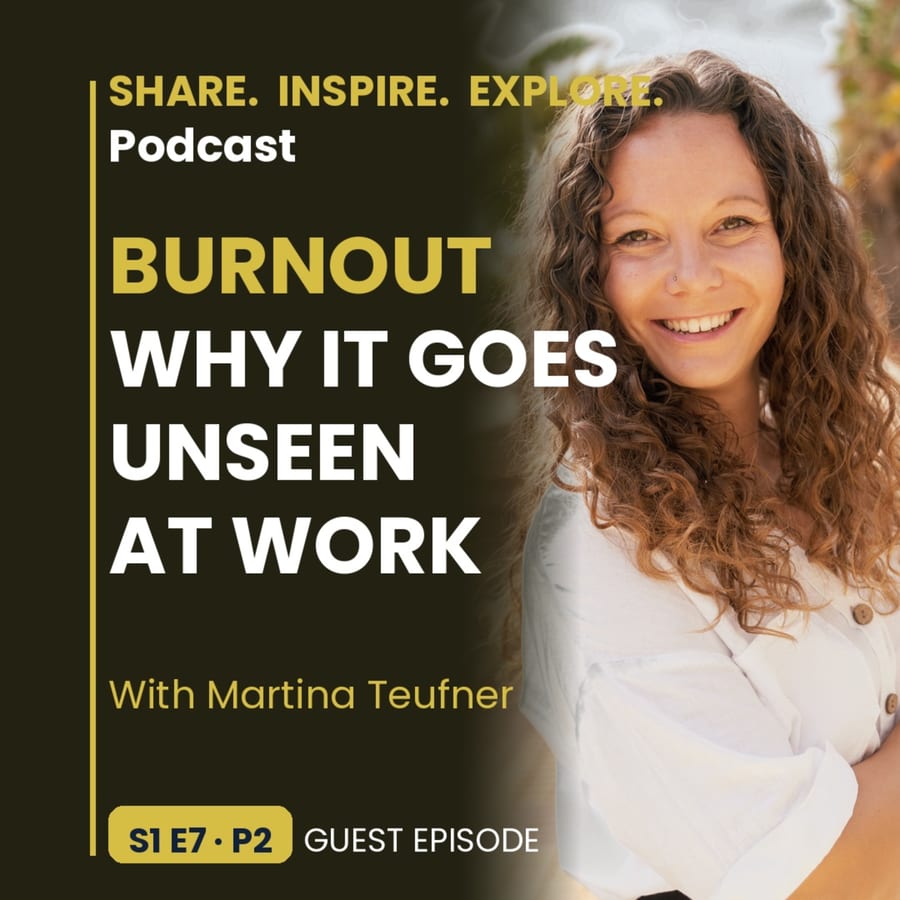
Understanding Burnout from an HR Perspective, Part 2 — Martina Teufner
Prefer to watch? This episode is on YouTube and the show is on Spotify.
About this episode
Burnout is not only about working too much. It is about feeling unseen, unsupported, and stuck in a system that does not account for you being a person.
In the second half of the conversation, HR consultant Martina Teufner and Chris Wilson go further into why burnout goes unnoticed inside companies, and why the support so often is not there at the moment someone needs it. Martina describes the power imbalance HR works under, caught between looking after people and delivering what the business wants.
They also get into what psychological safety means once you strip the phrase of its corporate use.
The power imbalance HR professionals work inside, and who it protects What a healthy workplace culture actually looks like in practice The early signs leaders and HR are best placed to notice
Season 1, Episode 7
Start with Part 1 if you have not heard it.
Connect with Martina Teufner: https://www.linkedin.com/in/martina-teufner/
Share. Inspire. Explore. is the podcast from Where I'm At, honest conversations on burnout, career change, and what comes next for working professionals.
Join the Where I'm At Community, free to join: https://community.whereimatcommunity.com/store/product/membership Website: https://www.whereimatcommunity.com
Where I'm At is based on lived experience, reflection, and educational support. It is not therapy, counselling, crisis support, or professional advice. Please consult a qualified professional for individual medical, psychological, legal, financial, employment, or specialist support where relevant.
Read the full transcript4,402 words
Automatically transcribed, so it may contain errors and does not identify who is speaking. It follows the conversation in order.
Welcome back to the Share, Inspire and Explore podcast. This is part two of our special episode on Burnout from a HR perspective with Martina Teufner. If you missed part one, I highly recommend going back to hear it first. We explored what burnout is, how COVID-19 changed the conversation and the pressures HR professionals face trying to care for others while managing their own well-being. In this episode, we shift from reflection to action. Martina shares insights into how HR can better approach employee well-being, recognise early warning signs and hold space for honest, supportive dialogue. We also talk about the very real tension between caring for people and meeting business demands. Let's jump back in.
Say somebody is experiencing the burnout, you see the signs, the negativity, everything that we've mentioned before. As I've also said, there's a sense of pride, the shield I mentioned at stake. It's such a delicate topic. And me as that person, looking back, I was very irritable and very hard to approach probably. I would be defensive and probably would react if you were to approach me.
Do you have any strategies where it's worked well and times maybe it didn't and maybe why? So this depends on my personal role, to be honest. If I'm in my HR manager role and I'm in my HR manager role, I would never simply just go to an employee and ask them and tell them that I see signs of burnout in them. I would never do that, except for when I'm also their friend, because this might happen at the workplace that an HR person befriends an employee from a different department, if you work together for several years, then it's of course different. And there, I also experienced it in a different way, because then it's easier. If you had several lunch dates together, you talk a lot,
you are more than just work colleagues. Then I can easily go up to the person and say, hey, I have the feeling you're stressed out or I see behavioral changes. Do you want to talk about it?
If it's simply an HR employee relationship, I would never do that. Because this is like, why, on which basis could I just go to someone and tell them, hey, I have the feeling you're stressed out. I don't think that this works. So the strategy here would be to first talk to the line manager and ask them because they are closer to the employee normally. And you would ask them, hey, I have the feeling about this employee. Can we talk about it? How do you see that? And normally, you would then,
if the line manager agrees, you would then together come up with a strategy. Who is the best person to talk to this employee? And in most cases, it will be the line manager because they are way closer to the employee than HR. I worked in corporations that have more than 20,000 employees. Of course, I didn't know everyone there. And still, when I sat in a meeting with someone and I saw that this person seems unhappy, I would go up to the line manager and say, hey, I saw this person today for the very first time. I don't know anything about them, but I have a feeling. Can we just talk about it? Is there something to talk about? And in such a case, of course, if I would just go to the employee, it would be
very, very, very weird to say, hey, I just met you, but I have the feeling you're unhappy here. Should we talk about it? So it gets very hard when you have a line manager who is not a good line manager.
Then it gets really hard. And then honestly, you just have to see if I as an HR person, and we're very convinced that there is a problem, I would probably try to find out more. I would maybe try to talk to the employee, maybe have a lunch and just not raising the topic, but just getting to know each other and see if this is something normal, or if there is a problem. Or at some stages, you would maybe ask the work council to help or to see how you can approach this person without being too straightforward. Because honestly, if you don't know a person, it's, I think, a bit too straightforward to just go there and ask them about their mental health. It would be a weird approach.
It could feel like it could feel like an attack. Yeah, yes, yes. There are many reasons how, you know, you end up in that mental state. Absolutely. I mean, talking about employees affected, do you see any differences in, let's say, high achievers and versus disengaged workers?
Maybe, maybe not. I don't think so, honestly, because maybe high achievers try to cover it up a bit more. And there it's maybe a bit harder to spot. But still, for high achievers and disengaged workers, it's always about the behavioral changes, because this is what you can see the most. And even a high achiever might show some behavioral changes, they might complain a bit more, or they might be late for meetings, some small things. You just have to also recognize these small things. But I think, honestly, it's always the topic about look for behavioral changes, We talk about tracking employee well-being. I mean, I wasn't aware of these potential discussions that HR obviously are maybe good at reading the room, even those people that you, as you mentioned, that you
don't know. But overall, how do you track employees? You've mentioned, we know the surveys, but are there any other touch points you want to talk about? So normally, you don't track these kind of things. Because at least in Austria, if an employee is on sick leave, I'm not allowed to ask why. So if you're on sick leave, it might be burnout, it might be cancer, it might be depression, it might be just the flu. So as an HR person, I am not allowed to ask you. Also, your line manager is not allowed to ask you. The only thing that we know is you're on sick leave, and it wasn't a work accident, because this is the only difference you know. So you would never track this. Because if a person comes to me and tells me what kind of illness they have, I would never write down somewhere. This is not a work accident. So you would never track this. Because if a person comes to me and tells me what kind of illness they have, I would never write down somewhere. This is not a work accident. So you would never track this.
Because if a person comes to me and tells me what kind of illness they have, I would never write down somewhere this person has burnout. I would not. I mean, it's not allowed by law. So you would not track it. But what you of course track is like employee satisfaction, as a whole, you would track performance. And there you might see some things. But you would never track illnesses or something like that.
Yeah, that's interesting. That's interesting. My experience is the managers do ask. And me being an over explainer, I say too much. So these are things I'm trying to train myself. But I mean, are managers trained to recognize burnout? Probably not, as you've mentioned, HR not. So why would managers? No, but honestly, what I think is that managers should be trained in talking to their employees and having honest conversations. Because this can really help in this kind of cases. Because, of course, it would be nice if your line manager is really interested in you as a person and asked you, hey, how are you feeling? And it would be great if you could just answer honestly.
Honestly, but this is like we're all humans. And not every manager is good in managing employees. And not every manager is a great leader. And not every manager is interested in their employees. It's just very personal or very individual. So they're not trained. Normally, they're not trained in recognizing burnout. Of course, there are some companies who do this kind of training. But I think it's better to cover the basics in having a decent human conversation from the manager to the employee, from the employee to the manager, and to be honest to each other without having to lie and without having the feeling that you're interrogated or that your manager just asks you. So they know, because they're, I mean, I knew a manager who just wanted to know what the employee has. And what you're doing with this information. Are you interested in the health and well-being of another person? Or you're just nosy?
Lack of trust. Yes, yes, absolutely. And I mean, these are all humans. But to answer your questions, no, they're not. Normally, they're not specifically trained for that. Of course, there are some companies who have trainings in place. But I think if you look at most of the companies that don't train specifically for burnout, I'm happy if they even train for leadership skills in general. So that's another podcast. That's another podcast. Yeah. Yeah.
I mean, I had no problems going to HR, but I think many employees would hesitate to approach HR about burnout. How can someone start the conversation in a way that's constructive and safe? So my recommendation would always be, if you have the feeling that you're too stressed out, if you have the feeling that you have a burnout or depression or whatever,
I would always first recommend to talk to a professional medical doctor to know what's going on. Because in HR, there are no medicals. We are not no psychologists. We cannot do the things that doctors can do. So if someone comes to us and tells us, oh, I'm stressed out, we might react the wrong way because we're not trained to take it serious enough or to see all the small things that we should maybe see in a person that has a burnout. So that would always be my recommendation. Of course, I know people sometimes don't think about that. They forget about it. And they see HR as there, as a trustworthy department or person, and then they go there.
And I think, be honest, tell them about your feeling, but also tell them what you expect from them or what you need from them. Because it's like when you go to the accounting department and tell them that you have a burnout, they will also not know what to do. And HR might only recommend go to a doctor or work less, or they can offer to talk to the supervisor, but they also have limited possibilities to support. So if you decide to go to HR and tell them about your burnout, I would really tell them openly and tell them what you're expecting from them. Are you expecting them to keep it quiet? Are they allowed to talk to someone about it?
Or do you want to keep it a secret and just tell them in order to tell someone? Or do you expect specific help from them? Do you need any support? Maybe you need support in talking to your line manager to reduce your workload.
So these are things HR can support with. And some HR experts will already know that they can offer these kind of things. But if you decide to talk to HR and you maybe talk to a very young person or someone who just recently joined the company, they might just be overwhelmed with the question because they don't know. They don't have the experience of what they can do and what they can offer.
And I assume that the reaction of someone like that would either be to try to overhelp, like, oh, let's talk about it and I listen to your complaints, but then they cannot do anything with these complaints. Or they will just send you away and say, oh, yes, everyone has a stressful day. Just deal with it. Both reactions won't help you.
So if you want to talk to HR, do it transparently, but also keep in mind to tell them what you need from them. So they can assess, can I really help you or not? And then, of course, HR has also to tell you transparently what they can do and what they cannot do.
Does this make sense? Yes, absolutely. I mean, just thinking back to the time in the company, we worked together with a thought. I was surprised when I approached, it was, I think it was you or your colleague. I can't remember, but there was budget, actually, for coaching. It was labeled coaching, but actually it was therapy.
And so that was a nice feeling that you could speak to someone externally. And there was definitely the feeling there was no dialogue between that coach because there are ethics involved with therapy and confidentiality, obviously.
And so that was a nice thing to experience. But as you said, it depends on the person knowing that is available. That's the conversations can go dangerously one way or the other.
Yes. And that brings me back to also HR people are people and humans. And if you decide to tell someone within the company, then choose wisely, I would say. Think about, okay, is this person able to handle what I'm going to tell this person? You know, you also have to assess a bit because just because someone is working in HR, they are not good in HR. They are not good people. I mean, most of them, but I would assess, okay, is this person someone I would really want to talk to and who would really want to help me?
Or is this just someone who does their job and doesn't care about everything else? Because also this kind of people might work in HR, it might happen. But yeah, I think you may have answered part of it already. But as an employee who has concerns about burnout, what can they realistically expect from HR to do in response? I mean, you've mentioned already the doctor, but can you maybe expand on that?
Yes, of course. So what HR can always do is give the recommendation to talk to an external person. It might be go to the doctor and get a diagnosis. It might be like in your case, hey, we have a budget, go and talk to a coach or therapist and the company pays for it. It's quite important for HR to get this thing external because we cannot deal with burnout or with mental health issues because we're not equipped for that. So HR will and should find an external solution and external support for the employee. And I think this is something you can expect, either a recommendation or there might be a budget. Or if you have an HR business partner, an HR manager who can think a bit out of the usual, they might find budget even if there is none.
So, of course, you can expect this. The second thing that you can expect is HR can always support you when you have issues with talking to your line manager. Because HR also deals a lot with management and they are also there to support you. If, for example, you want to tell your line manager, but you don't know how, so they can brief you and they can support you in that. They can prepare you, they can even talk to your line manager for you if there is any issue. And sometimes if they understand what you're doing for work, they might even be able to support you in assess the stress levels of your work in helping you.
Okay, where can you reduce, but this depends if they can understand the content of your work, if they can have a say in this or can support you in that. I think what you shouldn't expect is that they are just listening to complaints and they can also not do a diagnosis or help really in healing because the healing is something that shouldn't happen within the company because HR managers are not equipped to do that. So, maybe the development of tests could be integrated, but that's a conversation for maybe psychologists and the like.
Yes. We've covered this maybe as well. The next topic is about addressing burnout and the challenges HR face. What are those in terms of trying to address burnout from your perspective? So, I mean, I think the main challenge is expectation versus reality because the employee expects to get help. Of course, the employee goes to HR and asks for help and probably also HR would want to help.
But in reality, we cannot really help, I think. We can give external resources, we can support the process, but we cannot heal the burnout. We cannot have weekly conversations about it, which leads somewhere. So, I think these expectations both employees and HR have towards HR are quite high.
And then when reality hits, it's probably hard for both because HR would maybe want to help but cannot and the employee would wish for help and then HR tells them to go away and talk to someone else, which is also not a nice feeling, I assume. So, I think this is a really big challenge that HR is facing here, that the expectations from all sides are a bit different to the reality.
Yeah. Yeah. Is there an expectation from management as well, your HR, clean up the mess? In some companies, yes. If you have a bad company culture or a toxic company culture, it might be, but not always. Or at least in the companies I worked with or I worked for, I normally had, as an HR manager, I had a very good basis with the managers and I could tell them, okay, I mean, this is not okay and this is okay. And in general, the company cultures were okay, but I assume in toxic company cultures, there might be also the pressure from the management. It gets really hard when the pressure comes from the owner of the company, because, you know, if it's just leadership, you can always turn to the owner of the company if there is an issue with management.
But if the owner of the company has this expectation, and I had a job interview where this would have been the expectations and I didn't take the job, because HR is not there to clean up the mess of a manager.
That's not, that's not it. HR is not there to lead the employees. We're not the leaders. There are managers, they have the role, they get the salary, so they have to lead.
And it's their job, to be honest. And I think a company and HR should be very clear on that, that leadership topics, HR can support, but HR will not take over.
And that's why I personally don't feel this pressure from the leadership team, because I don't, I don't take it seriously. If a manager tells me to clean up their mess, I would just say no, to be honest. But this is maybe also a thing that is true for me and not for every HR manager.
Interesting, interesting. I mean, are there any, are there any further, you know, misconceptions employees have about what HR can and can't do? I think the main misconception is that HR is there for the employees, because in a sense it's true, but this is like the main big thing, right? Because HR is a department like finance, like sales, like product management that has to put in something into the value chain so the company can earn money.
Who is really the representative of the employees is the works council, but not every company has that. So I think that's the biggest issue and the biggest challenge employees and HR and management and companies are facing when it comes to these kinds of things. And also HR itself has a role conflict here.
And I'm not sure how to solve this. My approach is always radical transparency and telling people, okay, I'm here in my role as an HR manager. I will be on the side of the company.
Even if I, as a person, as Martina, don't think this is right and I have a completely different opinion still in my role as an HR manager, I will now do this and that. And I think if you're this transparent about your role and how you, or in which role you are in a conversation, then you somehow can help to break up these misconceptions, but still it's somehow, it always comes up. It always comes up.
That sounds quite challenging, your role at times, but I'm sure, I'm sure you handle it. I'm sure you handle it well. It also makes it very interesting. It's maybe an interesting way to the next. I think this is the last topic for the podcast today.
How does HR balance employee needs and business interests? Because, you know, how do you navigate the balance when dealing with burnout concerns? Not so easy, to be honest. But in the end, if you're good HR professionals, you will work with some kind of numbers. So you will, for example, measure things like how many sick leaves do we have? How good is performance? And then you will use these numbers to support actions you want to take.
So you will go to management and tell them, we might have an issue with burnout. I want to help the employees on this. And I undermine this because we have a lot of sick leaves. They cost us a lot of money. And then, you know, management will say yes. HR will try to play both sides, to be honest, and to have somehow a balance. And on some days, you will be there as an HR manager in your role and you will do things like, so the worst or the best example for that is you have to fire an employee that you like. I mean, that's horrible. Still, as an HR manager, you will do it because it's your job, even though you don't like it.
And on the other hand, you might try to get a good deal for this employee or to have a good goodbye. So you will try to give both sides what they need.
But in the end, you will never manage to have a 50-50 balance. You will always have, if it's like a tough situation, you will be on the side of the company, but you can somehow use this to help employees. Does this make sense?
Yeah. And also, it's how I experienced in recent years. I had the feeling that the difficult conversation was coming. It's not actually, I mean, we cover returning reintegration into work and a few podcast episodes later, but it's not the end.
Me as a hardworking, conscientious employee, it just hit a bit of a wobble. You can get back there. And these are, and I don't just speak for myself, the people I've talked to who have experienced this are also the same.
Hardworking, very capable people. Going back to work, you just want to, I want to get back to normal and you want to get a balance. And unfortunately, in some cases, the companies see you as a high risk now. You're a high cost, potentially, if you go on sick leave again.
So it's a quiet firing, I think is a term. Oh, yes. You've seen, you've seen on LinkedIn. And this rings true for me. But let's cover that in a further episode. I think let's wrap up today's episode, maybe with some advice from you, Martina. I mean, what's one key piece you'd give employees experiencing burnout?
So my key advice would always be get help, whatever help you need, really get help. And this is also from my personal experience. I would recommend to go to a doctor, to a psychologist, to a coach, whatever. Get help and build a strategy, how you can deal with these things. Do you need to talk to your employer or not? Do you want to talk to your employer or not? Do you want to tell people?
So that's something I would really, if you have the feeling I'm too stressed, I'm burned out, go get help. And don't have too much pride and think you're weak because you're not.
So that would be my recommendation. Yes, you're not. That's so true. Thanks very much. Listen, huge thanks again, Martina, for coming on to the Share, Inspire and Explore podcast.
Thanks. Thanks very much. And thanks to the listener or viewers as well. If this episode resonated with you, don't forget to follow, subscribe and leave a review. In the next episode, we'll be discussing HR's role in burnout prevention and what they're doing or should be doing to stop burnout before it happens.
See you next time. You want to say goodbye, Martina? Yes, of course. Thank you for having me. Thanks for joining. Bye. Bye. That's it for today on the Share, Inspire and Explore podcast. I hope something resonated with you, a moment of clarity, encouragement, just a reminder that you're not alone.
If you find this helpful, share it with someone who might need it. Hit follow or subscribe to join us for future episodes. If you're new here, please check the link in the description to join the community.
Burnout is tough, but it's also a chance to heal and rediscover what matters. Thanks for being a part of this journey. And until next time, take care and keep exploring what's possible.
I'm Chris Wilson, and that's where I'm at.