
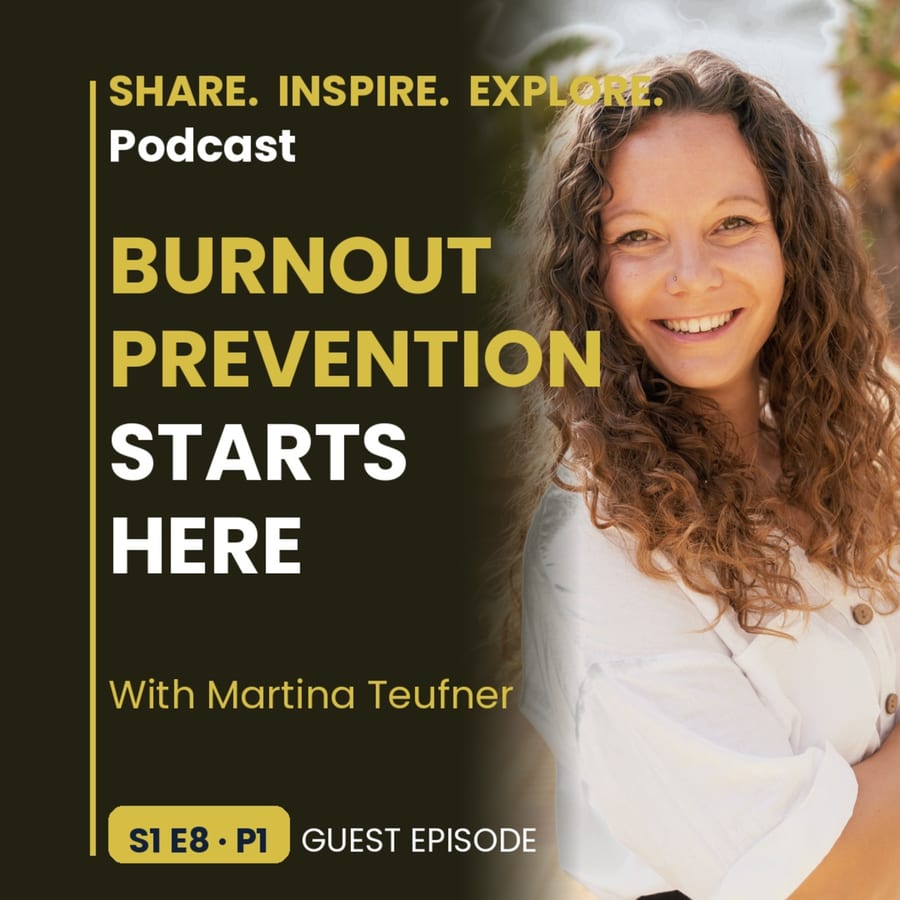
HR's Role in Burnout Prevention, Part 1 — Martina Teufner
Prefer to watch? This episode is on YouTube and the show is on Spotify.
About this episode
Corporate burnout is not an employee problem. It is a systems problem, and prevention starts with policy rather than perks.
HR consultant Martina Teufner returns to talk with Chris Wilson about what actually prevents burnout before it starts, and what only looks like it does. Drawing on twelve years in HR, she is direct about which interventions work and which are decoration.
They get into rigid structures, leadership that has not moved with the work, and what happens when nobody can find out what the policy actually says.
The red flags companies routinely miss in their own data Work life balance against work life blending, and why the distinction matters Why flexible work prevents more burnout than any wellbeing perk
Season 1, Episode 8
Connect with Martina Teufner: https://www.linkedin.com/in/martina-teufner/
Share. Inspire. Explore. is the podcast from Where I'm At, honest conversations on burnout, career change, and what comes next for working professionals.
Join the Where I'm At Community, free to join: https://community.whereimatcommunity.com/store/product/membership Website: https://www.whereimatcommunity.com
Where I'm At is based on lived experience, reflection, and educational support. It is not therapy, counselling, crisis support, or professional advice. Please consult a qualified professional for individual medical, psychological, legal, financial, employment, or specialist support where relevant.
Read the full transcript3,808 words
Automatically transcribed, so it may contain errors and does not identify who is speaking. It follows the conversation in order.
Welcome to the Share, Inspire and Explore podcast, the voice of the where I'm at burnout community. I'm Chris Wilson. And after my own journey through burnout and depression, I'm here to share real stories, inspire personal transformation and explore the path from burnout to balance. Each episode brings honest conversations with burnout survivors, mental health experts and mindset coaches offering lessons, strategies and hope. Whether you're recovering, curious or searching for motivation, this is your space to grow. Let's dive into today's episode.
Welcome back to the Share, Inspire and Explore podcast. In this episode, we're continuing our HR and burnout series by focusing on prevention. Burnout is a major workplace issue, but what can HR do to stop it before it happens?
What policies and programs actually work? Today, we're once again joined by the community HR expert, Martina Teufner, an experienced HR consultant, business coach, founder of Resource Minds Consulting, founder of HR Business Friends, and awarded one of LinkedIn top HR voices in 2024. She helps companies create healthier work environments.
Welcome back, Martina. Before we dive in for our new listeners, can you maybe share a little about your experience in HR and how burnout prevention has become part of your work?
Sure, of course. Hi, Chris, and thank you for having me back. So I have been working in HR for more than 12 years now. And I started my career as an intern in a big corporation and worked my way up to head of HR in various companies and different industries. Today, I'm self-employed, as you mentioned already, as an HR consultant, and I have the possibility to work with a lot of different companies, see a lot of different processes and also help these companies to create better HR process and therefore a better work environment for everyone.
And honestly, burnout wasn't my focus topic from the beginning, even though I had in my first job, I had a colleague who told me that she had burnout. Burnout just became a topic for me when I myself experienced it. And today, I'm happy to help companies to prevent burnout, but also to be on your podcast and talk about it. Excellent. Great stuff. So we're going to cover a number of topics today. But let's start by asking the question, why should HR prioritize burnout prevention?
So HR is a company function. And in the end, HR has also the role to help the company create value and to earn money, basically. And if you have a burnout case in your company, this might affect the whole team, not only the individual.
And this might also affect the productivity and in the end, even prevent the company from making profits or the company won't gain as much money as they would want to. And sure, you could deal with the problem when it arises and then you can deal with it when one person has a burnout or you tackle it beforehand and invest in prevention. Because if the problem never comes up and you deal with it beforehand, you don't have that high risk to lose company profits in the end. And that's why HR should deal with this stuff. I mean, we've seen a lot of development in the, let's say, employee benefits, mental health days. Do you see these having any traction on the prevention side and effect?
Yes and no. I think these are good measures. I think it's important because what these mental health initiatives do is they raise awareness. And so they help people to see if someone is troubled or they help them to see if they themselves have a problem maybe earlier than before. But I think it's not enough to just have a mental health day a year and then leave it be, to be honest. I think it's a way bigger topic.
But these mental health days and initiatives are very good in raising awareness and also helping people to deal with these kind of topics. Because normally this is not an everyday workplace topic, right?
Absolutely. I mean, if we talk about, let's say, science, a workplace lacks prevention measures, what are some of the red flags that you accompany doesn't have effective burnout prevention strategies in place? I think, first of all, if you don't have a written down procedure or written down processes in HR, this might be already a red flag. So if you don't have any transparent processes for giving feedback, assessing performance, leadership, and stuff like that, like general HR processes and procedures, if you don't have transparency about that, this might already be a small red flag at least. Bigger red flags would be a high turnover rate or high rates of sick leave, excessive overtime. Or, for example, when people start coming very early to the office or staying until very late at night, this could be also red flags that show there is something missing that tells people to go home to their family.
Or there is something missing that tells them excessive overtime is unhealthy or there is something that doesn't help them to work for the company or stay in the company. So these could be all red flags that show that you don't have effective burnout prevention strategies.
Yeah, and if I can just add to that, my go-to are the employee feedback websites, the glass doors here in Austria. We have Canunu. There's often a lot of signs in there from the feedback the companies don't want to see, but I'm so happy those are there because that's a great place to dig a bit deeper. Yes, but be careful with those websites because employers can make it happen that reviews get deleted.
So it might be not the whole truth there. And of course, maybe a lot of disgruntled employees are disgruntled for other reasons. Yes. Maybe other than burnout. So the negativity should be maybe taken with a pinch of salt in some cases. Yes, but still, it's a good thing to look at also as a company themselves. If they want to do something or they want to implement strategies and measures, it's a good starting point to look at these websites and just check what kind of reviews do we have. And maybe as a starting point, use those as an input where to start.
You know, we hear all the time companies, customer centricity, strategies, very little about employee centricity because, you know, they say a happy employee is a happy customer. And I think there's a lot of truth in that, to be honest. Absolutely.
But maybe it's something companies can really focus on. Yes. Yes, you're absolutely right. Maybe that's going into the policy design and HR's role. What proactive measures can HR implement to reduce burnout risk?
So what HR can do is, of course, these mental health days and initiatives and raising awareness because this is something very easy to do. The other things are a bit more difficult, I would say, like giving flexibility, having flexible work schedules, having the possibility of remote or hybrid work, home office, because these kind of things are a bit more difficult to implement in a company for everyone. So HR could encourage realistic goal setting through calibration processes where managers internally have to defend the goals they're setting for employees. This way, HR can also help a bit in monitoring the workload of employees. And they also can analyze trends, for example, in sick leaves or turnover rates or overtime.
And also, of course, leadership trainings, training the managers how to do leadership, how to communicate properly, and also promoting regular check-ins. And they can encourage breaks, for example, remind employees that they have holidays because some employees, they just forget about it. And so you can, as an HR person, you can remind them. And you can also offer mental health resources like coaching, for example. So employees can, when they feel they have an issue, can get immediate help and don't have to wait until they are having, experiencing a burnout.
So I think those are the first things that come to my mind, what proactive measures HR could implement. Yes, I've seen those becoming more popular now. And as you said, it's coaching, right? It's a more friendlier word than therapy, so to say. But it's nice that companies are offering that. You don't need to be hitting the wall, so to say, to be able to have that resource made available to you. So it's good that companies are changing their ways there. But it's still a long way to go.
And I think you would agree on that. Yes, absolutely. Coaching can be very helpful in prevention. But once you have burnout, or once it's too much, then it would be better to go to a therapist rather than a coach. But in the end, things can help.
Yeah, often there's maybe underlying issues there that only therapists can support with. Yes. How can companies design policies to encourage, I don't like saying this, but work-life balance. It's like, it almost stresses me out that I have to think about this work-life balance. I should just be able to adapt to my day as and when I need it. I've seen on LinkedIn recently, people are posting copies of people's calendar, trying to shame them. A lady had an appointment two hours for her hairdressers. Have you seen that one going around? Yes, I saw it. Yes, it's just that they just want attention. These kind of people just want attention on LinkedIn. So I was laughing a lot about it.
And honestly, I also don't like the term work-life balance because it's just life. Everything is just life. And balancing life is enough. And I think work needs to blend into that.
And so I just recently heard someone talk about work-life blending, which I would prefer because work is part of life. And that's why, so, but I personally try to only balance my life and my work blends into that.
Work-life blending. I like that. Yes. Yeah. So you asked how companies could design policies to encourage work-life, let's say, blending or balance. I think the most important thing is flexible work arrangements.
So especially giving people the opportunity to decide where to work and when to work. Because every person has their own rhythm in life. And for example, I'm no morning person.
And if you ask me to work at 8 a.m. in the morning, I will manage somehow to be in the office. But I will not be productive and I will not be happy. So if you make me do this every day, work is not blending into my life. It's a horrible experience for me and I will not be happy.
But if you tell me, hey, work whenever you want, I would maybe work at 10 p.m. and be super happy, productive, and the company could earn more money and everyone is happy. So giving this flexibility and trusting the employees that they know best when and where to work, I think that is the best policy to design. And of course, you need a lot of rules because you somehow need to work together in a company. You should be in a time zone close to each other. So if you have a lot of meetings, you need to take care about data protection. You need to take care about taxes if people work in different countries. So it's very difficult to design these policies.
But you can do it. And the best possible way is to talk to the employees, ask them about their needs and design these policies together and see, OK, what legal framework do we have and how can we work together on this? So I think that's the one main thing.
The other thing is, of course, HR can put some rules in place like clear boundaries. For example, in some companies, managers are not allowed to write emails after 6 p.m. Because this could put pressure on the employee or no calls before 7 a.m. This was a rule I implemented for me personally in the company because I said, if you call me before 7 a.m., I will not be able to talk to you. Or you could also have no meetings after 1 p.m. Because in the afternoon, everyone has focus time. So you can have these rules in place. And this is something companies can do. But I would always recommend to work on these policies in the design process together with the employees.
Because if just HR and the management team is working on those, you will probably not meet all the needs you have to meet. And one other thing is to inform employees because some people just don't know their rights. They don't know that there is a parental leave. They don't know how many days of holidays they have. They forget that they should take a break every now and then.
And you can inform them just on a regular basis. You know, you can just tell them. And for this, for example, these health initiatives or well-being days could be a good measure just to inform employees about these kind of things. Because they forget about it. And those would be policies or measures a company could take, from my perspective.
It's interesting. I mean, people like me who struggled or maybe continue to struggle to set boundaries and take the breaks. Can companies use technology to set those automatic reminders? I know they do monitor a company laptops.
Yes, of course, you could do that. I mean, a very simple example is I bought a new screen at MediaMarkt for me to work. And this screen automatically has implemented that if I don't go away for five minutes every hour, it reminds me that it will turn off or something.
So, and for me, it was really weird to get this reminder from my screen. And this was like, not in the instructions or nowhere. So, of course, companies could just do this, you know, or you could have like a lunch break where I say, okay, between, I don't know, 12 and 2, there is a lunch break. And at 12, every employee gets an email like, hey, lunch break is starting. Of course, you could implement something like this. Honestly, I don't know any company that is doing that. The only thing what I know that companies are doing is informing employees because, for example, in Austria, by law, after six hours of work, you have to have a 30 minutes break.
So, this is like the normal lunch break. And normally, companies do inform the employees about that and also have this shown in the time records. So, that employees also see, okay, I had my break from two or I see here, there is a 30 minutes break in my time records every day. So, I probably should do this break. So, this is what companies are doing.
I don't know any company that tells people every day do a break. I think it's ultimately the responsibility of the employee. I get that. Maybe. There are different tools you can do. I've seen these cubes where you can set a timer and it's easy. It's not complicated to set up. There's other mechanisms.
But what I think would be hard to implement are those policies fighting the old structures, like core time hours is definitely a fixed thing. So, between 7 and 6 or 7 and 7, you're only allowed to book. And here in Austria, you are not allowed to work more than 10 hours a day or you get in trouble. The company gets in trouble, yeah? Yes. Of course, managers will tell you don't book over 10 hours, even if you do 12, 13 or more.
Yes, that's a big issue. I mean, this is by labor law. And this labor law is in place to protect the employees. And it's a very, very big issue if managers tell the employees, book different times than you're working.
Because this also can, you can have problems. Let's say you work 13 hours. You work until, let's say, 11 p.m., but you only book until 8 p.m. And 11 p.m., you go home and you have an accident.
So, nobody would believe you that this is an accident from your workplace to your home because you booked until 8 your time. So, there are a lot of problems with that. So, I think there it's very important to educate also managers and to have very clear consequences in place. So, if, because this is by law, this is nothing the company can decide on. The company cannot decide on if you're allowed to work 10 hours or 12 or 13.
I mean, they have some flexibility here. But in the end, this is by law. And this law is there to protect the employees. And they have to live with that. We cannot change that. And I think we shouldn't change that, to be honest. It would be great if there would be more flexibility.
Still, I think there it's really important that the company has very clear consequences for managers who tell the employees to basically give a false statement in their time records. So, that's what I think. I know in a lot of companies, it's different. And I know that also in HR, it's not always easy to handle these kind of things. Because sometimes there are rules that you have to ban. For example, if you have a business trip, it's not so easy to decide when your flight is leaving. So, there are some, sometimes you have to find ways. But honestly, on a daily basis, there should be consequences if people do this. Yes.
Often, the project deadlines take over. And rules are, rule books are thrown out the window. Which actually, sorry to interrupt, which actually I'm okay with. You know, I understand business have needs. And there are peaks and troughs.
But when that becomes the norm, this is the issue. And you have no, you're feeling no control over your working day, your private life. Absolutely. And I think, of course, if the company asks you to do overtime, to be flexible, that's okay. And it's also okay to bend the rules a bit. But this has to go in the other direction, too. If the employee then comes and says, okay, I need to leave earlier today, it has to be possible. It has to be possible that both parties are flexible and working together and find solutions together. So, then it's okay. And if you have, like, these peaks, you have to have times where there is no peak.
If you always try to perform on a peak level, at one point, it won't work out. I can tell you that doesn't work out. Yes. So, and I think one has to be very clear about that. So, of course, there are peaks. And, of course, everyone wants to be flexible. And the company demands you to be flexible. But if the company demands that, they have to give it back, too.
And I think it's a giving and taking, always, because employees and employers are in a contract relationship with each other. And both parties need to do their part. Exactly.
Well said. And in terms of, we've mentioned mental health days already. Flexible work arrangements, reduced meetings. What have you seen works well and what not so well? So, the most, so the thing that works best is flexible work arrangements. That is, if you implement it well, what works best for everyone. But the implementation process takes time and also the design process takes time. So, I think that works best and has also the biggest impact. Everything else, like mental health days, reduced meetings, some rules about breaks, from my perspective, are add-ons to this flexible work arrangements.
If you only have the add-ons, you might have, it might be a bit better. But the impact is not as big as if you really implement flexibility time-wise and place-wise.
And the second big thing is really training managers and leaders. So, to have real leadership in the company, to have real conversations with the employees. Because this is what you see every day and what you go to every day is working with your line manager. And I think it helps a lot if you invest in training them and having good leaders in the company. This also has a very big impact.
So, for me, the two things, flexibility and good leadership, are those two things you should focus on. And everything else, from my perspective, is a nice add-on. It's great that you do it. But the big impact is with the other two.
Absolutely. And I would even say the clear vision and clear strategy from leadership as well. Because if that's not there, there's just absolute chaos. And you question what you're even working on. And that can also send you into a spiral.
Absolutely. That was such a powerful reflection on flexibility and how it really needs to be a two-way street. Something employees and employers co-create. Not just in force. We've touched on the importance of policy design.
Red flags to watch out for. And why flexible work isn't just a perk, but a key prevention strategy for burnout. But we're not done yet. In part two, we go deeper.
Martina and I talk about how HR can balance business goals with employee needs. How to set realistic workloads. And what leadership should actually be doing to prevent burnout. Beyond just lip service. We also discuss the real cultural shifts that need to happen. And how employees can advocate for better workplace practices without fear.
That's coming up in part two. I'll see you there. That's it for today on the Share, Inspire and Explore podcast. I hope something resonated with you. A moment of clarity. Encouragement.
Or just a reminder that you're not alone. If you find this helpful, share it with someone who might need it. Hit follow or subscribe to join us for future episodes.
If you're new here, please check the link in the description to join the community. Burnout is tough. But it's also a chance to heal and rediscover what matters. Thanks for being a part of this journey.
And until next time, take care. Keep exploring what's possible. I'm Chris Wilson. And that's where I'm at.