
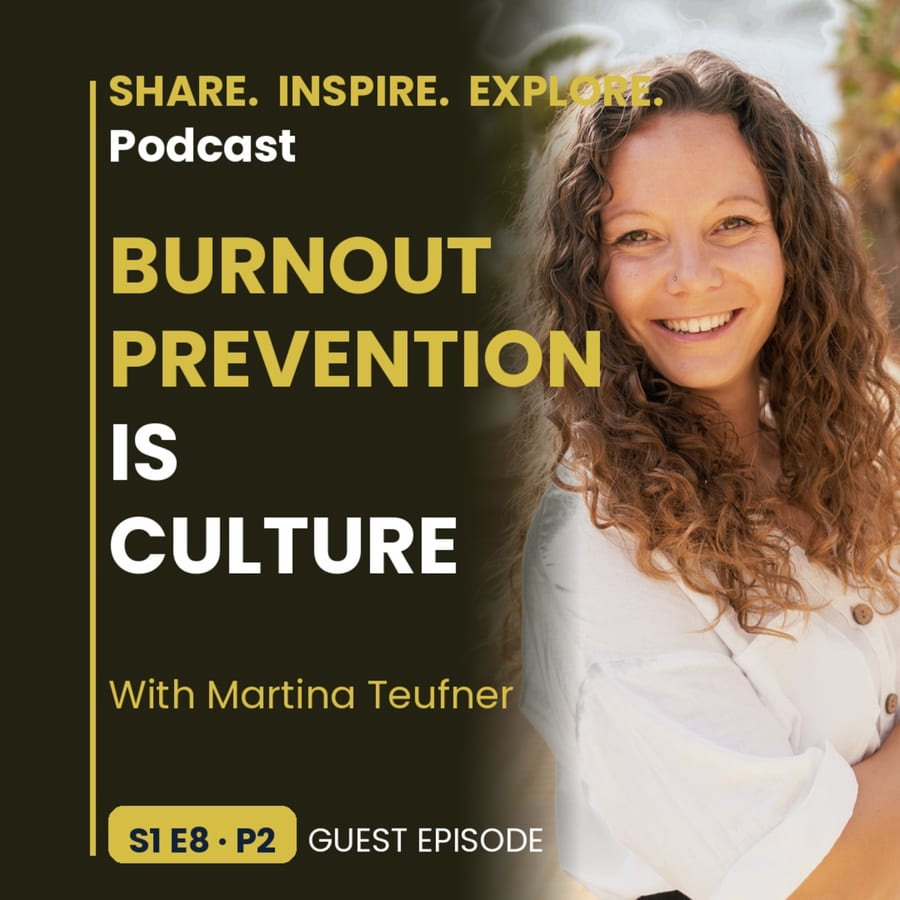
HR's Role in Burnout Prevention, Part 2 — Martina Teufner
Prefer to watch? This episode is on YouTube and the show is on Spotify.
About this episode
Preventing burnout means changing what a workplace rewards, not adding something to the wellbeing budget.
Picking up where Part 1 finished, HR consultant Martina Teufner and Chris Wilson work through the how: balancing business targets against the people expected to hit them, training managers to notice burnout early, and building a culture that does not quietly punish the person who admits they are struggling.
They also talk about the fear of speaking up, and why so much of prevention comes down to whether honest conversations are survivable.
Supporting flexibility without treating performance as the trade Why leadership behaviour sets the limit on everything below it Toxic silence, and what makes it safe enough to break
Season 1, Episode 8
This is the second half of the conversation. Part 1 covers the foundational risks.
Connect with Martina Teufner: https://www.linkedin.com/in/martina-teufner/
Share. Inspire. Explore. is the podcast from Where I'm At, honest conversations on burnout, career change, and what comes next for working professionals.
Join the Where I'm At Community, free to join: https://community.whereimatcommunity.com/store/product/membership
Website: https://www.whereimatcommunity.com/community
Where I'm At is based on lived experience, reflection, and educational support. It is not therapy, counselling, crisis support, or professional advice. Please consult a qualified professional for individual medical, psychological, legal, financial, employment, or specialist support where relevant.
Read the full transcript4,133 words
Automatically transcribed, so it may contain errors and does not identify who is speaking. It follows the conversation in order.
Welcome back to Share, Inspire and Explore. You're listening to part two of our deep dive into HR's role in burnout prevention with the brilliant Martina Teufner. If you missed part one, I highly recommend go back and listen. We talked about what burnout prevention looks like from a HR lens, the warning signs that companies are ignoring and how workplace policies like flexible work and mental health initiatives can make a real difference if they're done properly. In this episode, we're shifting focus to how HR can build trust with leadership,
how managers can be trained to spot burnout early and how we move beyond checking boxes to create lasting cultural change. We also explore the role of leadership in walking the talk and what employees can do if they feel unsupported. Let's get back into it.
But we've touched on flexibility. I'm sure companies worry about lower productivity. If you say, oh yeah, come in here and you can, as we've discussed this flexibility, how can HR, you know, design policies that support employees without hurting business goals?
I think this comes again to training managers and leaders to be good leaders because the employees are normally in most cases, they are grownups and they mostly know when they work best and where they work best. So it's only a trust issue. And I think what HR can do is first train managers and leaders. So they learn how to trust their employees. And so they also learn how to, together with the employees,
set up rules, how they want to work together. Because maybe one employee only wants to work in the home office, another employee wants to go to the office every day and somehow you need to make it work. I would see this as a team process, not a company-wide process, because I think every team needs to check how can we work together and then see how can we fit into the company. So for HR, it's training leaders to trust their employees to have these real conversations and to meet the employees' needs. And HR can support this with data because, as I said, mostly it's a lack of trust and that's why leadership doesn't want employees to work
flexible hours or flexible places. So HR can support it with data. They can show, for example, performance reviews. reviews. I mean, you can have a look at that and see if the performance of the employee is better or worse when the person works from home. And on basis of this, you can make a decision. You can look at sick leave rates. You can look at overtimes. You can look at, I don't know if you work, for example, in a company that has a ticketing system. How many tickets can an employee do when working from the office and how many can they do when they work from home? So you can measure all these things. And HR has access to these KPIs and measurements and they can help leaders to understand and show them in numbers.
See, this employee is working best from home because they work the most or they produce the best quality, whatever. And then it's no question because why would you ask an employee to come to the office if the work quality is worse when they're in the office? Nobody would do that because why? So I think that's what HR can do. So first of all, help managers to understand, also giving the framework for flexibility and then support everything with numbers, because then there is no argument against it. I have to mention realistic workloads here because that's the reason for overwork. At least it was for my case of burnout and I'm sure is for many listeners and viewers out there.
How can HR, how can HR, what strategies can HR implement to help managers set realistic workloads? I'll give you an example. The big five consultancy firms come in and promise the biggest moonshots, but you have the same infrastructure, the same productivity underneath, and it just doesn't match.
How can HR help here? How can HR help? That's really hard because HR doesn't understand every role and every position and every task in the company. So they cannot themselves assess how big is the workload of a person. And also, you know, some people are faster, some are slower. So this doesn't mean that the slower person is a bad employee, but people deal different with the tasks and with task lists.
But what HR can do is bringing managers together because the managers are those who set the goals. They are those who set the expectations and are those to communicate them to the employees. And as HR, you can implement so-called calibration meetings on a regular basis. So you could do these kind of calibration meetings, for example, if you have an annual goal setting process before the goals are set together with the employees. You bring all managers together and they have argued every single goal they set for the employee in front of all the other managers. And the other managers are there to challenge the goals, are there to ask, OK, how can this employee do that?
This goal is not specific enough. What should be done there? So you have a group of people challenging each other. And this is a high pressure meeting for every line manager. So this is not a nice situation for them, but that way they learn to think about these kind of things. And of course, HR is part of these meetings and there they could discuss this.
And if you don't do this only for the goal setting process, but also, I don't know, once a month or every two months, you bring all the managers together and they discuss the progress on work or the progress in projects. And they discuss together and challenge each other.
Hey, I think your employee is working a lot. I see this one employee has five projects and the other one has three. Why is that? And then they have to argue for it.
And that way they might learn. Oh, OK, I have to look at this because they learn from each other. And I think that is something HR can facilitate without assessing themselves, the workload of every employee individually, because HR cannot do that. But they can help the managers to get together, challenge each other, talk to each other, and therefore set more realistic goals. And second thing, train managers to have real, honest conversations on a regular basis with employees. Because if you do that, your employees will tell you when it's too much and the manager should then be able to hear it.
But they also need to learn that because, you know, not everyone is a great leader from the beginning. So this is what HR can do from my perspective. First of all, implement this calibration meetings, because this is something you can just implement as a process. And the second thing is train managers to be real leaders who listen to their employees and talk to their employees on a regular basis.
It's great. By the way, Martina's link is in the description. No, that's great. It sounds like an ideal place to work, what we're painting here today. And it should be something to aspire to.
But it's a culture topic, right? And so managers and executives who set this workplace culture, what role does leadership play in preventing burnout? Oh, a very big role. So I would say everyone sets the workplace culture, every single individual in the company. But of course, managers and executives are those people the employees look up to.
And so the main thing they can do is leading by example. If your manager sends you an email at 10 p.m. every day, you might have the impression that you need to answer at 10 p.m. every day. And so you as an employee, you will probably adapt and think, oh, it's not so bad. I will answer.
And so it starts. If your manager doesn't do that from the beginning, the pressure never starts. Also, same thing when your manager screams at someone in the office and you're a new hire, you will think, OK, it's normal here to scream at people. And you will maybe also start to do that.
So what I would expect from managers and executives is leading by example, showing how it should be done. And maybe they write the email at 10 p.m., but they can set the timer that it's sent the next day at 9 a.m.
And then it's OK. I mean, I also work at nighttime sometimes, but I don't send the email. I just program it for the next day. So I think that is a very big thing, setting an example and showing how it should be done, because it's like the normal human behavior to follow the leader. And if they show how it's done, employees will follow in the good way, but also in the bad way. The second thing is, I think managers and executives should learn how to recognize and address employee well-being, which means talking to the employees and really listening, which maybe sounds easy, but it's very hard because they're always stressed and they have so many meetings.
And then it's easy to push an employee meeting where you don't have a project to discuss. But I really believe in weekly one-to-ones between the manager and the employee.
And I really believe that these conversations, if you have honest conversations, you will recognize very early on if there is something wrong and the employee gains trust in you. And then it's easier for them to tell you if there is something going on and then you can do something. And last but not least, adjust workloads if necessary, of course. So if the manager sees, okay, for whatever reason in the calibration meeting or the employee tells them it's too much, support the employee somehow to reduce the workload, to really take measures. And I think that's the role management takes. And I mean, even if it's hard, I would recommend to do that because in worst case scenario, this employee will have a burnout and will not be able to work on any project.
So it's better to work on just two out of five than on none, I would say. So those are the three things. Leading by example, talking to employees on a regular basis, and if necessary, adjusting workloads.
Again, sounds great. And I hope companies can implement such strategies. Yes, I hope so too. But in reality, it's maybe going to take... Take some time. I mean, are managers trained to recognize burnout? I think we've maybe have covered this in the last episode if you're new here.
Or is that just somewhere that still needs improvement? So I don't think that managers are trained to recognize burnout. So from my perspective, every manager should be trained to be a leader.
And in the best case scenario, they do this on a regular basis. Every year, having a leadership training and learning these kind of things and recognizing the health status of the employee or the well-being of the employee, for me, is one part of leadership. Because if I'm a good leader and I talk to my employees regularly, and they trust me and are honest with me, this is all leadership.
Then I will recognize if there is a behavioral change, if there is something going on. And this will help me to prevent that someone goes directly into a burnout.
So I don't think that it really needs like this every year at burnout recognition training. I think what's really needed is general leadership training, where this is part of, where you talk about it, where you tell the managers, okay, if you see these signs in an employee, if you see they have behavioral changes, talk to them. Ask them if they need support. Ask them where you can support them.
And then I think if you implement this as a company, leaders can prevent burnout quite well. I just thought when you say leaders should set by an example. I remember a few years ago in the canteen at the place I was working and this gentleman walks past and then somebody just flippantly says, oh, that guy had burnout, like he was diseased.
And that had planted a seed in my mind. And that's maybe why I didn't come forward. But honestly, I think the best way that leaders can lead by example is how they treat people who have burnout and how they treat them coming back to work. Because that is the real leading by example. How a company culture handles that. Because it's going to handle it. The statistics don't lie. It's coming.
So I think you can really set a great example to everyone because everyone does watch and everyone does talk. Just like that situation in the canteen. It would be great if that same conversation had happened. That guy had burnout and he came back and he's back to his former best. Something more positive as opposed to this kind of isolating comment.
Absolutely. I would even go so far, why talk about someone who's not involved in the conversation and say, oh, this guy had this and that. So I would rather introduce this person and say, hey, this is Chris. Chris just came back. Chris, you want to introduce yourself? Or something like that without even mentioning.
Because why should someone else talk about the burnout of another person? So this is my perspective. But you're right. If you want to talk about it, then at least make it a positive comment and not a negative one. Yeah. I mean, we have planned an episode to talk about reintegrating in the workplace. But I think it's definitely a point for leading by example as we are discussing that today. Next up, if an employee sees burnout issues in the workplace, how can they advocate for better policies without fear or backlash? It goes just what I've just said. I was afraid to speak up because of one lunchtime situation.
Do you have anything to add on that? So it's really hard to speak up for every topic. But there are possibilities in some companies. So some companies already set up the possibility to give anonymous feedback. Like there is a box somewhere in the canteen. Maybe you put a piece of paper in and nobody knows that it was you. Some also have like external partners to work with. And if something like that is in place, then I would recommend to use it. The other way is look for a trustworthy person. This could be in HR. This could be in the works council. This could be your line manager.
This could be your colleague. But some of these things need to get out. And if you don't know a strategy how to address this issue, how to make it better,
maybe the other person can support you. And maybe they have an idea what you can do. Of course, best case scenario is if you have a good relationship with HR or the company owner and you could just go there and tell them and say, hey, we have a problem here. And they will say, oh, yes, let's tackle this. But to be realistic, this will not always be the case.
So I would recommend to find supporters. And then maybe at one point, you know, step by step, you can help make things better. But honestly, I'm always for transparency. So best case scenario would be get all the courage you have.
Walk up to HR and tell them if you trust them. Of course, if you have a bad HR department, then go to a line manager, go to the works council.
But in general, I would rather prefer an employee to speak up than someone staying quiet and getting sick. And also, if nobody tells the things, maybe nobody sees them.
And so nobody can do anything about it, you know, because sometimes people just don't see the obvious. And that's not a good thing. And that's not a good thing, but still it happens.
So it's good to speak up. But I know it's very, very hard. Especially for me, I was identifying myself by my job. And when I felt that starting to crumble, it was very hard to handle, actually. And, you know, you go through the repercussions in your head. If I lose this job, then I'll not get the same salary or another job somewhere else. I'll have a black mark against my CV.
Everyone will ask, why did you leave the company? Of course, you can mask it in different ways. But this is the thought process. And there's a lot of things internally blocking you from coming forward.
But yeah, like you said, sorry to interrupt. Like you said, it's speaking with people who you can trust. Networking. Networking is underestimated because you do, it doesn't matter, I think, where you work. You can identify people you can talk to and maybe share some of those more personal moments together.
And that just helps. Like the talking is such a weight off your shoulders. They say a problem shared is a problem halved. I think there's a lot in it. It's definitely very true.
And also to add to that, also external resources might help if you don't know who to talk to within the company or you're afraid, like you said, to lose the job, to not get the salary you're aiming at, whatever.
Maybe external people like your community, for example, could be helpful because people who went through this process can give you another perspective and maybe help you to do the next step. Because you have the possibility to talk to someone who understands you, who knows what kind of fears you have. And maybe they can just help you, support you until you're ready to tell someone in the company and to take the next steps. So this would also be an option if you cannot talk to someone internally to find a community who raises awareness and who talks about these topics openly.
Well, thank you for the plug, of course, this community, as a time of recording, it's a waiting list right now. But in the future, the Wearmout community will be, as Martina said, a place. And I'm sure we can have Martina as guest speaker at some webinars and we can come and do some Q&As. So looking forward to that.
What would you say the future of burnout prevention from a HR perspective is? What are the trends? So I think the trends are these mental health days or yoga classes at work or meditation classes at work. And I think it's good because the topic is out there and companies are doing something, even though those are the things, like I said before, they are just small things and they don't solve the issue. But I think it's a good direction we're going in because I have the feeling that companies start talking about mental health. Companies start talking about burnout. They start thinking about it, which means at one point they will figure out that this one mental health day a year doesn't help so much.
And then I see that it's going in the right direction, even though we now have this back to the office discussions and everything going on. I think still the we're moving in the right direction.
So but that's the trends I see. I see this mental health days. I see these apps that are provided for employees where they can get a therapist easily, which is also a good thing, or where they can, where the company pays for meditation classes. And I think this is all good.
But for me, in the end, it all comes to flexibility in the work arrangements. And I think this, once the companies see that, this will be a game changer, because this will hopefully, in my perfect world, this would wipe out burnout.
But this is my perfect world. I think, honestly, the attitudes towards flexible working from the younger generations are my hope, personally, for change, because they're the ones going into job interviews, from what I've heard, demanding their borders, their boundaries in terms of when I work and how long I work. And I think this is forcing companies to change, because they need the younger ones to come in. You know, the older ones are retiring, the older ones that come in, there needs to be some change. And I was hoping that would have been in recent years, especially when I was in the burnout, forcing the four-day week.
I mean, there are arguments, squeezing full-time hours into four days is also not good. But certainly, the flexible working arrangements are, for me, what I'm waiting for. Absolutely. I think it's very individual. So, to give you an example, I would hate a four-day week, because I love to work seven days a week, but less hours every day.
So, I think this is the kind of flexibility we need. Everyone should find the place and the time when work fits best in their life. So, we're back to work-life blending.
Work-life blending. Yes. But it's hard to do that for companies, especially for companies who have, like, strict rules for the last 100 years. It's a big change. So, we also have to give the companies time to adapt to these flexible hours and to all these changes. But I think they are coming.
So, and this, I'm very optimistic, because I think this is coming. People are asking for it. And at one point, the companies will give in. And then we will all learn to work in this new, changed environment. And maybe not everything will be perfect, and we will find something else to change.
But still, it's everything moves in the right direction as a whole, if you look at it as a whole, even though if some companies are not, are going back to unflexible working arrangements. And focusing on outcomes, as opposed to sitting at your desk.
So much time is wasted anyway, you know, in the office. I think we're more productive. As you said, some of us are more morning. I worked in IT. A lot of the developers didn't want to start before 10. But we were trying to have the meetings before that. But we have to appreciate we're not all the same.
And good stuff. That's it for today's episode. Let's close on a key takeaway here. Martina, if you could give me one piece of advice to HR leaders and one to employees when it comes to preventing burnout, what would it be?
It's one advice to both, to HR leaders and employees and all the managers, talk to each other honestly and listen to each other. I think that's the main thing you could do to keep things moving or to get them moving. So really talk to each other and try to really listen to each other.
Thank you. As I said before, Martina's link is in the description. You can see her expertise shining through in today's podcast. And thanks again, Martina, for sharing those insights. And I look forward to our next podcast. Okay. Thank you so much for having me. You're welcome.
If you found this episode helpful, follow, subscribe, leave a review and share it with someone who might benefit. Next time we'll be discussing HR's role in burnout recovery. So stay tuned.
Bye for now. Bye. That's it for today on the Share, Inspire and Explore podcast. I hope something resonated with you. A moment of clarity, encouragement. Just a reminder that you're not alone.
If you find this helpful, share it with someone who might need it. Hit follow or subscribe to join us for future episodes. If you're new here, please check the link in the description to join the community.
Burnout is tough, but it's also a chance to heal and rediscover what matters. Thanks for being a part of this journey. And until next time, take care and keep exploring what's possible.
I'm Chris Wilson, and that's where I'm at. Hey.