The Signs of Burnout You Might Be Missing
Prefer to watch? This episode is on YouTube and the show is on Spotify.
About this episode
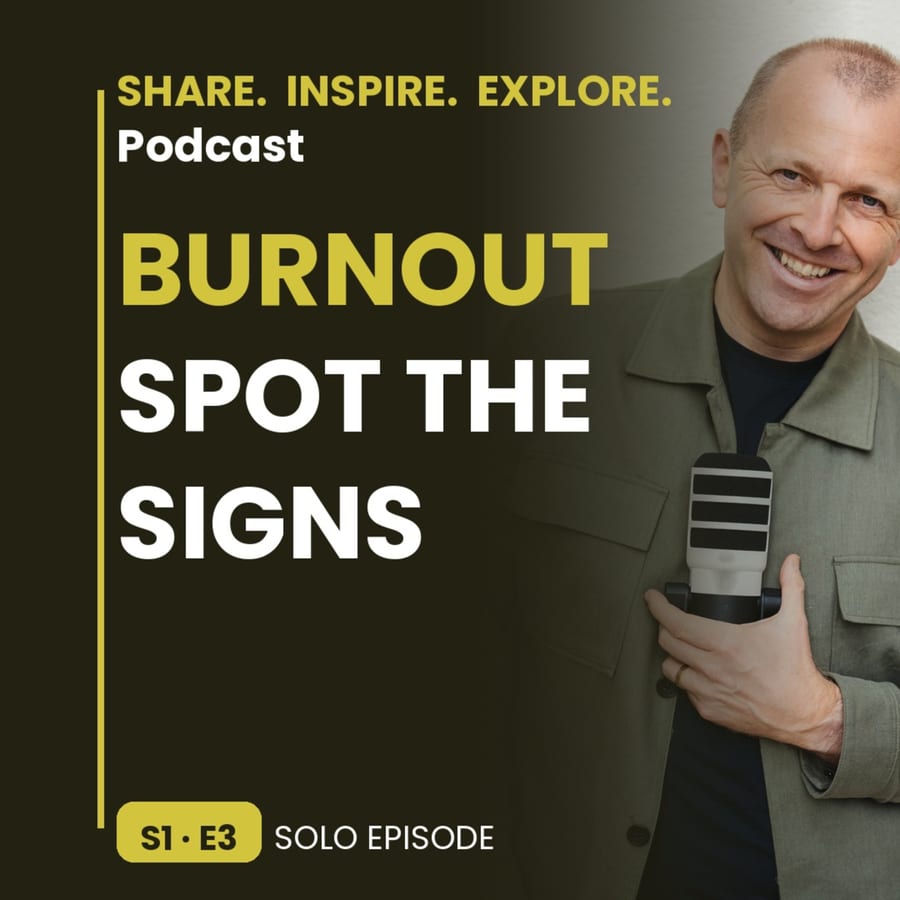
The signs of burnout creep in slowly, disguised as ordinary stress. By the time most people notice, it has already taken hold.
This episode works through the physical, emotional and behavioural signs, with examples from my own collapse rather than a checklist off a website. Persistent exhaustion and broken sleep. Cynicism and self doubt that arrive so gradually they feel like personality rather than symptoms. Withdrawing from people, and the coping habits that quietly make it worse.
Recognising them early is what buys you options.
Physical signs: exhaustion, disturbed sleep, a weakened immune system Emotional signs: overwhelm, cynicism, self doubt, loss of motivation Behavioural signs: procrastination, withdrawal, unhealthy coping
Season 1, Episode 3
References: https://mentalhealth-uk.org/burnout/ https://en.wikipedia.org/wiki/Occupational_burnout https://www.helpguide.org/mental-health/stress/burnout-prevention-and-recovery
Share. Inspire. Explore. is the podcast from Where I'm At, honest conversations on burnout, career change, and what comes next for working professionals.
Join the Where I'm At Community, free to join: https://community.whereimatcommunity.com/store/product/membership Website: https://www.whereimatcommunity.com
Where I'm At is based on lived experience, reflection, and educational support. It is not therapy, counselling, crisis support, or professional advice. Please consult a qualified professional for individual medical, psychological, legal, financial, employment, or specialist support where relevant.
Read the full transcript2,751 words
Automatically transcribed, so it may contain errors and does not identify who is speaking. It follows the conversation in order.
Welcome to the Share, Inspire and Explore podcast, the voice of the where I'm at burnout community. I'm Chris Wilson. And after my own journey through burnout and depression, I'm here to share real stories, inspire personal transformation and explore the path from burnout to balance. Each episode brings honest conversations with burnout survivors, mental health experts and mindset coaches, offering lessons, strategies and hope. Whether you're recovering, curious or searching for motivation, this is your space to grow. Let's dive into today's episode.
Welcome back to the Share, Inspire and Explore podcast. In today's episode, we're getting real about recognizing those red flags. Because let's face it, sometimes burnout can be sneaky. It creeps in slowly, disguised as an everyday stress until it's practically taken over your life. But just like any health issue, the earlier you can catch burnout, the better. So let's dive into the symptoms covering the physical, emotional, and behavioral changes that can signal burnout.
Before we begin today's episode, I want to remind you that I am not a mental health professional. This podcast is for information purposes only. If you feel affected by anything discussed in this episode, or suspect that you're experiencing burnout, or other adverse mental health conditions, symptoms, please seek help from a licensed professional.
First up, physical symptoms. And trust me, these are more than just feeling a bit tired after a long day. I mean, we're talking persistent, deep rooted exhaustion that just doesn't quit, even after a good night's sleep. The first symptom. Fatigue and exhaustion.
Give you an example, you wake up feeling just as tired as you did before going to bed, no matter how much sleep you got. Simple tasks like replying to emails feel like monumental efforts.
I struggled to keep and maintain my responsibilities at home, as I put all my energy into work. Not enough for my family and very little for myself. I had no desire to play with the kids and I resented the people that could do both and appear fine.
Next up, and it's a big one, sleep disturbances. Burnout can seriously mess with your sleep patterns. Insomnia, waking up in the middle of the night, constantly feeling like you could sleep for a week. Those are all classic burnout symptoms.
I personally remember when I was burning out, I would be wired at night. My mind was racing with all the things I hadn't done and everything that could potentially go wrong.
I felt like every waking moment of my day needed to be productive to survive. I often contemplated getting up and opening the laptop, which sometimes I did. It was like my brain had forgotten how to switch off. I would be playing out conversations that had happened and also discussions that could happen the next days. In hindsight, I was relying on caffeine to carry me throughout the day. I mean, I would sometimes have up to 10 cups. I know some colleagues would take cans of a famous energy drink, which has even a worse effect. So I'm glad I avoided that. But if a new focus task would hit my mailbox, my immediate reaction was coffee, chocolate. Then in the evening, the glasses of wine were designed
to bring me down again. I was programming myself for what was to come. And it was no wonder I struggled to switch off. Even when my usual wind down method of lying on the couch in front of
my favorite TV shows, that failed. And what I've learned the last few years is sleep is the top of the body resilience tree. It is something I continue to work on and I'm using medication and alternative approaches and still exploring. But that's what this challenge is all about: exploration.
Next up, physical aches and pains. It's not just sleep. Burnout can manifest in a whole host of physical aches and pains. Muscle tension, especially in your shoulders and your neck.
I mean, these can all be signs that burnout is putting a strain on your body. The next symptom: chronic headaches or migraines. For the muscle tension that led to my headaches, it was constant. I'm not a migraine sufferer and I've heard that is a miserable place to be.
To fix it, I would just continue this "perform at all times" mindset. I would medicate using painkillers. Depending on the severity of the headache, I would take small or larger doser tablets. And
looking back at this, this had the potential to become a dependency and it could have been. But I can't say for sure. I do, however, remember my wife expressing concerns at how frequent I would reach for the medication cupboard. Nowadays, I think twice before taking painkillers and drink more water or focus on calming down.
Next symptom: digestive problems. So you can experience unexplained stomach pains, indigestion or nausea during your commute to work, thinking about work. For me personally, I didn't get stomach pains. However, my digestion was all over the place. I would be too stressed to eat and skip meals. Not because I was on some diet, so to say, but I noticed lunchtime I would hoover the food.
I mean, hoover the food down because it felt like taking lunch was for losers. And it was eating into my to-do list time. I didn't want to sit with colleagues so much and do the small talk, even though that was the best thing for me to do looking back.
And after hoovering my food, I would then get really tired, a little nauseous. And I track I track my health data and I would see my heart rate variability, a measurement of stress spike.
I've learned that during burnout, this is your body reacting to anxiety and tension. Next up: a weakened immune system. This is the last physical symptom. You seem to catch every cold or flu that goes around, even when others recover quickly.
This happened to me. I would always say, why always me? However, I would rarely take sick days because the perform at all times mindset, I would go to work or work from home feeling like crap.
And colleagues would tell me to go off sick, but those concerns were ignored. I was a martyr and the house built of cards would fall if I stopped. I learned the term presenteeism, which is how I explained my situation of going to work in an unfit state.
I will cover this in a further episode with a HR professional. These physical symptoms can often be dismissed as just being run down, but they can be important red flags indicating that something deeper is going on.
Then there are the emotional symptoms, which can be more difficult to recognize and acknowledge. The World Health Organization defined burnout as a syndrome resulting from chronic workplace stress that hasn't been successfully managed and that unmanaged stress can wreak havoc on your emotional well-being.
First symptom: feeling overwhelmed. Now, you might feel constantly overwhelmed like you're drowning in a sea of to-do's with no hope of rescue. And that sense of helplessness can be incredibly demoralizing.
I've seen the good and bad at work with this experience, you know, working in a team where you feel heard and your concerns are listened to and acted upon.
Unfortunately for me, this was the exception. Often when I was in other teams, I raised concerns. I was dismissed and told to get on with it. We're all in the same boat.
Or colleagues would hide behind their job descriptions and were afraid to take on more. Was this entirely the fault of the workplace? I've learned yes to an extent, but my inability to say no was as much to blame.
Next up: cynicism and negativity. Developing a pessimistic outlook on work, life and the people around you, you start to see the glass as half empty, not just at work, but in other areas of your life as well.
You might find yourself withdrawing from people, feeling detached and emotionally numb. It's like burnout slowly chips away at your ability to connect with others and experience genuine joy. Looking back, I was always considered myself a glass half empty.
But it wasn't always the case. And I can see now this was reflected in my state personally and the environment I was in. Next up: detachment and isolation. Which is withdrawing from social interactions and feeling emotionally distant from others.
You start feeling disconnected from your job, thinking like, none of this really matters. Or you roll your eyes at the workplace meetings or avoid conversations with colleagues. I can remember feeling completely disillusioned with my work. I used to be so passionate about what I did, but burnout turned me into a cynic. I just didn't care anymore.
It even affected my relationships with my colleagues and I became withdrawn and irritable. Which, let's be honest, didn't make me the most pleasant person to be around. And if you're watching, ex-colleagues, I apologise.
I began resenting friends who invited me to social events, seeing them as obligations rather than opportunities to relax. At home I was physically present, but my head was elsewhere, like I was planted in a scene of a movie.
My wife would come home from work and my home office was in the bedroom. The curtains were drawn. I was sitting in darkness with my laptop. Obviously this made her very concerned and would cause disagreements. But at the time I felt this was normal behaviour and I just wanted to be left in peace and carry on.
Next symptom, self-doubt, feelings of failure and low self-esteem. This is a big one, and burnout can really mess with your self-esteem. You start questioning your abilities. Feeling like you're a failure, even when you've objectively done well.
It's like this constant voice in your head, constantly telling you're not good enough. Questioning your self-worth. No matter what I do, it's never going to be good enough. This voice in my head, I've been fighting most of my life, from school onwards.
It was what was driving me to work the way I did. And perfectionism, overdrive came from a fear of failure. And I failed at school. I failed at uni. So I have to make that up if I want to be successful.
But then I would blame myself for not being able to keep up with unrealistic workloads, internalising the failure instead of recognising the systemic issues. Next up, loss of motivation and enjoyment.
With loss of motivation and enjoyment, you see a decline in the interest of activities you once found pleasurable. Towards the end, my main passion watching football felt numb. My team is Liverpool Football Club. Even though we had this inspiring leader in Jurgen Klopp, creating magical moments.
I was starting to detach and question, what is the point of it all? It's just a game around an inflatable ball. Next up, anxiety and dread. With anxiety and dread, there's a persistent worry, fear and apprehension.
I mentioned earlier how this played out in my fear of failure and drive to get work done. In the end, I was an anxious, trembling mess. And even the sounds of leaves blowing on the street was enough to make me jump.
So that's the emotional symptoms. They can significantly impact your relationships, work, performance and your overall quality of life. The last piece of the burnout puzzle are the behavioural symptoms.
These are the outward changes in how you act or interact with the world. And they can be a big clue that something's not quite right. First up, procrastination and decreased productivity.
One of the most common behavioural symptoms is decreased productivity. You might find yourself procrastinating like a pro, struggling to even get that simplest task done. That to-do list just keeps growing, but the motivation to tackle it is nowhere to be found.
This just creates stress later and also impacts performance by lowering the quality of work. I would leave everything last minute and spend hours doom scrolling social media instead of doing what needed to be done.
That wasn't all of the time because, of course, I had this "get stuff done" attitude. But for sure, this was the case for tasks I didn't know very well and was ashamed to admit that to other colleagues.
But this just creates more stress later. I tried to maintain high quality, but this meant working longer. Next symptom, difficulty concentrating and making decisions. Making decisions, big or small, can feel overwhelming, almost paralyzing.
You second-guess yourself, overthink every option, end up feeling even more stressed and frustrated. Next up, irritability, short temper and potential conflicts. A small inconvenience like a co-worker being late for a meeting triggers an exaggerated reaction, such as yelling or shutting down emotionally.
For me, I would see this as disrespectful to me and I'd take it personally because I was the martyr keeping the project alive. At home, I would snap at my family over minor things and, towards the end, I had a wake-up call and my young son started crying and said, "Daddy, why are you always sad?"
So I needed to hear those words, and they will live with me forever. Next symptom, withdrawal from responsibilities. Next symptom, withdrawal from responsibilities. For an example, you've been delegating tasks to colleagues or leaving things unfinished, hoping someone else will take care of them.
In my case, I had no one to delegate to, but in the end, I couldn't take on anything more. And when asked to take another project, I couldn't say no because I knew I was about to stop, whether I liked it or not.
So what does it matter what I say anymore? The situation will not change. Or so I thought. Burnout can also make you withdraw from your social life. You might cancel plans with friends, avoid social events, and just want to hide from the world.
Responsibilities, even basic ones, can start to feel like a burden. Next up, eating too much or too little, sleeping excessively, or struggling with insomnia. I always turn to comfort eating, but as if claimed to have no time to cook, I was getting high scores, it seems ordering from well-known delivery services.
And the type of food was compounding the negative effects around my lifestyle. Next up, increased reliance on unhealthy coping mechanisms. Turning to alcohol, drugs, or excessive screen time to escape stress.
These behavioral changes can be noticeable to others and can further strain your relationships and work performance. Drugs was not my thing, but as mentioned already, at times alcohol played a part in trying to wind down.
Looking back, it was also doom scrolling and online shopping. I would get parcels delivered and I wouldn't even remember ordering during this scrolling frenzy a few nights before. The scary part is that we turn to unhealthy coping mechanisms to deal with the pain of burnout.
It's like trying to numb the negative feelings. But in the long run, these behaviors only make things worse. So there you have it, those are some of the key signs and symptoms of burnout. From the physical exhaustion, the sleeplessness, to the emotional roller coaster of cynicism, self-doubt and social withdrawal.
Remember, recognizing these signs is the first step towards getting the help and support you need. That's it for today's episode, next time we'll be exploring the different stages of burnout.
But for now, take some time to reflect on your own experiences. Are any of these symptoms resonating with you? Let me know in the comments. Take care, and thanks for listening.
That's it for today on the Share, Inspire and Explore podcast. I hope something resonated with you. A moment of clarity, encouragement, or just a reminder that you're not alone.
If you found this helpful, share it with someone who might need it. Hit follow or subscribe to join us for future episodes. If you're new here, please check the link in the description to join the community.
Burnout is tough, but it's also a chance to heal and rediscover what matters. Thanks for being a part of this journey, and until next time, take care, keep exploring what's possible.
I'm Chris Wilson, and that's where I'm at. you