
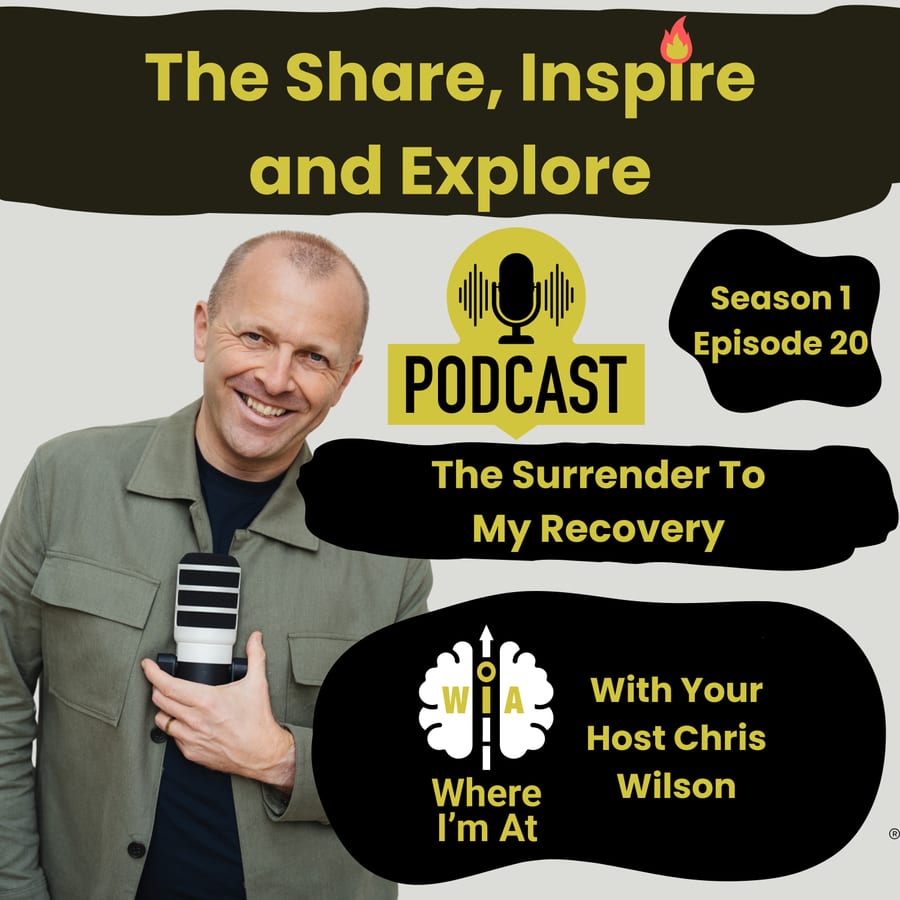
The Surrender To My Recovery
Prefer to watch? This episode is on YouTube and the show is on Spotify.
About this episode
The actual moment of surrender is not cinematic. It is 4am, a work laptop, and an email that says I can't come in.
Part two of my three part burnout story is about what came after the collapse. What asking for help really looked like, rather than how it sounds when people describe it afterwards. What psychiatry, psychotherapy and rehabilitation actually gave me. And what burnout showed me about myself once I finally stopped running from it.
This is for anyone who has hit their limit and is trying to work out what recovery involves, past the tidy version.
What asking for help actually looked like, in practice What psychiatric care, psychotherapy and rehabilitation each did What stopping made visible that running had kept hidden
Season 1, Episode 20
Content note: this episode contains honest discussion of burnout, psychiatric care, and a serious physical health event. If you feel unsafe or unable to cope right now, please contact local emergency services or a crisis support line. Crisis lines by country: https://en.wikipedia.org/wiki/List_of_suicide_crisis_lines
Share. Inspire. Explore. is the podcast from Where I'm At, honest conversations on burnout, career change, and what comes next for working professionals.
Join the Where I'm At Community, free to join: https://community.whereimatcommunity.com/store/product/membership Website: https://www.whereimatcommunity.com
Where I'm At is based on lived experience, reflection, and educational support. It is not therapy, counselling, crisis support, or professional advice. Please consult a qualified professional for individual medical, psychological, legal, financial, employment, or specialist support where relevant.
Read the full transcript2,206 words
Automatically transcribed, so it may contain errors and does not identify who is speaking. It follows the conversation in order.
A note before we begin, this is part two of my personal story sequence and everything I share is based on my own lived experience. I'm not a therapist, psychologist or doctor so nothing you hear is medical advice, a diagnosis or treatment recommendation. Today's episode contains honest discussion of burnout, psychiatric care and a serious physical health event. If any of this feels activating for you, please take care of yourself first. Pause, skip ahead or come back when you're ready. And if you're struggling right now, please reach out to a doctor, therapist or crisis service in your country. You don't have to hold this alone.
Welcome to Share, Inspire, Explore, the podcast from where I'm at. This is a space for honest conversations about burnout, career change, recovery and what comes next. I'm Chris and through lived experience, real stories and expert conversations, this podcast is here to help working professionals feel less alone and understand what may be happening and explore a steadier, more honest way forward. If you've been keeping it together on the outside, while something deeper has been shifting underneath, you're in the right place. Let's get into it.
Welcome back, everyone. Yeah, this is part two. And if you haven't heard part one yet, my descent into burnout, please go back first and have a listen, because it will give you the context for everything in this episode. So this one is about what came after.
And just a quick recap, where part one left us, you know, it was coming through this huge high stakes project that looked great on paper, but wrecked me on the inside, heart racing,
hands shaking, brain permanently foggy, you know, living on caffeine, painkillers and evening numbing strategies. Snapping at the people I loved. And my son had asked me why I was always sad.
And I simply didn't have an answer. So something had cracked open. But it wasn't the surrender just yet. What was the actual moment you stopped? Well, far less dramatic than you'd imagine. I'd been lying in bed all night, thinking about work, ruminating in my head. It was around four in the morning. I just, I just had enough. Yeah. My mind was at full speed. I just couldn't rest.
And so I just got up, I opened my work laptop and I typed that email. I'm sick. I can't come in. And I sent it. A huge, huge moment.
I, then I just, I lay back down. And for the first time in a long time, I, as I could remember, I slept. Eight hours. Solid. Yeah. My, my body had been waiting for that permission for a very long time.
What did asking for help actually look like? Well, this was messy. You know, I, I, I started crying, total random moments. I just felt completely lost. I didn't recognize myself in the mirror or any of my own behaviors, you know, something, you know, underneath all of that. I just couldn't ignore it anymore. I crossed a line. I just couldn't quietly uncross, you know, for someone wired the way I was, you know, built to be the dependable one, the strong one. Admitting I couldn't fix this by myself felt like a failure.
Again, playing back to my old narrative, yeah. But looking back, you know, this was the first real act of courage in my recovery. I'm so happy I did that.
What did you actually say? I just told the truth. I mean, it was, it was clear to those close to me. Um, but I said, I told the truth and that's all it was. But that was for me enormous, you know, uh, I told my wife, I'm not okay. I told my doctor how bad things actually were, you know, not the edited version or the acceptable version. It's the real one because for years I'd been, you know, softening, you know, my struggles. So it sounded manageable, but this time I didn't, you know, in that honesty, the surrender of the performance is, you know, what opened the door to everything that followed.
What did medical support give you? So yeah, I eventually started medication and, you know, I'm very careful how I talk about this because I'm not suggesting it's right for everyone. Um, but I do want to be honest about what it did for me because the silence around it doesn't serve anyone. The medication didn't solve burnout. It didn't fix me or the patterns or heal old wounds. But what it did was turn that, turn that volume down, just down enough that I could think, feel, and actually do the work of recovery. Just gave me enough headspace to take that next step. Um, so the world felt, you know, slightly less like a constant emergency. And that was seriously enough to
begin. What did therapy give you? Well, something I'd genuinely never had before, you know, this, this place where I didn't have to perform, you know, where my story didn't have to be tidy, where I could be contradictory or frightened or furious and nothing bad happened. So we explored the patterns I've been running for, for decades and failure narrative, the people pleasing compulsive over delivery. And, you know, it's not, it's not to find someone to blame, but to finally see the wiring clearly, you know, because, because once you see it, you can start to slowly, gently choose differently. What was the rehabilitation program like? Yeah. If you see on YouTube, YouTube, I, I documented my time in a psychiatric rehabilitation clinic. It also was going in,
I thought this six weeks would be enough. I do the program recover and simply go back to work. And if you've seen that blog on YouTube, you can see it clearly. I was treating recovery like another project to deliver. You know, but rehab didn't work like that. It took me out of the performance mode for the first time in years. I didn't have to be on. I could be quiet, messy, emotional, blunt, numb, you know, whatever. I was actually that day and the world didn't end.
Simply didn't end. So that alone began to chip away at something I'd, you know, carried for decades. And so if I'm not high functioning, I'm not safe. Did you go back to the job after? Just to close up the contract? Essentially, I didn't. You know, I made the decision not to return to that job that had been making me sick, which has been financially hard. Identity-wise, even harder. It was definitely the right call.
What happened next? Actually, a week after I left that job, I had a stroke, a pulmonary embolism, you know, a blood clot in the lung. Serious. Like, this was just another signal, you know, one my body had apparently been building towards for some time. You know, that chronic stress that I had been running on had left the real physical damage. It was frightening. And, but in a strange way of clarifying, you know, you can only ignore your body for so long before it stops asking and starts telling you. What did recovery actually show you about yourself?
That when the doing stops, the truth gets loud. You know, once I wasn't drowning in deadlines and projects, there was nowhere left to hide myself. Why did the inner critic get louder? Better and not quieter. Because that's what happens when, you know, when you slow down. I found in the early weeks of recovery that that voice was brutal. You know, you're weak. You've damaged your career. You know, people will think less of you. You should be coping better by now. And, you know, for a while I believed every word. You know, but with professional help, I started to see that voice differently. You know, not as the enemy, but as a very overactive, old protector.
And this was built from earlier pain, you know, trying to shield me using strategies that, you know, were built about 35 years ago. And that didn't excuse the damage it did, but it changed how I responded to it. So, you know, instead of automatically obeying it, I could pause, notice it and ask, is this the truth? Is this truth? What did progress actually look like? Well, nothing like a film montage by no means. It was subtle, you know, uneven, often boring. You know, a moment, a morning where I'd wake up fractionally less heavy or I'd take a walk where, you know, my breath naturally deepened or a day where I didn't reach for coffee by 10 o'clock.
Saying no to something once and not apologizing for it. Um, you know, none of those were big moments, more like tiny messages from my nervous system. I'm starting to trust this new pace.
So I stopped asking, am I fixed yet? Uh, I kind of started asking, you know, where is there 5% more space than there was before? You know, and that question is kinder and definitely more accurate.
Is recovery a finish line? No. No, it's not. Definitely. It's something I live with and tend to. I, I still see my therapists, not every week, but regularly. And I don't wait for a crisis before going. You know, I try to check in with my energy before I say yes to things.
I've gotten faster at noticing when I'm stretching too thin. And I name it earlier on, you know, rather than waiting until I take a break. And that's the whole point, you know, you know, not that vulnerability disappears, but that you see it coming sooner.
Have you experienced burnout since? Yes, actually, more recently than people might assume, you know, building this platform, this podcast, this community, something I genuinely love. But while carrying a job that had stopped fitting alongside the kind of, you know, household and financial pressure that accumulates towards the end of last year, you know, that all landed quietly all at once.
Although this time I caught it earlier than I would have before. So I made a harder call sooner, stepping back from employment. And I gave myself space to reset.
And that's the difference. You know, not that I didn't wobble, but that I didn't wait until it broke again. And that story, you know, burnout from the work you love and what it means to catch it earlier is definitely where season two begins.
If you're listening to this and something in the last two episodes felt uncomfortably familiar, I want to say something to you directly. You're not weak or struggling. And you're not a failure because you're exhausted.
And you're not broken because your system has reached its limit. Because burnout is a signal. And the most useful thing I can offer isn't a five-step plan. It's this. Tell one honest truth to someone you trust.
Just one. And see what opens up from there. And if you're in a place where you're thinking about harming yourself, please reach out for urgent support in your country. You don't have to navigate this alone.
Look, if I had to leave you with one thing from these two episodes, it would be this. You can't heal on the same terms that broke you. The mindset, the pace, the patterns that help you survive up to now.
They may not be the ones that carry you forward. So recovery began for me when I stopped trying to win at a game that was burning me out. And I allowed myself to step entirely out for a while.
And that took help. It took surrender. And it took time. Thank you for being here for both parts of the story. In part three, the season finale, I step back and make sense of what this whole season has been.
The one pattern running underneath all of it. And that's what's coming in season two. I'm Chris Wilson. This is Share, Inspire, Explore. The finale is next. And I'll see you there.
That's it for today on the Share, Inspire and Explore podcast. I hope something resonated with you. A moment of clarity, encouragement. But just a reminder that you're not alone.
If you find this helpful, share it with someone who might need it. Hit follow or subscribe to join us for future episodes. If you're new here, please check the link in the description to join the community.
Burnout is tough, but it's also a chance to heal and rediscover what matters. Thanks for being a part of this journey. And until next time, take care. Keep exploring what's possible.
I'm Chris Wilson. And that's where I'm at. I'm Chris Wilson. I'm Chris Wilson. And that's where I'm at. I'm Chris Wilson. I'm Chris Wilson. And that's where I'm at. I'm Chris Wilson. I'm Chris Wilson. And that's where I'm at. I'm Chris Wilson. I'm Chris Wilson. I'm Chris Wilson. I'm Chris Wilson. I'm Chris Wilson. I'm Chris Wilson. And that's where I'm at. I'm Chris Wilson. I'm Chris Wilson. And that's where I'm at.