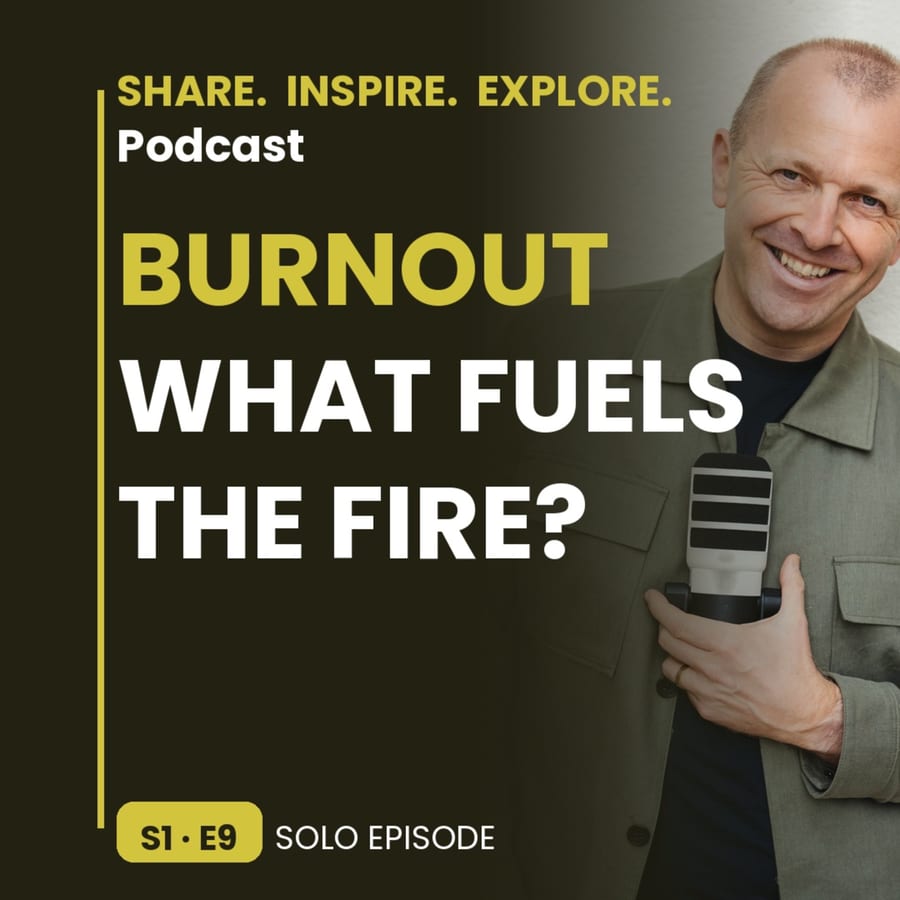
Burning Out? What Fuels the Fire at Work?
Prefer to watch? This episode is on YouTube and the show is on Spotify.
About this episode
Corporate burnout is not about being too busy. It is about what is actually burning you out, which is usually not the hours.
This solo episode goes into the workplace dynamics that build burnout long before anyone reaches collapse. Toxic cultures, expectations nobody says out loud, emotional labour that never appears in a job description, and the gap where leadership should be.
The point is not to let individuals off the hook, it is that treating burnout as a personal failure guarantees the same thing happens to the next person in the role.
Why overwork is usually a symptom rather than the cause How micromanagement and emotional labour do the quiet damage What organisations can change to prevent burnout instead of treating it
Season 1, Episode 9
Share. Inspire. Explore. is the podcast from Where I'm At, honest conversations on burnout, career change, and what comes next for working professionals.
Join the Where I'm At Community, free to join: https://community.whereimatcommunity.com/store/product/membership Website: https://www.whereimatcommunity.com
Where I'm At is based on lived experience, reflection, and educational support. It is not therapy, counselling, crisis support, or professional advice. Please consult a qualified professional for individual medical, psychological, legal, financial, employment, or specialist support where relevant.
Read the full transcript2,234 words
Automatically transcribed, so it may contain errors and does not identify who is speaking. It follows the conversation in order.
Welcome to the Share, Inspire and Explore podcast, the voice of the where I'm at burnout community. I'm Chris Wilson. And after my own journey through burnout and depression, I'm here to share real stories, inspire personal transformation and explore the path from burnout to balance. Each episode brings honest conversations with burnout survivors, mental health experts,
and mindset coaches offering lessons, strategies and hope. Whether you're recovering, curious or searching for motivation, this is your space to grow. Let's dive into today's episode. Welcome back to the Share, Inspire and Explore podcast.
Burnout isn't just about being overworked. It's about a system that keeps adding fuel to the fire. And today we're diving into the workplace factors that make burnout worse. Before we dive in, a quick content note. In this episode, we'll be discussing burnout, toxic work environments, emotional manipulation, and workplace bullying. If any of these topics are sensitive for you, please take care while listening and seek support if needed.
Let's recap what burnout is for the new listeners. And I recommend you go back to episode two of this podcast for more information. Burnout isn't just about being tired. It's a state of emotional, physical, and mental exhaustion caused by prolonged stress. According to the World Health Organization, burnout is classified as an occupational phenomenon, not a medical condition, but a significant workplace issue that affects mental well-being.
So what are the contributing factors in the workplace? Burnout doesn't have a single cause. It's a perfect storm of various factors. Let's break down the workforce stressors. And once again, I have to add a trigger warning as some of these factors touch on sensitive topics.
Sometimes burnout isn't just about overworking. It's about the environment we're working in. Toxic workplaces accelerate burnout, making recovery nearly impossible. It can poison even the most resilient of minds.
Here are some common signs of a toxic work environment. Unrealistic expectations. The constant pressure to work overtime without any recognition or reward. Back-to-back meetings every day and no time to do the work.
Innovate your personal time and makes it impossible to plan or fulfill activities outside of work. Work overload. Unrealistic workloads push people beyond their limits. When do more with less becomes the mantra, burnout is often the result.
Unclear expectations. Ambiguity about roles or goals creates constant stress. Not knowing how your performance is measured can lead to constant anxiety about job security. A lack of control and autonomy can also fuel the burnout fire.
When you feel like you have no say in how you do your work, it can be incredibly draining and demoralizing. Then there's the lack of support. Managers or colleagues dismiss concerns instead of offering solutions.
That's how we've always done it around here. Just get on with it. Or we're all busy, so just do your job. This mindset often shuts down innovation and dismisses employee concerns, leading to frustration and burnout.
There's the micromanagement. When every decision is scrutinized, creativity and autonomy suffocate. Picture having to get approval for every email you send. That level of oversight is exhausting and demoralizing. Or ever had to tweak a PowerPoint 26 times?
Micromanagement at its finest. Micromanagement stems from workplace culture or leadership pressures, but it can have a real impact on employees. Then there's office politics and favoritism. Success depends on who you know rather than the quality of your work.
Have you ever found yourself in the smoking area as a non-smoker just to network? Then there's the lack of recognition. When hard work goes unnoticed, motivation plummets. Imagine pouring your heart into a project only to have it ignored or criticized.
And then when things go wrong, there's the blame culture. Mistakes are met with punishment rather than constructive feedback. We have all surely been there. That finger-pointing, the witch hunt. What a way to instill fear in teams.
Then the work-life balance. Employees are expected to be available 24-7. Since COVID, this went to the extreme, right? Checking emails at the dinner table. Being somewhat proud that you work, even when you're sick.
I'm not feeling well, but I'll power through today. That sends out the wrong message. The dreaded noise when a team's call is initiated outside of office hours still sends shivers down my spine.
Work-life balance is a tricky one, right? Because offering flexible working hours is about trust on both sides. With old, rigid structures, you knew where you were. But now it's more of a grey area.
What are your thoughts on work-life balance? This toxic competition. Colleagues being pitted against each other, rather than being encouraged to collaborate. I realised I was being used as a pawn.
By saying yes and volunteering for most things on my team, I was guilty myself. It was only when I met a colleague for coffee, catch-up, when I left, a job, that they said this put unfair pressure on them. Which really got me thinking.
I became toxic myself. But this was me being a chameleon, adapting to the environment at the time. Next is bullying or harassment. Workplace bullying can take a heavy toll on both work and home life.
Constant criticism or intimidation can make even the most confident person doubt themselves. Manipulation and gaslighting It's often hard to spot manipulation or gaslighting at work. Gaslighting is when someone makes you doubt your own thoughts, feelings or memory. It can make you feel confused, anxious, and like you're always in the wrong, even when you're not.
In the workplace, this might look like being told you're too sensitive or overreacting when you raise a concern. Being blamed for mistakes that weren't your fault. Being left out of meetings or decisions and then told you should have known something.
Hearing praise privately but being criticised in front of others. And having your responsibilities changed without warning and then being told you're not keeping up. This kind of behaviour isn't always loud or obvious.
Sometimes it's quiet and subtle. And that's what makes it so harmful. Over time it wears you down and makes you question yourself. If you've ever left a meeting thinking, wait, am I going crazy?
Maybe it really is my fault. That could be a sign you're being gaslit. Being treated like this over and over doesn't just cause stress, it can actually feel traumatic.
Your body starts to react like it's in danger all the time. You feel tense, on edge, and unsure of yourself. No job is worth that. And if this sounds familiar, please hear this. You're not imagining it. It's not your fault.
Look, it's a sensitive topic. And one, by all accounts, on LinkedIn, a worrying trend. You've seen also on TikTok videos or YouTube videos calling out this behaviour. And rightly so.
It is disgusting. And what makes it worse are the companies which tolerate it. I look forward to going deeper into this in the future episodes with experts. Bullying at work can be subtle or direct, but the effects are real. Once again, if you're experiencing this, please reach out to someone you trust. No one should have to navigate this alone.
That's it for the toxic workplace triggers. If you're experiencing multiple issues on this list, it might be time to rethink your work environment and consider what's best for your well-being.
Feeling lost in the aftermath of burnout? You're not alone. Where I'm at is a new community, created for those in recovery, those at risk, and those supporting others. It will be a safe, evolving space to recognize, reset, and reinvent with live sessions, peer support, expert Q&As, and more.
It will be free to join in the beginning. And while not everything will be there from day one, this will be a community which is built by us and for us.
Click the link in the description to join and shape what's next. My name's Chris Wilson, and that's where I'm at. Thank you. Now for some more general triggers. In the form of job insecurity and fear of redundancy.
In today's economy, many of us live with that nagging fear that our jobs could be gone tomorrow. And that constant worry can take a serious toll on our mental health.
Studies suggest that burnout is a leading cause of workplace absenteeism. It's no wonder with the fear and insecurity, we go above and beyond what's expected of us. Then there's the isolation.
The lack of social connection, especially in remote work, can lead to burnout. Working from home might seem ideal. But without the water cooler breaks or lunch breaks with colleagues, it can be very lonely.
And in our increasingly connected yet disconnected world, social isolation and loneliness are becoming major contributors to burnout. We might have hundreds of social media connections, but true, meaningful connections are harder to come by.
And the lockdowns. I actually loved working from home. And lockdowns for an introvert like me were easier. The small talk is tiring and a gun in the way of productivity.
However, I saw how I can really risk burnout and the importance of social contact with colleagues. The big debate is compulsory return to office policies and reduced remote work benefits. At the time of recording, I've just returned to work. I'm over a month in and I can say I'm going to the office every day now in order to rebuild those office social skills, which I lost in the last years, which probably contributed to my burnout.
But that's just me. And I know being forced back to the office, our first response in such changes is to complain. Because change is hard. But if you think about it, and have been yourself in a burnout situation, treat it as a defense mechanism.
And an opportunity to form real connections in a society which is drifting apart. Now that we've identified these burnout triggers, let's discuss organizational strategies to combat them. I want to say these are observations and based on experience, but I'm not qualified or trained in any organizational transformation.
If you are, I'd love to hear your strategies of how you successfully implemented for your clients or organization. First up, improve communication and support. Let us move away from the top-down approach and have more two-way discussions.
A better understanding of problems and goals can lead to better solutions and a happier workforce. Ensure fairness and recognition. Behind every manager is a team. Leaders deserve recognition, but not without highlighting the very teams that make it happen.
Equal pay and clear career paths. Promote work-life balance. Emphasize rest periods, especially when managers see employees struggling. Offer flexible work options. Then it becomes a give-and-take relationship. Train managers to identify burnout.
This is a big one, right? I would love organizations to help people reintegrate after burnout and celebrate those as success stories. If companies want stronger employee branding, show employees how you acknowledge and take care.
It is by this very example you will build trust and be known as a great place to work. All in all, create a supportive, respectful workplace. They do exist. Is yours one of them?
Those are just my 10 cents. If you're an expert in this field, I'd love to hear your strategies. Are you successfully implemented for your clients or organization? Organizational culture plays a crucial role in either fueling or preventing burnout.
A positive culture that values employee well-being can make all the difference. It should be our right to psychological safety at work. We've always had a trained first aider for our physical security,
so equal emphasis should be given to trained listeners as a first line of defense to our mental well-being. Especially in medium to large organizations. Well, there should be enough budget, right? Let me know your thoughts in the comments below.
And once again, if you're working on transforming workplaces for the better, I'd love to hear from you. This week, I ask you to take a moment to check in with yourself.
Which of these burnout triggers feels familiar? So there you have it. From those demanding workloads to the toxic workplaces, there's no shortage of things that can fuel the burnout fire. But the good news is, understanding these contributing factors is the first step towards taking control. Combating it requires effort from both organizations and individuals.
Remember, creating a supportive environment and prioritizing well-being are key to preventing burnout. Thank you for joining me today. Remember, recognizing the science is the first step to reclaiming your energy and passion.
And seeking professional help is my recommendation. Until next time, take care of yourselves and each other. Bye-bye. That's it for today on the Share, Inspire and Explore podcast. I hope something resonated with you. A moment of clarity, encouragement, or just a reminder that you're not alone.
If you find this helpful, share it with someone who might need it. Hit follow or subscribe to join us for future episodes. If you're new here, please check the link in the description to join the community.
Burnout is tough, but it's also a chance to heal and rediscover what matters. Thanks for being a part of this journey. And until next time, take care. Keep exploring what's possible.
I'm Chris Wilson, and that's where I'm at. you