
Burnout vs Stress vs Depression: The Key Differences
Prefer to watch? This episode is on YouTube and the show is on Spotify.
About this episode
Burnout is not just extreme stress. If we treat it like stress, we miss it completely.
This episode covers the history and the science: the term being coined in the 1970s, and the WHO formally recognising burnout in 2019. I break down the three dimensions the research uses, exhaustion, cynicism and reduced efficiency, and where the real lines sit between burnout, stress, depression and anxiety.
The distinction matters because it changes what actually helps.
How burnout became officially recognised, and what took so long The Maslach Burnout Inventory, and what it does and does not measure Why burnout has to be addressed at the source rather than managed
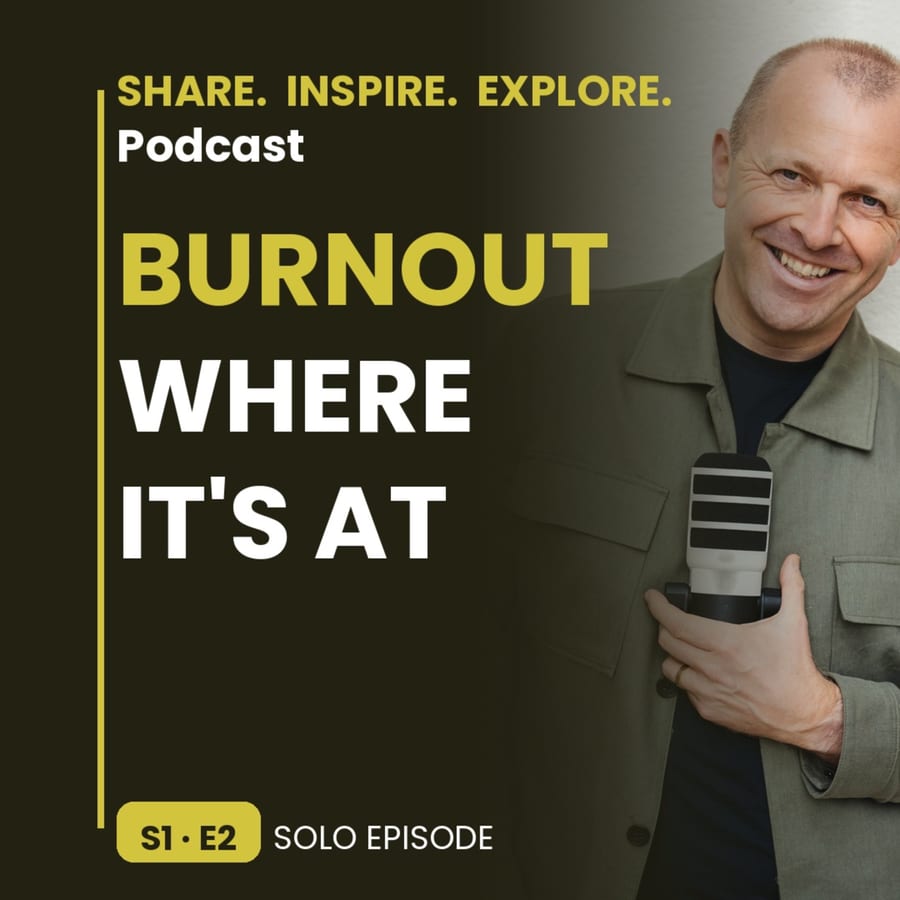
Season 1, Episode 2
References: https://en.wikipedia.org/wiki/Herbert_Freudenberger https://en.wikipedia.org/wiki/Maslach_Burnout_Inventory https://www.who.int/news/item/28-05-2019-burn-out-an-occupational-phenomenon-international-classification-of-diseases https://mentalhealth-uk.org/burnout/
Share. Inspire. Explore. is the podcast from Where I'm At, honest conversations on burnout, career change, and what comes next for working professionals.
Join the Where I'm At Community, free to join: https://community.whereimatcommunity.com/store/product/membership Website: https://www.whereimatcommunity.com
Where I'm At is based on lived experience, reflection, and educational support. It is not therapy, counselling, crisis support, or professional advice. Please consult a qualified professional for individual medical, psychological, legal, financial, employment, or specialist support where relevant.
Read the full transcript1,659 words
Automatically transcribed, so it may contain errors and does not identify who is speaking. It follows the conversation in order.
Welcome to the Share, Inspire and Explore podcast, the voice of the where I'm at burnout community. I'm Chris Wilson. And after my own journey through burnout and depression, I'm here to share real stories, inspire personal transformation and explore the path from burnout to balance. Each episode brings honest conversations with burnout survivors, mental health experts, and mindset coaches, offering lessons, strategies, and hope. Whether you're recovering, curious, or searching for motivation, this is your space to grow. Let's dive into today's episode. What exactly is burnout? Is it simply stress or something more? Hi, everyone. Welcome to the episode two of the Share, Inspire and Explore podcast. Today, we're deep diving into a topic that's impacting a staggering number of people. Burnout. If you're feeling constantly
drained, emotionally exhausted, and feel like you're running out of fumes, you're in the right place. Before we begin today's episode, I want to remind you that I am not a mental health professional. This podcast is for information purposes only. If you feel affected by anything discussed in this episode, or suspect that you're experiencing burnout, or other adverse mental mental health conditions, please seek help from a licensed professional.
Now you might hear the words stress and burnout thrown around, but they're not the same thing. Understanding the distinction is critical to addressing the issue effectively. I want to ask you, have you ever felt completely drained at work, like you just can't keep going?
What does burnout mean to you? I'd like to hear. Let's look at the history of burnout. Believe it or not, the term burnout was first coined in the 1970s by a German-American psychologist named Herbert Freudenberger. He was working with drug addicts at a free clinic, and noticed the staff were displaying symptoms like exhaustion, quickness to anger, sleeplessness, and a reduced cognitive flexibility amongst clinic volunteers. He noted that burnt-out workers often look, act, and seem depressed. He described this phenomenon as burnout.
Now, while Herbert Freudenberger coined the term burnout, in the 70s, it was actually Christina Maslach, a social psychologist who developed the first widely recognized scientific measurement of burnout in the 1980s. Her research, alongside her colleague Susan Jackson, led to the creation of the Maslach Burnout Inventory, MBI, a tool that has become the gold standard for assessing burnout in various professions. Maslach's work helped move the understanding of burnout from purely anecdotal concept to a measurable phenomenon with specific dimensions. This wasn't just some pop psychology fad. It was backed by science. So the AMBI gets to the heart of burnout, focusing on three crucial dimensions. The first, exhaustion. That feeling of being utterly drained, both emotionally and physically, like your battery is
always at 1%. Second, cynicism. It's like a shield going up, a detached and negative attitude towards your work, and the people who you work with. You start to question the meaning of it all.
And lastly, reduced professional efficiency. That nagging sense that you're just not cutting it anymore, even if you objectively are. Your confidence takes a hit and motivation goes out the window.
The MBI uses a series of questions to assess how strongly you relate to the statements about each of those dimensions. Depending on your responses, you'll get scores for each dimension,
giving you a clearer picture of where you stand on the burnout spectrum. Now, the MBI's impact was huge. It sparked a wave of research, allowing deeper dives into the causes,
consequences, and potential solutions for burnout. Maslach's research highlighted that burnout is not simply a matter of working too hard. It's a complex interplay of various factors, including workplace stressors,
individual characteristics, and the lack of resources and support to cope with demanding situations. But here's where things get a bit complicated. Even though there was this amazing tool and tons of research, burnout still wasn't officially recognized as a medical condition. There was a lot of debate in the scientific community.
Some folks thought burnout was just a super intense version of stress, maybe even a stepping stone to depression. Others argued it was its own unique animal with specific characteristics. This lack of a clear definition caused major issues, especially for people struggling with burnout. It impacted access to health care and social security. Imagine needing time off work to recover from burnout and not getting the support you need because it wasn't officially recognized. Now in some countries like Sweden and Netherlands, they were ahead of the curve.
They understood the impact of burnout and offered financial support to those who got a formal diagnosis from the doctor. The problem was there wasn't a universal set of guidelines for doctors to follow, which created a whole lot of confusion and inconsistency.
It took decades, but finally, in 2019, the World Health Organization, the WHO, stepped in and officially included burnout in the 11th revision of the International Classification of Diseases, the ICD-11.
They defined burnout as a syndrome conceptualized as resulting from chronic workplace stress that has not been managed successfully. This was a huge win. It meant that burnout was finally registered. It was recognized as a legitimate health concern. But, and there's always a but, the WHO classified it as an occupational phenomenon, not a straight-up medical condition. What this means is that while burnout is a real health problem, it's directly linked to the workplace. It's not considered a general mental health disorder, like anxiety or depression.
This distinction is important because it emphasized that tackling burnout requires addressing the root causes in the workplace. It's not just about individual coping strategies. It's about creating healthier work environments.
Does this definition resonate with your experience? Have you noticed these symptoms in yourself or others? Let me know in the comments below. Let's compare burnout to stress. Stress is typically a short term and
linked to a specific challenge or demand. It can be positive or negative, but tends to resolve once the stressor is removed. Whereas burnout develops over time due to chronic stress, leading to a state of emotional, physical and mental exhaustion, where recovery requires more than just rest.
Let's use an example: stress. A sales manager, preparing for a big presentation, feels the heart race, loses appetite temporarily, but relaxes after successfully delivering the presentation. The same sales manager, experiencing burnout, begins dreading every presentation, loses passion for the job entirely, and feels detached and ineffective, even when they achieve their goals.
Stress is like a spark, it can ignite action, and drive us forward, but if that spark isn't managed, it can turn into a raging fire – burnout. Burnout vs. Depression
Although there are shared symptoms, including exhaustion and negativity, depression is a clinical medical health condition that affects all aspects of life and may occur without any external triggers. It involves persistent feelings of sadness, worthlessness, and a lack of interest or pleasure in most activities.
Compared to burnout, which is primarily related to chronic workplace or situational stress, and is often specific to the environment or role causing the exhaustion. However, if left unaddressed, burnout can lead to depression.
Let's have an example on depression. So a software engineer feels no joy in activities they once loved, such as playing video games, spending time with friends. They wake up feeling hopeless every day, unrelated to their workload.
The same engineer, experiencing burnout, feels exhausted, detached when working on projects, but regains some energy and joy over the weekend when they spend time with friends. Their symptoms are tied to the demands of their work.
Lastly, let's compare stress and anxiety. Stress is a reaction to external pressure and typically dissipates when the pressure is resolved. On the other hand, anxiety is more persistent. It's a condition involving excess worry, even in the absence of an immediate stressor.
Anxiety often stems from an internal feeling of dread rather than external challenges. Using the same examples, for stress, a student at this time feels pressure while studying for an exam. But once the exam is over, they feel relieved and return to their normal routine.
That same student, experiencing anxiety, constantly worries about failing future exams, even when no test is scheduled. They experience racing thoughts and restlessness, preventing them from enjoying downtime. So there you have it, a quick journey through the history of burnout.
From those early observations by Freudenberger to Maslach's game-changing MBI and the WHO's long-awaited recognition, our understanding of burnout has come a long way. I plan to have guests qualified to discuss this topic in future, especially the MBI test and its role today, along with other testing approaches.
And finally, I just want to reiterate the importance of recognizing burnout early. Launching this channel has sent some alarm bells my way, but I'm now aware and take the necessary precautions.
I encourage you, the viewer or listener, to share your stories. I'd love to hear your experiences with burnout. What has helped you manage it? Feel free to reach out, leave a comment. And finally, a reminder of my disclaimer. If you're feeling overwhelmed or suspect that you're experiencing burnout, please consult a medical health professional.
That's it for today. And until next time, take care and thanks for listening. That's it for today on the Share, Inspire and Explore podcast. I hope something resonated with you, a moment of clarity, encouragement, or just a reminder that you're not alone.
If you find this helpful, share it with someone who might need it. Hit follow or subscribe to join us for future episodes. If you're new here, please check the link in the description to join the community.
Burnout is tough, but it's also a chance to heal and rediscover what matters. Thanks for being a part of this journey. And until next time, take care, keep exploring what's possible.
I'm Chris Wilson, and that's where I'm at.