
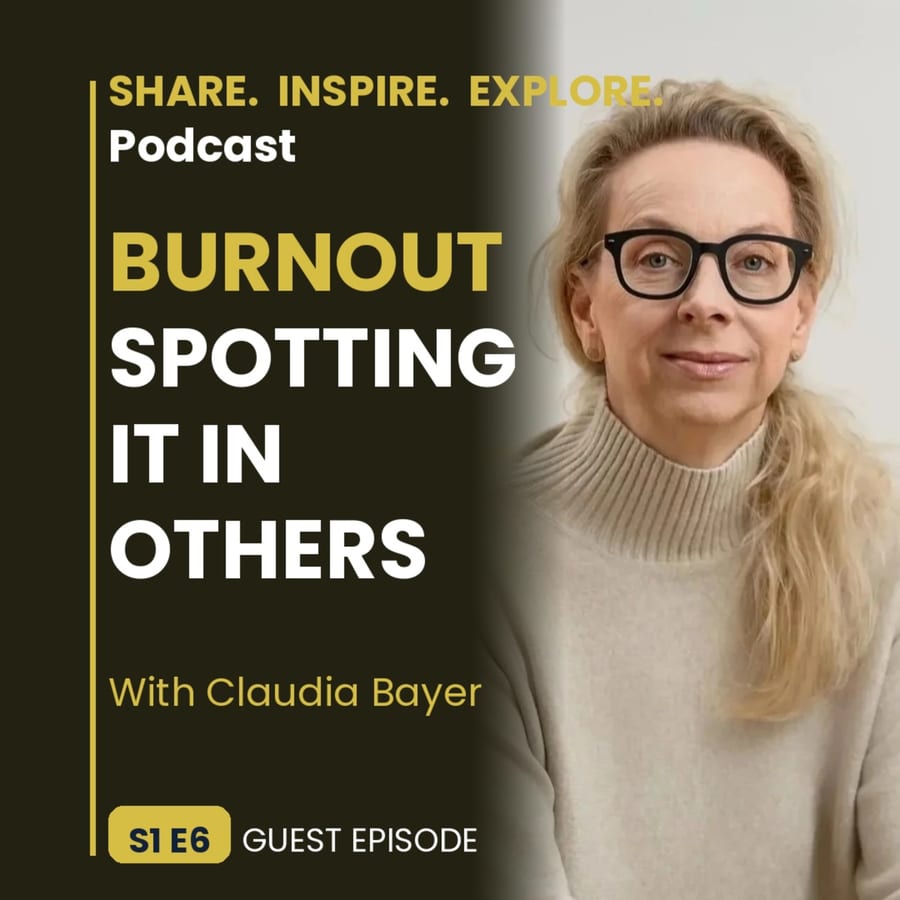
How to Identify Burnout in Yourself and Others — Claudia Bayer
Prefer to watch? This episode is on YouTube and the show is on Spotify.
About this episode
The signs of burnout are easy to miss in yourself, and easier still to miss in someone you work with.
Psychotherapist Claudia Bayer joins Chris Wilson to talk about what burnout actually looks like before it becomes a crisis. They cover where the line sits between ordinary stress and something clinical, why burnout gets mistaken for depression, and what the people around you tend to notice first. Claudia is Head of Psychotherapy at Lebens Resort Ottenschlag and runs a private practice in Vienna.
- The clinical difference between burnout and everyday stress
- The early warning signs most people explain away
- How burnout shows up in colleagues and family, and what to do about it
Season 1, Episode 6
Share. Inspire. Explore. is the podcast from Where I'm At, honest conversations on burnout, career change, and what comes next for working professionals.
Join the Where I'm At Community, free to join: https://community.whereimatcommunity.com/store/product/membership
Website: https://www.whereimatcommunity.com
Where I'm At is based on lived experience, reflection, and educational support. It is not therapy, counselling, crisis support, or professional advice. Please consult a qualified professional for individual medical, psychological, legal, financial, employment, or specialist support where relevant.
Read the full transcript2,289 words
Automatically transcribed, so it may contain errors and does not identify who is speaking. It follows the conversation in order.
Welcome to the Share, Inspire and Explore podcast, the voice of the where I'm at burnout community. I'm Chris Wilson. And after my own journey through burnout and depression, I'm here to share real stories, inspire personal transformation and explore the path from burnout to balance. Each episode brings honest conversations with burnout survivors, mental health experts and mindset coaches, offering lessons, strategies and hope. Whether you're recovering, curious or searching for motivation, this is your space to grow. Let's dive into today's episode.
Welcome back to the Share, Inspire and Explore podcast. Today, we're talking about something incredibly important, recognizing burnout before it reaches breaking point. Many people don't realize they're burnt out until they're deep in it. So how can we spot it sooner? To help us navigate this, I'm joined by Claudia Bayer, a highly experienced psychotherapist specializing in systemic therapy for individuals, couples and families. She's head of psychotherapy at Leben's psychiatric resort in Ottenschlag, Lower Austria, and runs a private practice here in Vienna, supporting adults, children and adolescents. Claudia has lectured at the University of Vienna and has extensive experience in child protection, psychiatry, and family counseling. Before psychotherapy, she worked as a marketing director for international corporations. Her deep expertise in mental health
health and diverse background make her a valuable guest and the resident mental health expert on this podcast. Welcome Claudia. I'm excited for our conversation today. Thank you, Chris, so much for being here.
Super. Before we get into the details, can you tell us a little bit about your work, in your own words, and how burnout became a key focus for you? Yes, I specialize in mental health, working as a psychotherapist in a clinic for mental health with a focus on stress, burnout, but also depression, anxiety. Well, over the years, I've worked with many individuals who didn't even realize that they were burned out until it was too late. Because burnout is really sneaky, I found out. It disguises itself as sometimes as just being busy or having a tough week. But it can have severe consequences when, if left unaddressed.
A short disclaimer from my side. This episode discusses burnout, stress, and mental health challenges. It is for informational purposes only and not a substitute for professional medical advice. If you're struggling, please seek support from a qualified healthcare professional. Right, Claudia? Claudia? Yeah, that's very important.
So, understanding burnout symptoms. We hear the term burnout a lot, obviously, on this podcast, over the last episodes. But how would you define it in clinical terms? Yeah, burnout is defined as a state of chronic, physical, mental, and emotional exhaustion caused by prolonged stress.
It's different from regular tiredness, I'd say, because it's really persistent and rest alone. For example, weekend off doesn't fix it. It often leads to feelings of detachment, cynicism, and a decreased sense of accomplishment also.
Many people associate burnout with just being tired, but what are some more subtle signs, would you say, that often go unnoticed? Well, that's a very good question, because burnout patients itself, they tend to be very high achievers that have really high expectations for themselves. So, they are not hitting those goals anymore.
Therefore, a lot of self-doubt and a sense of failure, but it comes up. And in addition, you can feel emotionally numb, losing your motivation, when even, you know, small things you used to love no longer excite you.
Or you feel a sense of helplessness, you don't know where to go, you feel alone in the world, detached from others, even your close family then. And in general, and in general, and that's very important, you feel a lack of sense in what you're doing in general.
Yeah, absolutely. I mean, I remember the sleep issues, the headaches. And on that basis, can you talk about the physical effects from burnout? Yeah, physical symptoms always appear, like stomach issues, depends on your body, muscle tension and pain, therefore, headaches, insomnia, like not being able to fall asleep, or waking up at three in the morning, and then just not being able to sleep anymore. And also, frequent illness, this is due to, appears due to a weakened immune system. In addition, struggling to concentrate is, I can always see that, forgetfulness, feeling mentally foggy also.
This can lead to something like standing in front of the washing machine, not knowing how to turn it on. And then, increased irritability, being very short-tempered over, I'd say, rather small things.
Yeah. If we talk about recognizing burnout in others, many people don't recognize burnout in themselves, but those around them might notice change. What would you say are the key behavioral changes that signal burnout in someone else?
I'd say the key signs are withdrawing socially. So, isolating yourself from the group, or from workplace, canceling plans, avoiding conversations, and then also sudden personality changes. Someone who's, someone who's normally very cheerful, may become disengaged or irritable. The person has sudden outbursts, for example, with either high or low emotions.
Yeah, I felt like a grenade about to go off at times and was very impulsive. So, you experienced that? Yeah, absolutely. Then also, might be a drop in performance, whether it's missing deadlines at work or lacking energy for daily tasks at home.
And then, this procrastination, putting off what you might have done more easily in the past. And very, very common also, the self-medication. Self-medicating, turning to alcohol, junk food, excessive screen time, for example, and other means, legal or illegal, just to numb out.
And, obviously, turning to alcohol or other coping mechanisms may provide short-term relief, but can worsen symptoms in the long run. If you find yourself relying on these, professional support can help identify healthier coping mechanisms.
Yeah, I can relate to that. Looking forward to the couple of glasses of wine after work. It's just numbing, trying to numb out underlying issues, right? Yeah. I mean, if we talk about noticing burnout signs in a friend or a colleague, how can we bring that up in a way that feels supportive and not intrusive? I would mention it rather soon, approaching with empathy, but not judgment, instead of saying, I know you are burned out.
Just say, maybe, I've noticed you've been quieter lately. How are you really doing? Not in a group, but one-on-one, I would mention that. Or, I'm here, if you need to talk.
Just being here is very important. And maybe I've struggled with burnout before, too. Let me know if you want to have a chat. There's some good tips there. Absolutely.
Burnout affects the brain and the body. Can you maybe explain, you know, what's happening biologically when someone is burned out? Yeah, on the way there, chronic stress increases cortisol and adrenaline levels.
And they lead to increased blood pressure and pulse rate, rapid breathing, weight gain, sometimes, every time, microinflammation and weakened immunity, slower digestion and a sort of tunnel view. And then also stress diminishes, of course, this cognitive performance I mentioned already, making people then exert themselves more to achieve their normal performance and affecting the ability to remember common details about just daily tasks.
And then over the time, the brain starts sort of rewiring itself to be in a constant state of alarm. You are then in this survival mode all the time.
Yeah, it's not nice. This being hyper alert, even to small noises on the street. It really does, as you say, rewire itself. How do we differentiate between burnout and clinical depression? I'd say burnout is marked by helplessness and depression by hopelessness.
They can have different causes and also should be managed differently. Those with burnout generally have burned for something and now feel overwhelmed by demands and deadlines they can't meet, creating a sense of helplessness.
On the other hand, those with depression report a lowered self-esteem always. So, rather than helpless, they feel that they and their future are hopeless. Burnout is more like an apathy, so not really wanting to get on with seeing things. However, you can continue to function. Like in burnout, it's often work-related. And some people keep their fitness or even increase it and exercise, even as their work-related time is not so productive.
Totally. And from your perspective, what are the common symptoms with burnout and depression? Well, burnout shares some features with depression, but they tend to be general symptoms, such as feeling, a loss of pleasure, energy and concentration also, a lack of motivation and difficulties, sleeping or being cheered up. And then, if we talk of a depressive episode, this involves a drop in self-worth always, an increase in self-criticism and feelings of wanting to give up.
But not everyone with these symptoms will have a clinical depression, which requires a diagnosis and has an additional set of symptoms. So, burnout often improves with the rest. That's also a differentiation and changes of workload, while depression tends to persist regardless of external circumstances.
I would say these are the main things. And if you're unsure, whether you are experiencing burnout or depression, a mental health professional can help you to assess your symptoms. That's very important.
Yeah. Just to reconfirm to our listeners and our audience, you know, if you're unsure whether you have burnout or depression, please seek medical advice. Yes, very necessary. If someone recognizes burnout in themselves, what's the first thing they should do?
First, and very important, acknowledge it. Burnout thrives really in denial. And then the principal strategy is identifying the contributing stressors. Ask for help. Set boundaries. And then identify what's meaningful in your work or generally in your life.
Celebrate your wins is also something very important. Maybe writing down in the evening what went good, what you liked. Maybe also where you had luck. And then, of course, practice mindfulness.
Mindfulness. Yeah. Absolutely. With the setting boundaries. It's easier said than done, as we say. For those who feel like they can't afford to slow down, what advice do you have? If you don't take time for your wellness, you will have to take time for your illness.
So, anyway, you have to take time, either now or later on then. It's like another picture. Maybe it's like walking into a tunnel with a very weak flashlight saying, no, I don't have time for changing the batteries right now.
You will end up in darkness in this tunnel. Wow. So, take time off. You can start with breaks, but not in front of your computer. Five minutes maybe of deep breathing outside.
An actual lunch break outside is very, very important. Or saying no to non-essential meetings. These are just some of the points. There are lots, lots of others. Yeah, absolutely. And any of the listeners or audience out there struggling in their workplace, I would recommend to seek support through HR and or through, if your company has it, an employee assistance program.
But also explore legal protections, if applicable. Yeah. At what point should someone consider therapy for burnout? If symptoms are starting to affect your daily life, then it's time to seek for help. Your work, relationships, or your mood. It's time then to seek help because therapy can provide coping strategies before burnout really turns into a clinical depression.
Different strategies work for different people. So, there is no one for all. And if you're struggling to manage symptoms, seeking professional guidance can make a big difference. That's great. Great advice. And as we're closing this episode, if you could give one piece of advice to someone questioning whether they're burnt out, what would that be? Or if you could give one piece of advice? Or if you're on the way, listen to your body. Your body is always right, and burnout doesn't show up overnight. So, it's a very rather slow fate, but you have to be honest to yourself. The sooner you acknowledge it, the easier it is to recover. I couldn't agree more. Listen to your body.
Very protective of my energy now. And, you know, when you can feel that battery dropping. Listen, thanks, Claudia, for such an insightful conversation and for being my first expert on the podcast. This is a bit of a milestone, huh?
Yeah. You know, I look forward to coming back and discussing further topics. I will leave a link to your website in the description if anyone would like to reach out to you professionally. Thank you, Chris, for having me here.
Looking forward to our next talk. Thanks, Claudia. Great. And to you, the listener or viewer, if this episode helped you, let us know. And share it with someone who you feel might need it.
And remember what Claudia said about the flashlight in the tunnel. Don't neglect the batteries before it gets dark and take that break. Until next time, take care of yourself.
Bye-bye. That's it for today on the Share, Inspire and Explore podcast. I hope something resonated with you. A moment of clarity, encouragement, but just a reminder that you're not alone.
If you find this helpful, share it with someone who might need it. Hit follow or subscribe to join us for future episodes. If you're new here, please check the link in the description to join the community.
Burnout is tough, but it's also a chance to heal and rediscover what matters. Thanks for being a part of this journey. And until next time, take care. Keep exploring what's possible.
I'm Chris Wilson, and that's where I'm at. I'm Chris Wilson, and that's where I'm at.