
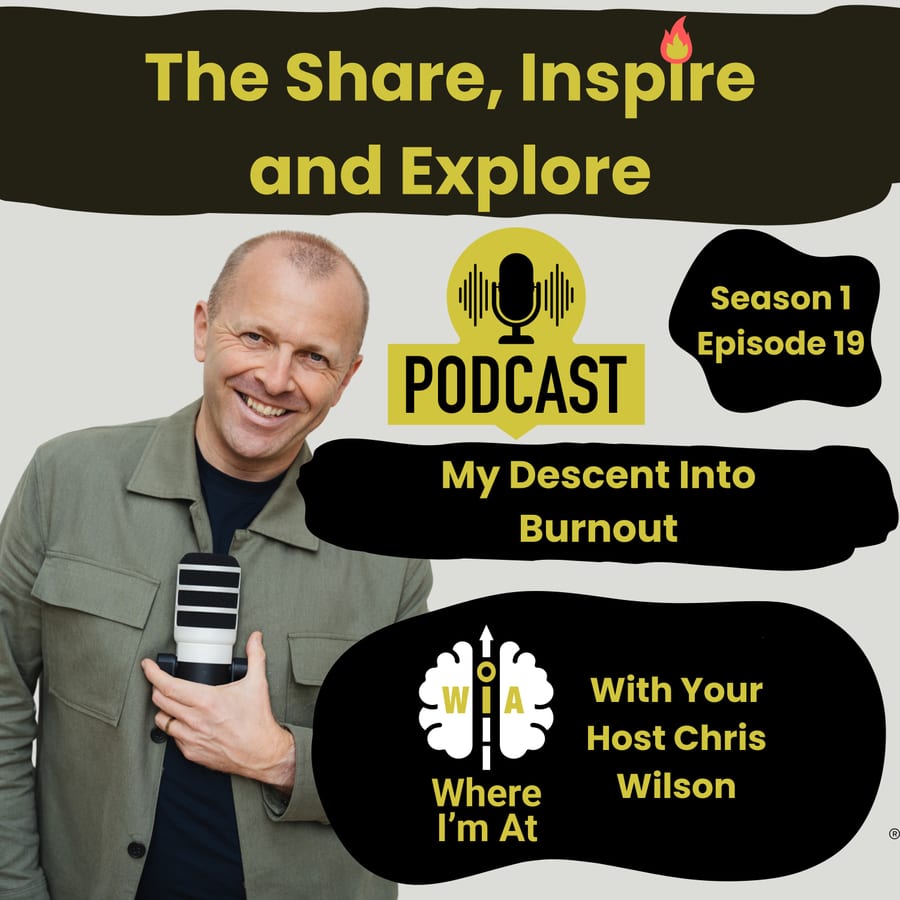
My Descent Into Burnout
Prefer to watch? This episode is on YouTube and the show is on Spotify.
About this episode
Burnout does not start at work. Mine started in Northern Ireland during the Troubles.
Growing up somewhere the world could shift without warning, I learned quietly, without anyone teaching me, to stay braced, stay useful and stay small. I carried that into every room I walked into for the next thirty years.
This is part one of a three part personal story, and it traces the patterns that drove me: the fear underneath the ambition, the coping that turned into its own problem, and the moment I could not hold it together any longer.
What the wiring was, and where it came from The fear underneath the ambition, and what it kept producing The coping that quietly became the problem
Season 1, Episode 19
Content note: this episode discusses a bomb explosion, burnout, mental health and alcohol dependency. Please look after yourself first. If you feel unsafe or unable to cope right now, please contact local emergency services or a crisis support line. Crisis lines by country: https://en.wikipedia.org/wiki/List_of_suicide_crisis_lines
Share. Inspire. Explore. is the podcast from Where I'm At, honest conversations on burnout, career change, and what comes next for working professionals.
Join the Where I'm At Community, free to join: https://community.whereimatcommunity.com/store/product/membership Website: https://www.whereimatcommunity.com
Where I'm At is based on lived experience, reflection, and educational support. It is not therapy, counselling, crisis support, or professional advice. Please consult a qualified professional for individual medical, psychological, legal, financial, employment, or specialist support where relevant.
Read the full transcript2,486 words
Automatically transcribed, so it may contain errors and does not identify who is speaking. It follows the conversation in order.
A note before we begin, this episode is the first of a three-part personal story sequence and everything I share is based on my own lived experience. I'm not a therapist, psychologist or doctor, so nothing you hear is medical advice, a diagnosis or treatment recommendation.
And there is a trigger warning, this episode contains a first-person account of a bomb explosion during the Troubles in Northern Ireland. And I also talk about burnout, emotional distress, mental health and unhealthy coping behaviours, including alcohol dependency.
I won't go into graphic detail, but if any of that feels activating for you, please take care of yourself first, pause, skip ahead or come back when you're ready, because your wellbeing matters more than getting through this episode.
And if you're struggling right now, please reach out to a doctor, therapist or crisis service in your country. You don't have to hold this alone. Welcome to Share, Inspire, Explore, the podcast from where I'm at.
This is a space for honest conversations about burnout, career change, recovery and what comes next. I'm Chris and through lived experience, real stories and expert conversations, this podcast is here to help working professionals feel less alone and understand what may be happening and explore a steadier, more honest way forward. If you've been keeping it together on the outside while something deeper has been shifting underneath,
you're in the right place. Let's get into it. Welcome back, everyone. Yeah, today I want to tell my story. At last, I want to do it a bit differently.
You know, not as one long narrative, but as the questions I actually get asked about, you know, regularly. So, yeah, let's go. So, first up, where does a burnout story actually start?
Well, for me, it's definitely not at work. That's the short answer. It's the thing that most people get wrong, I believe, about burnout, including me for obviously such a long time.
You know, the patterns that drive it, the need to prove yourself, the inability to stop and the way you cope, you know, when the pressure gets too high. And those get written long before any office or job title, as I've learned through therapy.
So, mine started in Northern Ireland, where I grew up, you know, during the Troubles and the religious conflict, actually. What was it like growing up in Northern Ireland? Well, strangely normal, actually.
It's hard to explain. You know, there were bomb scares at school, in the leisure centers, shootings. The news was just filled every day with incidents. You know, they were just the background the whole time. And you learned, you know, without anyone ever teaching you, that the world could shift in an instant.
And something in you adjusted to that, you know. It wasn't so loud. It was very quiet. But it was permanent. And I didn't know at the time, but that was shaping how I'd operate in the next 30 years.
Was there a specific moment? Well, yeah, I was 10, growing up in Eskillon, is the town I grew up in. And there is a Remembrance Day to commemorate the war.
And this was 1987. We had planned to visit there. We were a little delayed. My mother lost the car keys, thankfully. And as we parked in the car park a few hundred meters away, I just got out of the car. And when this bomb went off and there was no warning, I felt the sound before I'd heard it. There's this deep, heavy thud in your chest and your stomach.
The building, bricks, wood flying everywhere, dust, rubble, confusion, people running away from the scene, running towards the scene. People screaming. As I said, we were a few hundred meters away and it was just one of those ordinary things, you know, losing the car keys. But we realized later we would have been standing pretty much close to where it went off.
And it was such a tragedy. You know, we knew people who'd lost their lives that day. I got injured and it really affected the whole town. It was surreal looking back as a ten-year-old trying to process what happened.
Not just the ten-year-olds, it was everyone. Everyone is affected, yeah. How did that change you? Well, as I said, you don't have words. Words for it, back then I was ten. I just knew something terrible had happened very close by and it could have easily been us.
But what stayed wasn't constant fear. It was more like this low hum of readiness. You know, a watchfulness that settled in and never really left. You know, stay alert. Things can change in an instant.
So I carried that, you know, into school, into work. Basically into every environment I walked into after that. And it looked like being switched on, but it was actually being, you know, permanently braced.
What was home like, on top of all that? Yeah, I mean, there was care. Providing. But, you know, back in the days, emotions weren't really things you named or talked about.
And, you know, there was this strong Protestant work ethic running underneath everything. You know, doing and contributing were actually what mattered. And rest often came with guilt attached. And I became the quiet one. You know, this kid that doesn't cause trouble.
On the surface, easy inside, I was often fading into the background. And, you know, learning without anyone telling me that the safest thing was to stay small and stay useful.
Were you always sensitive to other people's moods? Always. If someone in the room was anxious, I felt anxious. If someone was stressed, I absorbed it. Without even knowing I was doing it. And like a quiet sponge, taking everyone else's weather and never naming my own, you know. So I got very good at reading rooms and very bad at knowing what I actually felt.
But that skill, you know, reading people, adapting, keeping things calm. I carried it straight into work. And it looked like emotional intelligence. But underneath it was self-protection. What happened at school?
Yeah. Well, a few months after the Ennis Gallen bomb, there was an exam that determined which secondary school you went to. It didn't pass. I found it very hard to study for it, hard to focus, you know. But I never knew fully how much that incident affected how I sat at, you know.
What I do know is the feeling that followed, shame. You know, that quiet, settling belief that everyone else is good enough and I'm not. And that one stuck around for a long time.
Later, when, you know, teachers started noticing me and saw potential in me, the attention felt exposing rather than encouraging. So I dimmed down. I just did enough to get through.
But never quite let myself, you know, be fully seen. What about university? I dropped out. Not once, but twice. I had a lot of fun there. I really came out of my shell in university.
But dropping out, the first time, I was on the wrong course for the wrong reasons. Because I'd followed friends, because I had no idea who I was or what I wanted.
So moving to Scotland felt like freedom. Here I could finally leave the shy, insecure kids behind. But underneath this new social confidence, the same wiring was still running. The sensitivity, the adapting, the pressure to look okay on the outside.
And dropping out twice felt like more evidence of what I already believed about myself. But I was never quite enough. What drove you in your career? Well, it wasn't ambition. It was fear.
And early on in a particular job, I got some feedback. It really stung me. You know, that kind that just doesn't challenge your work. Makes you feel small. Real small.
I was going to be moved into a role that was, it felt like a demotion. And something snapped in me. I said, I'll show you. I'll show you. So I enrolled in professional exams, passed them, and landed a contracting role. And I was earning like four times my previous salary.
And from the outside, this looked like a success story, but inside, it was pure survival. Just to prove I was enough. And so work had basically become the clearest measurement I had. And I was going to go max that out. Yeah.
Did achievement ever feel like enough? No. That's the thing about chasing approval. You know, when what you're really looking for is proof that you're enough. But it never really lands.
And praise always bounced off me, straight off me. So I'd smile and say, thanks inside, but nothing really moved. You know. On the other hand, criticism. Well, that went straight in. So, you know, even small comments, they felt enormous.
And they triggered shame. And that same internal command that this cannot happen again. And so I'd over-deliver, push harder, stay later. And of course, people rewarded it, which made everything worse, because it confirmed the strategy was working, you know.
Even as it was slowly breaking me. How did you cope with all of it? Yeah. Late at night. Exhausted and wired. I'd just slump at the sofa and start buying things online.
Click at the cart by, you know, half the time. I don't even remember placing the order. But then the parcel would arrive a few days later. It gave me this little spike of something, you know. Just this moment of looking forward to something.
How was the life, you know, because it just felt fairly gray. And it wasn't about the stuff. It was about the hit. There was a scrolling too, you know, hours bouncing between news feeds and timelines, email.
You know, it looked like switching off, but it was actually winding my nervous system, you know, up even further. What about alcohol? Hmm. Look, I want to be careful about how I say this.
I don't use the word alcoholic to describe myself. But what I had was an unhealthy dependency. And I was doing it, you know, for the wrong reasons. Numbing, escaping, or fitting into environments where, you know, it felt expected.
Like work trips, corporate events, nights out. And if alcohol was there, especially if it was free, you know, I often went pretty hard. Always with a couple of drinks in my hand, like I was back as a student.
But sometimes way too hard for the time and the place. I stopped over three years ago, during my recovery, actually. That was part of the deliberate rebuilding of my health.
And, you know, with that distance, the pattern is completely clear for me. Was it ever just one thing? No. It was never one thing. I have an addictive streak.
My really strong willpower, yeah. So when I decide to stop something, I usually can. And the problem was, whenever I rein one thing in, I'd quietly find the next. If it wasn't work, you know, it was drinking. If it wasn't drinking, it was shopping. If it wasn't that, it was scrolling, food binges, running.
You know, constantly checking my phone. There was always something. It was just anything to avoid, sitting with the discomfort underneath all of it. And I didn't see that pattern clearly at the time. I just thought I was someone who looked and liked to stay busy, yeah.
When did your body start telling you something was wrong? It actually had been telling me for a long time, and I just wasn't listening, yeah. I would wake up exhausted, no matter how much I'd slept, you know, constant headaches.
Chest was, like, permanently tight. I was living on coffee, painkillers, you know, just to function. And I told myself that it was normal, yeah. Everyone was stressed. This is just being serious about your work and what that looked like.
But inside, I was unraveling. I was angry, you know, withdrawn, snapping at people. You know, I loved. And then I feel awful about it minutes later. You know, at work, I felt like a grenade with the pin half pulled.
It was just, yeah. It was tough. It was tough. Was there a specific moment it broke? Yes. As I said, I'd ignored the signs. I'd even been warned by a doctor. You know, you're burnt out.
But there was this big project. It kind of looks, you know, impressive on paper, but it was draining me inside. Heart was racing again, hands shaking. My head was everywhere.
And the voice in my head said, you know, if you fail at this, you're exposed. You're the failure. You always feared you were. And of course, I delivered. I pushed through. Yeah.
Because that pattern was still running. But this one really broke me. You know, after that, I couldn't fake it anymore. You know, this hypervigilance and paranoia, this constant state of alarm. My body was running on. It was all becoming visible.
So I couldn't hold it together and I didn't hold it in, you know, at the same time anymore. So, and then one day, you know, my son looked at me, tears in his eyes. He says, you know, Daddy, why are you always sad? Daddy, why are you always sad? I didn't have an answer.
I couldn't, you know, I couldn't call it stress anymore. I couldn't call it tiredness. Something much deeper had caught up with me and, you know, it wasn't going anywhere until I actually stopped and faced it.
What came next? Yeah, what came next? That's, that's part two. So, uh, the, the surrender to recovery, you know, so what, what help actually looked like for me. And the slow, uncomfortable, you know, life-changing work of learning to start again.
Look, if, if anything in this resonates and you're struggling right now, please reach out to a doctor, a therapist, or crisis service in your country. You don't have to hold this alone.
I'm Chris Wilson. This is Share, Inspire, Explore. And part two is next. I'll see you there. That's it for today on the Share, Inspire, and Explore podcast. I hope something resonated with you. A moment of clarity, encouragement, but just a reminder that you're not alone.
If you find this helpful, share it with someone who might need it. Hit follow or subscribe to join us for future episodes. If you're new here, please check the link in the description to join the community.
Burnout is tough, but it's also a chance to heal and rediscover what matters. Thanks for being a part of this journey. And until next time, take care, keep exploring what's possible.
I'm Chris Wilson, and that's where I'm at. Thank you.