
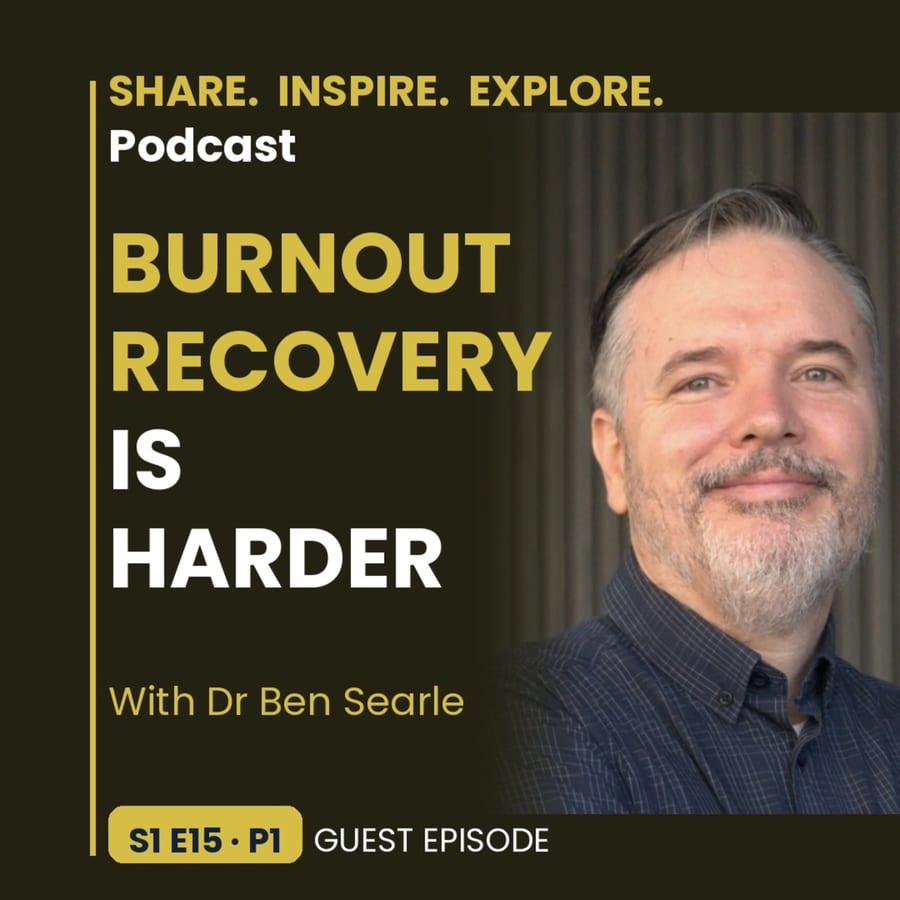
Obstacles of Burnout Recovery, Part 1 — Dr Ben Searle
Prefer to watch? This episode is on YouTube and the show is on Spotify.
About this episode
Burnout recovery is not as simple as taking time off. For a lot of people it feels harder than the burnout did.
Chris Wilson is joined by Dr Ben Searle, organisational psychologist, consultant and host of the Mind on the Job podcast, to work through why recovery stalls. This first part covers the obstacles that arrive early: circumstances that make real rest impossible regardless of intention, and the gaps in what people know about burnout, including people who work on it professionally.
They also get into guilt, and the way over responsibility quietly cancels out rest.
Why recovery can feel harder than the burnout that caused it The situational and knowledge obstacles that slow things down Why even specialists struggle to apply to themselves what they teach
Season 1, Episode 15
Connect with Dr Ben Searle: https://mindonthejob.com/ben-j-searle/ and https://www.linkedin.com/in/ben-searle-3a0a1b1/
Share. Inspire. Explore. is the podcast from Where I'm At, honest conversations on burnout, career change, and what comes next for working professionals.
Join the Where I'm At Community, free to join: https://community.whereimatcommunity.com/store/product/membership Website: https://www.whereimatcommunity.com
Where I'm At is based on lived experience, reflection, and educational support. It is not therapy, counselling, crisis support, or professional advice. Please consult a qualified professional for individual medical, psychological, legal, financial, employment, or specialist support where relevant.
Read the full transcript5,020 words
Automatically transcribed, so it may contain errors and does not identify who is speaking. It follows the conversation in order.
Welcome to the Share, Inspire and Explore podcast, the voice of the where I'm at burnout community. I'm Chris Wilson, and after my own journey through burnout and depression, I'm here to share real stories, inspire personal transformation, and explore the path from burnout to balance.
Each episode brings honest conversations with burnout survivors, mental health experts, and mindset coaches, offering lessons, strategies, and hope. Whether you're recovering, curious, or searching for motivation, this is your space to grow.
Let's dive into today's episode. Welcome back to the Share, Inspire and Explore podcast. I'm so glad you're here today because we're diving into a part of burnout that doesn't get talked about enough.
Recovery. Now you'd think recovery is straightforward. Rest, take a break, heal, and then come back. But the truth is, recovering from burnout is often way harder than it should be.
So why is that? What makes it such a struggle? And what can we do to make the process more supportive and effective? Joining me all the way from Australia is Dr. Ben Searle, an organizational psychologist who researches burnout recovery and resilience.
He's not here today as a medical doctor, but to share 20 years of insights from his work as a stress and burnout researcher until going through burnout himself. Since then, Ben has become passionate about burnout recovery and has spent a long time talking to others living through burnout.
He is himself a host of the Mind on the Job podcast, and he has recently written a book on evidence-based recovery advice. Today, Ben is going to walk us through the six most common obstacles people face in trying to recover from burnout and share practical ways to overcome them.
Hi, Ben. A warm welcome to the podcast. G'day, Chris. It is my pleasure to be here. With your expertise, I'm honoured to have you here today, so I'm really looking forward.
For our listeners, can you maybe expand a little bit more about yourself and your background? Yeah, sure. As you said, I am an organizational psychologist. So organizational psychologists are studying applications of psychology in the workplace. I was doing that primarily from an academic role. So I worked at a university, I was a teacher, I was a researcher, I studied stress and burnout in organizations, and I did that for 20 years. At the time when COVID emerged, I was also directing our team in organizational psychology.
And so when that happened, we faced massive changes across teaching, across research, across admin. I had to take on workload on behalf of peers who are unwell. I had a whole heap of students, undergraduate, postgraduate, they were calling me up about their own crises, their own things that were becoming difficult to manage in the midst of the pandemic. My own kids were at home rather than at school. And, you know, for various reasons, that was very difficult. A whole lot of things happened that were extremely difficult or very unpleasant. And that all took a huge toll on me, but also on many other people. Many people have experienced burnout in connection with that COVID pandemic.
Now, in my case, I realized I was burning out. But at the time, I couldn't see anything that I could do about it. I tried to keep going, but I could see that my mental and physical health were beginning to deteriorate. They were doing it very fast towards the end. And in early 2021, I decided that I had to leave. Since I left, I have been recuperating. I've been doing some independent consulting work with services such as helping organizations to assess and manage psychosocial hazards. But I've also been writing about burnout. And my first book, as you said, is about evidence-based ways that people can try to recover from the burnout experience.
Excellent. So before we begin, please note this podcast is for informational and educational purposes only. It does not replace medical, psychological, or legal advice. If you're struggling with burnout or related health issues, please consult a qualified professional.
So, Ben, can you start off by explaining why recovery is often so difficult in the first place? And if you're also okay with sharing maybe whether you found it difficult yourself recently?
Yeah, look, I will, because it was true. I did find it very difficult myself. That was a bit of a shock. I had taught about burnout for many years. I'd read a lot of research, and I'd even done some of my own survey-based studies on burnout. So I thought I was a bit of an expert in the area, and I didn't turn out to know quite as much about it as I thought.
One of the things I did know was that it wasn't going to be quick. There's this famous study that was done in 1997, Westman and Eden. That study measured burnout before, during, and after a three-week vacation. So these admin workers were three weeks before, three days before, in the middle of their vacation, three days after, and three weeks after, I think. They measured their burnout levels, and they noticed a couple of very interesting things.
They were interested to see whether there would be an anticipation effect, whether people start to feel better a little bit before they go away. So there's very slight indications, not really any indication that that is very effective. But the two more interesting things were, one, that while burnout went down during their vacation, it didn't disappear.
And the second one is, within three weeks of getting back to work, it was just as high. Their burnout was just as high as it had been before they left.
So, and that was for people who weren't severely burned out, that was just their levels of burnout didn't get eliminated by three weeks of vacation. So I knew three weeks of rest wouldn't be enough, and I anticipated that it would be several months of rehabilitation to recover.
So, you know, I paced myself. I didn't do too much. In fact, within a week of leaving my job, I managed to break my arm, so I had even more rest and recuperation than perhaps I anticipated.
I did a little bit of consulting work, but there wasn't really that much. I went to see a mental health professional. I said, I did all of the things that I thought would be appropriate things to do. Despite the fact that I had not held a job, I was doing a little bit of work, but mostly I was not working during those six months. I was noticing that when I looked at job postings, I was getting very stressed, very anxious, very emotional. I was getting stressed and anxious and emotional when I heard news about upcoming conferences that previously I would have gone to. I got stressed, anxious, emotional when I had to pass through the campus that I used to work
on. I got very frustrated, unusually frustrated when I got asked to do things that I didn't currently feel like doing. There was this possibility. There was a prolonged period of emotional disturbance that I was still recovering from.
When I sat down and tried to write about my experiences of burnout, I found I got really angry. And I got very stressed when I was in a situation where I had disagreements with people. And I sat down and had to think about this around six to nine months after I had left my job and thought, I'm not getting better.
This is pretty much a plateau that I've been on for months. My recovery had stalled and I started looking into not only what else I could be doing, which is sort of a large part of my book, but also why was my recovery stalling? What was the reason why, despite the rest, despite the break from work, I wasn't really getting better, which led me to sort of identifying these six obstacles that we'll talk about.
Excellent. If I can go back to what you just said about the anger. Was that part anger at yourself, given your background, but in your history? Or was it anger at some of maybe the triggers or a mixture of both? It was a mixture of both. The anger at myself was something that sort of emerged a little bit more later.
And so there was some discomfort early on. There was probably a lot of feelings of shame early on. But a lot of it, when I tried to get details down, it was, oh, these terrible organizational decisions or, oh, it was these things that happened that I wasn't able to manage at the time, or it was all these people who didn't treat me very well.
And it was difficult. I realized I was having difficulty letting that stuff go. One of the reasons why I was trying to write it down was to help me let that go.
And it was so uncomfortable to do that I took many goes at that. And it was well over a year before I was able to write that comfortably. Yeah, I can relate to that for sure.
It's like when you have, let's say, the base recovery, and then you have the energy to reflect and can go in this direction with the anger, as you mentioned, yeah.
Yeah. But I think we're covering some of the obstacles already. So shall we start? Yeah, let's jump into it. So the first one that I like to talk about is situational, the situational obstacles that we face. So there's a lot of things that we can have to deal with, things that are in the environment around us that make it harder for us to get to recovery.
And I'll break this one up. There's a few different kinds. They're all quite closely related. But the first one is being unable to take a break. So this is actually something I get asked about a lot. People say to me, oh, look, I'm burning out. All these people are burning out. And it's not feasible for them to take a break. What do we do?
And it's a very difficult question to answer because in a lot of cases, there are things you can do. But in a lot of cases, the break is at a minimum that's necessary.
As I said, three weeks of break aren't going to be enough to get the average person, not the most severely stressed person, but the average person is not going to make substantial inroads.
So a break isn't itself enough, but I do think that in a lot of cases, you don't need to be very burned out before it becomes being an important part of the approach to recovery.
So who asks me about this and what sort of circumstances? This is something that gets asked of me a lot from people in the United States. We know that the United States has poorer regulation of working conditions and employee resources.
And so it is possible in a lot of places in the United States for employers to say, no, you can't take a break for medical reasons. But even where regulations are pretty decent, it doesn't make it possible for everyone to feel like they can take an appropriate break if they're starting to burn out. There's a lot of informal expectations in organizations. There are situations when you can't risk, or at least you feel like you can't risk rocking the boat. So for example, if you're in part of a corporation, you're working towards partnership in a firm,
you know it's going to look bad if you say, oh, actually, I'm burning out and I need to take six weeks off. You know that's going to have an impact. And you know that you've made a big investment in that organization to try to get that particular goal. And I'm sure that people can take that and see how their own situation might fit there. There might be informal expectations on you that make it seem like it is not going to be possible for you to take a break. Now, on the surface, this is not something that I experienced because I did wind up leaving my job. I did therefore get to take a break.
Except that it wasn't actually all that different because the time that I needed to break was in 2020, it was within a few months of COVID starting and everything blowing up.
And I was starting to have breakdowns then. I was starting to know that things weren't right and I couldn't cope. And there was a period when I intended to take a break. And on the first day of the break, I got tapped on the shoulder and said, oh, we need you to do this thing.
And I wasn't able to take a break until the very end of that year, by which time, in many ways, I was a different person. So, you know, I put my notice in early in 2021 to say that I was going to leave, I was going to take a voluntary redundancy.
And I was told, okay, yes, your leave request has been approved and you finish up at the job in April, but then I got pressured to stay on from April until June.
So, in my case, if I had been able to take a break, I think things would have worked a lot better. But another side of this that we can look at is people with carer responsibilities. A lot of people who are in care roles, particularly if they are not in formally employed roles, if they're family care roles, those people don't get the opportunity for breaks. I know that, you know, my older child has a disability and, you know, we need to provide care. Now, he's a bit older and he's a little bit more independent, but he is still living with us and is very likely to be doing so long term and we never get a long break from those
carer responsibilities. So, people unable to take a break. In circumstances like that, it is important that you explore what options you do have. You have conversations, maybe you even investigate regulations. I probably could have pushed back a lot harder when I got tapped on the shoulder and told, no, we need you to do this.
And had I done so, I don't think there would have been, you know, a huge consequence. Even if I had demanded a really long break, even if it hadn't done my career that much good, I'd still have that career.
But the other side of this is, it's important to recognize, this isn't much fun to say, your situation can get worse. Your burnout can become more severe. Yeah. And it is worth sitting down and thinking, well, I'm being told that I can't take a break or I feel like there would be a negative outcome for me if I took a break, so I'll just stick at it.
This, this set of symptoms I have is, is kind of unpleasant. Sure. Maybe you're coping with it right now, but be aware it can get a lot worse. Yeah, you have to respect, respect it.
Yes, yes. You need to respect that and consider the alternatives. We're talking about the pressure that was put on you and setting boundaries for me, speaking from my experiences. It doesn't come naturally, but that's when you need those boundaries.
What was, what did you feel the pressure was that you couldn't say no? Was it a reference or your reputation? Maybe elaborate on that. Look, that is a great question. I think there were a couple of things that made me feel like I couldn't say no.
I knew that I had set up my email responder to say, nope, I'm on leave. And since I had received emails saying, we need you to come back and do this, that hadn't immediately been followed by, oh no, I'm sorry. I hadn't realized you were on leave. That seemed to be a pretty clear indicator that they knew that I was on leave and that was not something they were going to be considering.
But also I think I was, I think I had this idea of myself as someone who needed to be able to support my team. I needed to be able to ensure that everything was working. This particular case, we were, you know, someone was about to retire and we were in the process of selecting their replacement and I was being told, oh, actually, we need to move ahead with this pretty quickly. And I agreed.
I didn't really want to do it that week, but I thought, well, I do think this is a priority. And with all of the very difficult business going on with COVID, there isn't really a lot of other resources around. There aren't many people I can delegate things to.
Maybe I don't have an alternative. And I think that perception I had of myself as someone who had responsibility for all of the challenges of the team, all of the things that could go wrong if these actions weren't taken immediately, was an unhealthy way of seeing my role. A similar but related issue is being unable to actually leave a job.
So this is often a combination of factors. So you've got a financial situation that is a problem or you don't have many alternative job options or there are visa requirements or study requirements that are keeping you in the one spot. And yes, there is this risk hanging over you that we're going to go broke if I leave my job or if I quit. I'm not going to find another job, which becomes a bigger problem the older you get.
Or this is the job that I'm in. This is what I'm trained for. You have jobs like nursing or school teaching where that's the work you've done your training for. And if you walk away from that, all of the jobs are going to be pretty similar.
And unless there is one person who is just making that a really toxic environment, you might start to think, well, there isn't any point leaving. So in these cases, what I generally say is it is very easy to make assumptions instead of exploring alternatives if your current job's burning you out.
Yes, several years ago might have been a better time to think, gee, this isn't working right for me. Are there other ways that I can move forward with work? Are there alternative careers I can take on? But now is the second best time and be aware that six months, a year, two years down the track, it might be even harder.
Another thing I say with situational obstacles is lack of support. If you don't have support at work, if you don't have support at home, there can be a lot of stigma around burnout, around mental illness, around something called mental health gatekeeping, which is where if you were to say, I'm burned out, you know that someone else is going to say, well, you're burned out. You're not working hard enough to be burned out. Look at me. I'm doing this much more than you. You've got no right to come and tell me that you're burned out, which is a terrible thing for someone to be saying, but it can reflect.
It does happen. It does happen. And even if it isn't, if your perception of the team environment at work or if your perception of the family environment that you have to relate to people is that that's the way people are likely to respond to you. You are going to try and keep more of these things to yourself than perhaps is healthy.
So yes, it absolutely sucks if you don't have good support. But firstly, you don't necessarily know who is going to be supportive until you make the overture to reach out to someone. When I started talking about my situation with people, there were people who I didn't know very well who were tremendously supportive.
And yeah, there were people who I thought would be more supportive but weren't, and that was unpleasant. But you can try to reach out, and I strongly encourage, and Chris, this is something that will appeal to you, I strongly encourage you to reach out to communities of people who've been through a similar situation, other people who have gone through burnout. That is so important to being able to help you start to understand what is the situation you're dealing with, what are the things that you can maybe take action against.
Absolutely, yeah. Having some kind of support from people who have that understanding is going to be really valuable. And of course, there are always mental health professionals and other people who may be able to take your side.
But even if all of that is working well, even if you have an opportunity to take a break, even if you've taken a break and you think, actually, I don't think I can continue on with that work, but I think there might be other things that I could do. And even if you have good support, you can wind up in the situation where you think, okay, I'm taking a break.
All right, that was a nice break. Back to it. I'm going to take this new job with a positive attitude rather quicker than is very healthy. And that can be because of your assumptions. It can be because of work pressures or financial pressures or family pressures.
And I generally recommend that people get some good medical and mental health advice before they commit to some kind of return to work. Totally. This is a, it's a must as long as the resources around you support that. Yeah. There are obviously some, some challenges in that front, but it's so important.
And yeah, the peer support, don't you find when you talk to someone who has had burnout, I want you to mention that word. It's like, click, all of a sudden a stranger is telling you their most personal details. And it's because it's so relatable and that just opens the door to everything, right?
Yeah. Yeah, yeah, yeah. And you can do all kinds of, of personal development work and, and reassuring yourself and reading things that say, look, you don't need to feel ashamed about.
When someone else says, oh, I have had this experience of trying to, to write about my experiences and getting very emotional about that. That is, is very validating for you to say, oh, I kind of assumed that that would be a common thing, but knowing that this is a common experience helps you to feel this is something that a lot of people go through. It isn't just me.
And it is something that people can get past. So the second big obstacle is about knowledge, a widespread lack of understanding about burnout. What does it look like? Why does it happen? How bad can it get? And it's not just you, the listener, that may not understand it very well.
Lots of people don't. Your boss may not, your coworkers may not, your family may not, and that creates a whole lot of problems. And sometimes professionals who ought to know a bit more about it don't understand it very well either. There is a lack of good, publicly available information about what you can do about it.
For example, past a relatively early point, rest isn't going to fix burnout. It is difficult to make effective recovery without good help and guidance, and that can be difficult to find.
And there is difficulties around who can you talk to about this. There can be problems in the workplace where you think, I don't know who I can speak to about this without it causing problems for me. I don't know which individuals are going to be helpful and who is going to make my life hell because I've told them about this.
And it can be difficult to negotiate sort of mental health systems. You know, in Australia, I generally recommend seeing a psychologist, but the best person to see might vary a little bit depending on how your system works and how you negotiate through it to other people. So, that is all a big challenge for people who are starting to ask themselves, am I burning out? And I would add to that, I mean, a lot of advice that is generally available about burnout can be contradictory. It can be unhelpful.
So, for example, something that I see in a lot of discussion about burnout include really absurdly superficial advice like, oh, here are some simple ways to reduce day-to-day stress, look out the window, take some deep breaths.
Many of us are way past that by the time we've put burnout as a label onto what we're experiencing. And seeing that is very frustrating. It seems to be saying, oh, this is the solution to this much bigger problem that you have.
There is a conversation along the lines of, well, ultimately, burnout is a workplace problem and we need workplace solutions. We need workplace change to fix that. Now, I 100% agree with this, but it doesn't help me.
I got burned out and left my job. And those workplace changes, if they come, won't do me any good as I'm not in that workplace anymore. So, that sort of information can be quite frustrating to see.
And you do see some things around, oh, burnout can be due to perfectionism, Chris. Burnout can be due to workaholism. Burnout can be due to people-pleasing. Now, these are all characteristics that can increase your risk or can impact the severity of your burnout. But these are not behaviors that happen in a vacuum.
They're often encouraged by the culture of certain organizations or the attitudes of certain people in organizations. And saying things like that is very much a victim-blaming type of, well, you know, you're the wrong sort of person. You're doing the wrong things and that's why you're burned out, which isn't true at all. It is, there are vulnerabilities that are part of a very long list of vulnerabilities that aren't the reason why you burned out. They might just be the reason why it happened this year rather than next year.
And those things, in any case, aren't usually the most sensible places to start your recovery journey. So, in terms of trying to address this knowledge barrier, what I would suggest is that you try and prioritize understanding burnout as a condition. Do you have it, get some proper advice on whether this is the condition that you have and accept that burnout is a serious condition that you need to pay close attention to if it is.
Explore what options exist in the workplace. So, rather than try and understand all of the things that could be done about burnout, try to look very micro level at your job, in your situation.
What options do you have? Do you have access to some extended leave? Do you have the opportunity to ask for work accommodations? Who could give you some advice around those work accommodations before you formalize those sort of requests?
And start looking at what sort of actions could you maybe take to reduce some of the burdens that you're carrying. You can't try to digest all of the information that exists about burnout in one go.
So, try and take some small steps. It's obviously a great point to say that I have a whole book of advice about what burnout is, why it happens, and what you can do about it.
I'm still trying to get it published, but if you follow me, maybe I'll be able to give you some good news in the near future. Look forward to that, yeah. And you mentioned explore. It's one of the values.
See, share, inspire, explore. For me, it's too much change at once. It's overwhelming. And if I recall back, it was about those small experiments. Exploring, okay, try this. Did this work?
And then switch to the next. And before you're creating these new habits, before you know it, your confidence builds up again. You're starting to get to know yourself better.
And this is so important. And, you know, recovery is rarely solved by rest, as you mentioned. So it does require a combination of, you know, medical care, workplace adjustments and personal support.
And look forward to your book. We've uncovered two major recovery obstacles. Situational barriers and knowledge gaps. If these resonate, you're in powerful company. Share what's blocking your progress. Your story could spark someone else's upgrade.
Recovery is a bold recalibration, not a retreat. Stay tuned for part two as we take on the next challenges and unlock real momentum. That's it for today on the Share, Inspire and Explore podcast.
I hope something resonated with you. A moment of clarity, encouragement. But just a reminder that you're not alone. If you found this helpful, share it with someone who might need it. Hit follow or subscribe to join us for future episodes.
If you're new here, please check the link in the description to join the community. Burnout is tough, but it's also a chance to heal and rediscover what matters. Thanks for being a part of this journey. And until next time, take care. Keep exploring what's possible.
I'm Chris Wilson, and that's where I'm at.