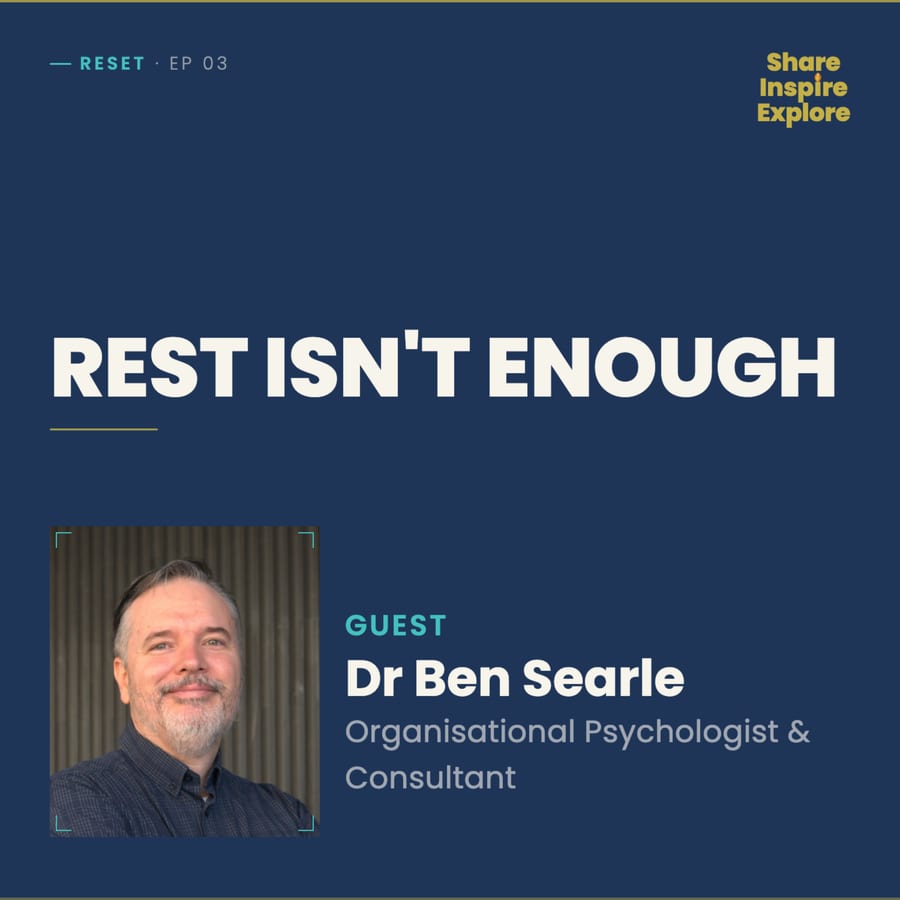
Rest Isn't Enough: Values, Strengths and Recovery — Dr Ben Searle
Prefer to watch? This episode is on YouTube and the show is on Spotify.
About this episode
Rest is necessary. For most people in burnout recovery it is also not enough on its own.
Organisational psychologist Dr Ben Searle explains what positive psychology adds to burnout recovery, and why reconnecting with your values and strengths is the part that actually brings you back. Ben spent twenty years researching burnout before going through it himself, which gives the conversation a particular honesty.
We get into why the first sign is usually a fading of good experiences rather than exhaustion, and how to tell a fear decision from a values decision when you are deciding whether to go back.
Why the earliest sign is positive experience draining away, not tiredness Using values and strengths to rebuild confidence after burnout Telling a fear decision from a values decision on the way back to work
Season 2, Episode 3
Connect with Dr Ben Searle: https://mindonthejob.com/ben-j-searle/ and https://www.linkedin.com/in/ben-searle-3a0a1b1/
Share. Inspire. Explore. is the podcast from Where I'm At, honest conversations on burnout, career change, and what comes next for working professionals.
Join the Where I'm At Community, free to join: https://community.whereimatcommunity.com/store/product/membership Website: https://www.whereimatcommunity.com
Where I'm At is based on lived experience, reflection, and educational support. It is not therapy, counselling, crisis support, or professional advice. Please consult a qualified professional for individual medical, psychological, legal, financial, employment, or specialist support where relevant.
Read the full transcript8,778 words
Automatically transcribed, so it may contain errors and does not identify who is speaking. It follows the conversation in order.
Welcome. This show is for people in the middle of something difficult. If you're navigating burnout, a career change, or rebuilding something that stopped working, you're listening to Share, Inspire, Explore. I'm Chris Wilson. I've been through it. And I built the Where I'm At community because I couldn't find the conversation I actually needed. Season two is guest-led. In each episode, I sit down with someone who's lived it or studied one of these phases. Recognize. Reset. Reinvent. Real conversations. Nothing packaged. Let's get into it.
Burnout can leave you feeling empty and disconnected. Like you've lost your sense of who you are, But what if the next step isn't just rest? What if it's rediscovering your values and strengths so you can rebuild with more alignment? Joining me once again is Dr. Ben Searle, an organizational psychologist who researches burnout recovery and resilience. He's not here today as a medical doctor, but to share 20 years of insights from his work as a stress and burnout researcher until going through burnout himself. Today, Ben is going to walk us through positive psychology and burnout recovery and how using your values and strengths support finding your way back. Hi, Ben. A warm welcome back to the podcast.
G'day, Chris. It's great to be back on. Glad to have you back. Can you tell our new listeners a bit more about you and your background? Sure. So, as you said, I'm an organizational psychologist. As you can probably hear from my voice, I am from Australia, from Sydney, Australia. I was an academic for 20 years, a teacher and researcher. I studied stress and burnout in organizations until I did go through burnout myself. And we discussed some of the particulars of that in the previous interview. Since I wound up leaving my academic role, I have been recuperating. I work in a consulting space, providing independent services, helping organizations to assess and manage things like psychosocial hazards in the workplace, the things that cause burnout. Writing about burnout, I've written a book
about evidence-based ways to recover. And I have my own podcast, Mind on the Job, where I talk about this and other broader issues in organizational psychology. I have a newsletter. I talk a lot about these sort of issues. Excellent. You're a busy man. Often.
Just to frame this, today, we're talking about the tools that can support burnout recovery and decision-making. They're not a substitute for therapy or medical care. So Ben, let's talk positive psychology basics. What is positive psychology in plain English? And how is it different from traditional approaches?
Sure thing, Chris. To understand positive psychology, you do need to know a bit of the history, the history of psychology. And for a long time, psychology was a largely, not entirely, but a large part of psychology. A big focus was mental illness, depression, anxiety, psychosis, and so on. And obviously, that is a useful and important thing to do, to understand people, be able to help people who are in need. But psychology is a much bigger field than that. It's bigger than mental health. It's the study of the human mind, how we think, how we learn, how we make decisions, how we perceive and experience the world around us. And positive psychology emerged from this sense that even within
that narrower domain of mental health, maybe our focus was too narrow. Maybe it was too focused on the negatives. And that by focusing on those negatives, we might be missing important things. So we might be missing positive emotions, like happiness or enthusiasm, and positive experiences, like flourishing and flow states, where things seem to be working and you're really engaged and focused and interested in what you're doing. Positive attitudes and beliefs, like optimism and self-esteem and self-confidence. Psychological needs, like autonomy, a feeling of being able to control the environment around you, or relatedness, a feeling of connection to other people.
And if we don't understand those positive experiences, if we're not factoring them into our theories, our concepts, it's very hard to shape our lives to experience more of those positive experiences. So, for example, professional work that I do often involves going into organisations and trying to identify the problems that make workers stressed. And that's important work. And, you know, in a lot of countries, not every country, but in a lot of countries, that's a responsibility that organisations need to meet. But even if we do a really good job of that, even if we can eliminate all of the problems, the absence of the worst problems doesn't necessarily create an environment that makes people enthusiastic about their work. That's what you can add with
positive psychology. When someone's experiencing burnout, what does positive psychology help with specifically? In the context of burnout, positive psychology can have an influence on a lot of aspects of the process.
Yes, it is true that burnout is associated with a bunch of negative experiences. There are a lot of symptoms that are very negative. There's exhaustion, there is detachment, disengagement from things and activities, disconnection from other people, cynicism. There's feelings of inefficacy, not being able to do things as well. There's negative emotions, there's cognitive challenges, there can be physical illness and physical limitations. And we can't ignore those things. Those are really important. We need to be able to support people through those negative experiences. But we can't just focus on the negative, partly because burnout is tied up with a lot of positive experiences. And without understanding the positive experiences and how to facilitate those, it's difficult not only to recover from burnout, but it's also
important in burnout prevention. So we need to think about a variety of ways that the positives of life can be injected into or considered in the approach we take to burnout. But where does it fit best? Is it early recovery or later on?
All the way through, all the way through, Chris. Positive psychology can play a role in terms of the causes of burnout. So sometimes what's contributing to a person's burnout is losing something that is important to positive aspects of our well-being. So maybe we were engaged in a project that was really meaningful to us, or maybe we used to have more time with our families and the nature of our job has changed, moved into a different job. And so we start losing things that are important for that positive side. So that can be part of why people burn out. Not so much necessarily the introduction of something negative, but the loss of positive. In early stages of burnout, some work I did in 2025 looked at early warning signs for burnout. And often some of the earliest warning signs are not the
emergence of negative experiences. There's a fading of positive experiences that tends to happen very early on. Loss of enthusiasm for things that you used to enjoy tends to be one of the things that people notice first. So that aspect of positive psychology is really important. And then when people start struggling with burnout, as they're starting to get really unwell, one of the things we try and do is pull back. We've got to drop things. We've got to put things away. And often the things that we have the most choice about what we're going to cut back on in our lives are the things that are really important and meaningful to us. So, oh, you know, I go and hang out with my friends. So, you know, I'm engaged in this hobby. Well, that's extra time. I don't need to be wasting on those things. I need to be sort of protecting my health and making sure I'm getting my job done.
And when we stop doing those things, we put ourselves at more risk. So, that's on the pre-burnout side. So, when people do become burned out, then there are a range of ways that we can use positive psychology. So, in the early stages of recovery, a lot of advice has you very reasonably focused on managing your symptoms, such as resting to reduce exhaustion. And that is absolutely critical.
Yeah, but by the time most people are burned out, recognizing that they're burned out, they are not going to get a solution from resting. They're not going to cure the burnout from resting. And if all they focus on is rest, that's going to get very frustrating. If all they focus on is the symptoms, the limitations, the losses that come with burnout, that has the potential to undermine recovery. It's setting yourself a health goal of, well, by the end of next month, I don't feel like this anymore. I don't feel bad anymore.
And that's, you know, that's an absence of something goal, which we know from a lot of research on motivation is not really very effective at motivating behavior because you don't know how to achieve less of something.
So, yes, you need to rest, but there's a lot to be gained in the early stages of recovery by treating yourself with things you enjoy. Spending time on books you enjoy, movies you enjoy.
If you're into computer gaming, it's one of the times when people can say to you, it's okay to do that. Re-engage with things that bring you that joy because reconnecting with those positive experiences is a really important part of the recovery process. So, it is important in early recovery. And then later, it's once you're starting to feel a little bit more yourself, you start to feel you have a little bit more energy. Positive psychology is an important part of setting yourself up for long-term success, reducing the risk of having relapses back into burnout. And that's where strengths and values become really important. That's excellent. I recall watching my favorite comedy shows from back in the 80s and 90s.
So, Ben, let's go to the values first. What are the signs someone's life or work is misaligned with their values? Well, to answer that, we need to understand what those values are. Your personal values are your beliefs about what's important to you, what's important in life, in work, in yourself. Is achievement important? Do you care what other people think of you? How much do you care about the environment? Do you want to be rich?
The things that you value influence the decisions you make, the tasks you prioritize, what you're willing to commit to spending time on, and how you feel about the way you've spent your time.
And so, when those things, the things that you do, are consistent with your values, you're likely to feel more engaged. You're likely to feel happier. You're likely to feel that life is more meaningful.
So, the better you understand your values, the easier it becomes to make decisions, to engage in actions that you feel good about. And yet, it is very easy to find that the pressures of work, the challenges of life, make it more difficult to live your life in accordance with your values.
You might get pressured into staying late at work when you want to be with your family. Your boss might want you to focus on speed when what you care about is the quality of your work.
That's where we start dealing with value misalignment. The great example that I usually use for value misalignment is the Pixar film The Incredibles. You have these superheroes who are forced to retire from superhero life. Bob the superhero is made to go and work in a health insurance office, and his whole job is about trying to prevent people from getting the support that they need. It is very clear that Bob is all about helping people.
That's all of that opening sequence with Bob is that he will not even do the things that are important to him because he wants to help other people. And so, it is crippling him that he is put in this position of not being able to help people, being forced to be unhelpful to people.
And that kind of experience is what happens when we are misaligned from our values. It feels really bad. The symptoms can vary between people. They aren't especially different from burnout that's driven by anything in any other causes. Many times we feel we have some awareness that something is wrong, that we're not doing quite what's important to us. But even that requires some awareness of our own values. So, it's important to understand what those values are.
So, how do values help someone in burnout recovery, especially if they feel numb and lost? Yeah, yeah. It's challenging. I think that exploring values can have a number of benefits to somebody who is in burnout recovery. Firstly, if only because it helps relieve some of that confusion that is going to come in when you burn out.
An understanding of values can help you to better understand why you've burned out if part of the reason was that you were Bob from The Incredibles, that you were going through this period of serious value misalignment. Because we often, many of us who go through burnout, have this confusion about why this happened to us, the shame that happened to us and not to everyone else. Why was that?
And it can be reduced. It can be made easier for us if an exploration of values can make us see, wait, you know, helping people was really important to me. Justice is really important to me. Maybe that's why I was so upset by that injustice that everyone else was able to shrug off.
So, understanding is part of it. But there are also things that you can do when you are, you know, when you're going through difficult periods, when it's hard to feel connected to life, to what's important.
A knowledge of your values can guide you towards choices about what is likely to make you feel better. Have you been focusing on something that isn't really that important to you? Are there things that you should be trying to prioritise? Are there things that never quite seem important to you at the time, but every week you think, damn it, I've failed to catch up with my friends again.
I have not spent time reading to my kids. I have done too much of this other thing. So, it can be useful to guide you. There are also some solid things you can do to make better use of your values. But for all of this, you need to know what your values are.
Absolutely. But, you know, however, when you're in burnout, you don't have much capacity for many things. Yeah. So, can you maybe discuss a simple way to start identifying these values that you speak about without it being overwhelming?
It can be really tricky to assess your own values. Now, some people have some really good insight into their values. And, you know, there are not many steps they need to take to have a better understanding. But, you know, before I blow you off and say, well, look, it's easy or it's just very hard. The reasons, there are a number of reasons why it's tricky. If you go looking online, you will find, you may have done this yourself, you find lists of values. Some of these things are hundreds of items long, Chris. Just picking your top half dozen of those could take you hours. And how do you do that? How do you compare these things?
It'll often seem like comparing apples with oranges. There are people, there are values that are very general. There are some that are very specific. Some of them are about social issues and some of them are about personal qualities or experiences. So, it's very difficult to compare them on their merits. And then some of them, particularly the broader ones, are a little bit difficult to interpret if you consider something like freedom. One of the things that you can value is freedom and flexibility and choice and being able to do what you want. And some people will say, oh, look, I really care about freedom. But when you try and dig a little deeper, many people will say there are some personal freedoms that they would fight very hard to protect.
But many people would also be quite comfortable surrendering some of their freedoms for a safer society. So, do we value freedom or not? Context is going to matter. So, that makes it quite tricky.
And then there's the issue that a lot of our gut responses can be misleading because there are things we're told are values that we should have. You grow up in the United States, you're constantly being told that freedom is important.
Many values are fed to us by society as things that are more important. I write in my book about how a lot of societies have this strong value of you need to be able to persist in the face of hardship, which is one of the things, one of the reasons why burnout can seem so very shameful.
So, when you start looking through a list of values, it can feel very uncomfortable to say things like, actually, I would like to have a high status position. That's something that I would value. Wealth would like to – something that I would like to put high up. That can be very uncomfortable for people to come to Crips with. And it's much easier to say, oh, no, I don't hold any stock in status or wealth.
And that is great if it is true. But if you genuinely value those things, it is not healthy. It's certainly not helpful to pretend that you don't. Just as it would be pointless to put protecting the environment at the top of your list of values, if you're doing that because you think that's the respectable thing to do, that's an honorable thing to have at the top of your list. So, in order to identify personal values, to do it effectively, you need to be able to look at patterns in your own behavior. And one of the reasons why I generally recommend people get mental health professionals to assist with this is that we can get so deep in the minutiae of our day-to-day lives.
It's hard to see those patterns. The exercises I have in the book, which are a bit complicated to describe without pictures, include questions about patterns. So, what are three to five things that you have worked extremely hard on in your life? And why do you think you worked so hard on those things? If that question can help you to see, what do you invest time and effort into, that's likely to point towards things that you value. But there is context there as well. Maybe that was something that you were told to do. Maybe you need to refine that question into what are some things that I've chosen to work very hard on. Another question, what are some of the biggest sacrifices you've made in your life?
Maybe you gave up a job. Maybe you moved to another place. Why did you make those sacrifices? What does that say about what you care about? Interesting. And another one, this is a dozen. Another one that I've pulled out here is, what are some of the things that other people do or have done? Maybe you've seen it in person. Maybe you've read about it in the news that really upset you. They really make you angry.
Because personal values aren't about philosophical debates about moral rightness and a perfectly functioning society. They're things about, what at your core do you really give a damn about? Otherwise, it wouldn't matter so much if you weren't following them. When people are, say, taking credit for other people's work, that drives me bananas.
That really gets me. And that says something about what I value. And so it's sitting with those emotions can also make you have that perspective, okay, this must be a value of mine. So it's listening to those signals, essentially.
That's it. And it's not about, there was one time I got angry about X. It's can you see a pattern there in the things that have made you angry?
Can you see a pattern in the things that have made you shocked or proud or excited? Those patterns of emotions, patterns of behaviors, that's where you start to see, oh, this is the person that I am.
This is sort of the core aspects of my being that are driving how I feel about the world. And once you get a sense of what those things are, you can start to say, oh, actually, I can ignore a lot of the superficial things that I was fussing over when making a decision.
You know, does it come down to, am I making the world a better place or not, for instance? And, you know, if I'm not, maybe I don't want to take this choice.
And just one more input from my side. When you're in burnout, for me, it was about recovery. But there was this burning desire to find out what happened, why, who am I? Who am I? It was the overriding thought that was going through my mind.
But if I look back, if I was to take, let's say, a values test at that point, I think the answers would be conditioned to the person I was pretending to be before that.
And so I think it's better to do this more later when the clouds have dispersed and you're more clear in your thoughts. And then you're ready for it. Do you agree with that?
Yeah, look, I do. I do. I mean, I think everyone's journey can be a little bit different. But there is that, there is that piece, there is that experience that I think is partly related to the grief process of bargaining and trying to understand what's going on. But I know for myself, for months, I was relitigating this argument in my head about what it was that had caused me to burn out. And so I kept coming to different conclusions. I kept coming to different assumptions about, you know, if I had done this, then maybe it wouldn't have happened. If I had done that, if I had recognized that this was important and prioritized this in my life.
And yet, I agree that there is a period where that is starting to get in the way. There's not a stable point from which, as I said, it is difficult at the best of times to be able to see these patterns in behavior. Working with mental health professionals can help you come out of the weeds and put you through that process.
Yeah, yeah, absolutely. And they can do things like challenging you about those values. Is this really about you, Chris? Or is this about the person that you were trying to be? The Chris that you were expecting to succeed in that role. That is, you know, that's an important thing to be able to ask yourself. And it can take time. It is not an easy question to answer. We are constantly being bombarded with messages from, you know, from the workplace, from society, the media we engage in. What's important?
What should a good person do? What should we be valuing in this life? And it's not that a lot of these things were being told are wrong. But there are, as you see, if you go looking online, there are hundreds of different things that people can value in life. And you need to be able to find the ones that are the most important to you.
Maybe we can move to strengths now. Sure. In what role do they play in rebuilding confidence after burnout? When we talk about strengths, we are talking not just about the skills you're good at. We're talking about positive personal qualities that shape our sense of who we are. The VIA Institute people talk about these as character strengths. So they're big picture things that are at a higher level than skills. They're things like curiosity and creativity and compassion rather than being able to draw a life like Kat.
If I could just interrupt you based on curiosity, can you tell the listeners and audience what the VIA Institute is? So the VIA Institute, they are a group of character strengths researchers and practitioners and they are the people who are, they develop this model of strengths and they've sort of set about assessing people's strengths, finding ways to assess people's strengths in a valid manner and conduct tests on what is good for building those strengths.
Makes people feel good about the strengths that they have. How do you integrate strengths more effectively into your life? How do you build up things that are not amongst your top strengths if you need to be able to use them?
So, you know, they write a bunch of books and they have a whole bunch of resources that you can buy and, you know, people who can tutor you on some of those things at a cost. But they also have an online strength assessment tool that is free for, you know, a very limited set of feedback about your strengths. And that's worth doing. It doesn't take very long to do. I can't remember exactly how long, but it's a useful tool for getting a sense of what are some of the areas I feel like I'm strong in.
So, when we're burned out, it is very easy and very common to dwell on what's wrong, to dwell on our symptoms, our limitations, things that we're finding harder to do now that we have burned out, to focus on our problems. Oh, I've left my job. I don't have a job. I don't have a feeling of identity. I've got money problems now. A feeling that we've failed.
And as we talked about before, it is not true that you have failed, that you are a failure. That is a very common and very misleading experience in burnout.
But these are negative experiences, are things that are likely to require some attention, some support, some work even. But if we just focus on our limitations, if we just focus on the aspects of our life that aren't working very well, if we're just trying to engage in activities that are trying to fix the things that are most difficult at the moment, that is very draining. That's going to drain a lot of energy, a lot of motivation.
It's very hard to push ourselves to do those things, especially in early stage recovery. Those are resources that are very scarce. Developing our character strengths is a very different proposition because when we spend times on things that we feel capable of, things that we feel are our core strengths, that tends to make us feel more engaged, more enthusiastic, more confident, almost the very things that burnout starts undermining early on.
Confidence is a really big one there because when we discussed obstacles to recovery, people who've burned out tend to be unwilling to engage in difficult activities because one of the things that burnout has done has made us feel like we can't accomplish things. We're not going to be able to handle stress.
Applying your strengths is so much easier there because it is something that doesn't feel as hard. It doesn't feel as unpleasant. It requires less of that self-regulation energy, the thing that we do to keep ourselves focused on a task that we hate.
So, it's not as difficult to get going and the benefits from it are likely to come a lot quicker. And that's really useful because getting some wins, seeing yourself do something capably, competently, is really very positive, really very effective early on in that recovery process. Once you see yourself succeeding, it gets harder to maintain that very negative internal narrative that you can't do things.
Absolutely. But, I mean, do strengths ever become a trap, like overusing them? Oh, for sure. Yeah, yeah. I mean, especially in situations where other capabilities are more important. But let's think about the context here. We're talking about people who have burned out, people recovering from burnout.
Our priority isn't becoming well-rounded individuals right now. That's a great thing to aspire towards well in the future. Right now, during recovery, our priority is getting better. And utilizing your strengths is very useful for that.
So, I wouldn't be encouraging people to only ever spend time on their strengths. If what we're talking about is lifelong success strategies, if I was talking to a bunch of high school kids, I would certainly say invest time in your strengths. But at that age, they're still finding themselves and learning what strengths they have.
When someone has gone through burnout, investing time in strengths is a very positive way to build up some recovery. And some of the ways that we can use our strengths involve developing those strengths, extending them or applying them in new ways or in new situations. That's a bunch of things that you're going to find in one of those VIA books.
And so, even if you're only using one or two signature strengths, if you're applying them by trying to learn about how to use those skills differently, how to apply them in different situations, that is a broadening experience. That is going to broaden what you can do.
And it certainly beats beating your head against a brick wall of activities you find too hard or just sitting on the sofa telling yourself you can't do anything. Absolutely. You can really play on your strengths. I guess it has this compounding effect to be able to tackle the next, let's say, hole in the bucket.
Yeah, yeah, yeah. Look, I always say that, you know, it is like a diet. You can't just do one thing and expect that to take you through to recovery. You've got to try a number of things and vary it and mix it up. But yeah, I would say early on, spending some time working on your strengths is a fairly good bet. I'm going to do this test with my kids now. I don't want them to make the mistakes because this is, it's a pity it's not in the schools, right? Because when you go to the career guidance, they say, what do you like doing? I like playing football. Do you want to be a footballer?
No. Okay. What else do you like doing? Playing games. And that single statement made me go into do computing science. Yeah. I think it's going to add more depth and more exploration. They did use it. They did actually do that at one of my kids' schools. And my kid brought it home and showed me their results. I was, you know, I'm just one person. I'm standing here observing. I'm not sure that has captured you. And I think this is the thing that I'm, I'm not confident that those tools work as well for adolescents just because that is a period of, of exploration, discovery. And, you know, there are 13, 14, 15 year olds who don't yet know they have amazing leadership
skills because they've not really had that opportunity. There might be kids who have, um, uh, immense potential for compassion and haven't been put in a situation where they, they need to show a lot of that. So I think life experience is an important part of it as well, but I would hope, and some of the, some of the data here are really very worrying, but I would hope that not too many underage are going through burnout, but we are seeing it at younger and younger ages. Unfortunately.
Just as a disclaimer, we refer to the framework from the VIA Institute on character, no affiliation or endorsement is implied. So let's discuss practical applications, but make this actionable. Um, so if somebody wants to start today, what's a simple values exercise they can try and let's say 10 minutes.
Pick a value. Why is it important? This is, you know, this is one of the simplest and easiest, uh, exercises in my book. There's some very good research around it. It's called value affirmation. Having identified something that you think is an important value to you, if you take 10 minutes to write about, or better yet, if you spend 10 minutes telling someone else about what aspects of that value are important to you and why are there points in your life where that value has been especially important or it's influenced decisions that you've made and you're pleased with that. That tends to have quite a, a big impact on people. Reminds you why that is, is something that you care about, why decisions that you've made that were
consistent with that value were good things to have done. And, and people experience a lot of mood and, and other positive experiences from doing that. And they do find that it tends to help them apply more meaning to their lives. That's great. Um, interesting.
This is a, this next question is, uh, it's a big, big question because returning to work, changing roles, changing careers, it's a minefield. It's overwhelming for anyone in a, in a level state.
How do values and strengths support decisions like returning to work, changing roles or careers? Yeah, there are very important things to be considering in that process because having burned out once, you don't want that to happen again. It is, it is an increased risk. So for everyone going through burnout recovery, especially if, if value misalignment played a role in your last burnout, and that's, it's quite common.
It's important to find a way of working, maybe even a way of living that is better aligned with your values. So I go through a bunch of activities around this in my book. They, if I could boil it down to a few questions, they're things like, what did you find most stressful or frustrating about the work you were doing? What kinds of work really engaged you?
What sort of projects did you work on or achievements did you reach that you were most proud of? Because we're trying here not just to understand our values, we're not just trying to understand the areas of work that may have been playing to your strengths or may have been failing to because ideally what you want to be able to do is go back to the same role and modify it or negotiate the role or find yourself a different job that is going to have better alignment, better alignment with your strengths. So you're spending more and more alignment with your values so you feel that it's meaningful, so you feel that it's meaningful, you feel that it's important, it's worthwhile.
So for example, if you regularly got frustrated by the administration and the rules and the protocols in your past job, everyone has to go through those things. Nobody loves them. But if they really made steam come out of your ears, you might be someone who really values independence and freedom and flexibility. So even if you don't decide to pursue working for yourself, you might need to look for a job and a work environment that better supports those sort of work values. Something that really enraged you might have interfered, have clashed with one of your values.
Something that you really enjoyed doing might have tapped into one of your strengths. So maybe you wound up in a role that didn't really fit your values or didn't let you use your strengths often enough.
So is there a job you could get that would help you to use your strengths more often? Ultimately, it's a process of understanding yourself and bringing yourself into better alignment with how you're spending your time, which has a lot of benefit for long-term well-being.
I'm just thinking, you know, as you're working with organizations, how do they filter out? Do they come up with lines of questioning and interview process to establish values of a person? How do they promote the people? Because as we all know, people are promoted into positions they shouldn't be.
That has obviously other circumstances contributing to burnout. Do you have any experience? Obviously, you have experience. Can you maybe share some light on that? Look, some of the organizations that I have knowledge of use some of these strengths and values in their assessment processes and their internal development. And as part of their strategic development work, it is not very common. And even where it is assessed, it isn't always used. It isn't always applied very well. It does have potential, though. It is something that organizations could reasonably do to say, oh, well, we want to start preparing. And we want to start preparing Chris for the next level up. But looking at Chris's strengths and values, the most obvious position to promote you to, is probably not going to use your strengths very well.
It's probably not going to be well aligned with your values. We need to look somewhere a little bit different. So there are plenty of organizations that don't even take the first step of saying, does the person have the skills for the next level up?
So if we go back to returning to that same environment, what kind of questions should someone ask themselves before returning? Another good question, I do cover this in my book as well. To narrow it down, one of those key questions is, am I ready to return to work? Am I physically and mentally healthy enough to be able to cope with it? And that's a whole other set of complex questions around, do I have enough energy? Do I feel like I can concentrate?
There are questions about what preparation you can do for returning to work. Are you able to spend approximately seven or eight hours doing the same sort of things you were doing in the workplace? Are you comfortable with interacting with people in the workplace again?
Are there accommodations or supports that you could request that would address any limitations you still have? One of the common ones that, in cases of burnout, can be very effective is a gradual return, where instead of going, okay, your medical leave is up, you're coming back to five days a week, eight hours a day, let's see the same level of performance as before. Instead, you bring people back a few days a week. You may not expect them to work eight hours a day. You may not give them the same level of responsibilities. And then, you know, as they demonstrate that they are coping with what they have you extended, that is much less likely to produce relapse in the same way that any other injury.
You would not leap straight, you broke your leg, you wouldn't take the cast off after four weeks and try and do a marathon. You'd need to consider these sort of accommodations to support people to getting back to work. But in terms of thinking about strengths and values, what you might need to ask yourself is questions like, what aspects of this work environment contributed the most to my burnout? Yes, there might be things that you personally can do to reduce your risk of burning out again, although in many cases, that's not really the individual's responsibility. But if there are, you know, if your assessment, when you've taken some time, you've sat down, you've looked at what was it that really made me stressed in the workplace?
What was it that was really felt wrong? What felt like it was not aligned with who I am, misaligned with my values? What aspects of the role aren't really where my strengths are? What other problems are going on in the workplace? What other psychosocial risk factors are there? How much of that is likely to change?
And, you know, that's a question worth asking. If you can't ask it of your boss, if you can ask it of your co-workers, if you can sort of explore some of these options, because you don't want the good work that you have done on recovery to go to waste. If you're going back into an environment that has all of the same stressors, all of the same contributing factors, it is very likely that you will experience some level of burnout again if things don't improve. Yeah, I thought that aligns with my experience.
Sometimes if we talk the values, I mean, we talk about the fear talking and the values talking, how can someone tell the difference? Yeah, no, it is important because when we're asking this question, when we start saying, oh, look, is that really going to change about work? Should I not really take the risk of going back to work?
It is true that there can be a lot of fear surrounding return to work. And that, you know, that's true if there has been a construction accident and someone might be thinking, oh, well, you know, what if someone drops a load of bricks on me again? In the case of burnout, it is a much more, it's quite a different set of fears because burnout is linked with complex trauma. Because both burnout and complex trauma involve prolonged exposure to mistreatment.
So it's quite natural that your brain is associating work with stress and to feel anxious in response to that. There's a temptation to tell yourself that it's a problem place. And maybe when we start talking about values and strengths, that's just giving you a language to do that when a big part of the problem could be that you've come to associate the workplace or worse still, just the work itself with threat, with danger.
I would say that's one of the reasons why having a fairly good understanding of your values is useful because that can help you narrow down. Okay, well, these are the things that matter the most to me.
That may not be reflecting in what the actual problems are here in the workplace. It may not be about my values. Maybe some of my fears are not about value misalignment. Maybe they're not about more systemic problems, although usually they would be.
I mean, this is where preparation can be useful. One of the things that I did for a couple of years after I left my job at the university, I felt very uncomfortable going back to campus, even though one of my kids sees a health professional there and I have access to the library.
Going there made me feel nervous. You know, I was telling myself I was worried that I would run into one of my former colleagues and, you know, it would be embarrassing. And forcing myself to go there and walk around and even attend some events there, it was not pleasant at first, but it did make a difference. Meeting up with some of the people I used to work with helped even more. There is an element to which gradually re-exposing yourself to some of those things can help you to draw a distinction between systemic problems, including value misalignment on the one hand. And you've been through some very unpleasant experiences and maybe the threat centers of your brain are hyping that up more than they need to.
But as with so many things, this is a great thing to talk to a mental health professional about. Couldn't agree more. But if we talk now about strengths, how might they help inform boundaries like workload, communication and your availability? Look, I mean, I guess the first thing I'd say is that it's worth understanding that we aren't robots. So if you're looking for new work or negotiating conditions for returning to work, it's important to be aware that your capacity to do work is going to vary depending on the nature of what you're doing. Strengths is useful for thinking about that. If you're working on a task that utilizes your strengths, you can probably do complex work, focused work for longer because you're not putting as much energy into forcing yourself to do the work.
When we're working on weaker areas, when we're working on things we're not as comfortable with, a smaller task might feel a lot more draining, especially those of us who are of the neurodiverse persuasion.
And if we're recovering from burnout, there is even a risk with the time we spend in our areas of strength because it can be so tempting if we get back into a rhythm with work. And we're doing things that we feel confident with, it can be tempting to stay in the zone and push ourselves to work longer hours.
And finally, we're feeling engaged and capable and useful and we're demonstrating that we're still very good at our job. But if you push yourself too hard, it can be really bad. It can be worse than just one bad evening or being tired the next day. It can trigger other kinds of burnout relapse.
So you do have to be disciplined. You have to give yourself work-free periods even when you're doing something that you're feeling enthusiastic about. Yeah. Just another word of precaution. There are free strength surveys online, including the VIA Institute. If people do use online tools, it's worth checking privacy policies before submitting personal data.
So I have a prop for the next question. Ooh, love a prop. Good vibes only. Ah! I want to address the good vibes only concern. Where can positive psychology backfire?
Like forcing gratitude when someone actually needs rest or clinical support? Yeah. So there can be some very toxic elements in the general positivity movement. And it can present in a range of different ways. It can be people who are very unwilling to talk to or about negative topics, depression, anxiety. People who don't want to engage with that, don't want to engage with people who are experiencing negative experiences. And that is a very excluding and ableist kind of perspective to take. But toxic positivity can have even more extreme levels. If you're refusing to acknowledge the reality of negative experiences, if you're insisting that all problems can be solved with positive thinking or positive self-talk, that is starting to detach from an understanding of the complexity of mental health.
And you start to see people going further and further into nonsense, like all medications are harmful and everything can be cured with exercise and sunlight and positive affirmations, which is only a step away from all maladies, including diseases, are caused by having negative attitudes.
And there are people out there who genuinely believe these things and, you know, some of them have very well-followed Instagram accounts. So, yeah, I hope that your listeners understand that those are nonsense and very unhealthy beliefs. And, frankly, they're kind of insulting to the origins of positive psychology, which kind of boil down to, hey, look, here are some aspects of life that we haven't looked at as much that we could maybe look at more closely and get something out of, rather than, oh, everything that isn't positive is false and meaningless and we should ignore it and turn away from it.
But, yeah, it's important to sit with the emotion, whatever that is, as well, you know. It is not a flaw of your brain that you sometimes feel sad. It is not a flaw that you sometimes feel anxious. It is not a flaw that you sometimes feel frustrated. Those things have meanings. They are, again, we're not robots. This is part of the way that our brains work.
If you're constantly pushing those away to try and experience positive experiences, then what you're doing is prolonging the way that those negative experiences are impacting you because you're not giving your body and your brain the chance to process them.
It can be difficult to know whether this is a moment in your life where you should be working on a recovery activity that diminishes negative experiences or one that is enhancing positive experiences. At different times, you might need different things. Sometimes it can be helpful to work on two or three different things in the course of a day. It is not healthy to tell yourself that everything must be positive.
That's not how human beings work. Again, a mental health professional might be better able to walk you through this, how you can sit with your emotions effectively. They might be better able to gauge what sort of things are more likely to help you at any given time. Even in my book, I say, look, not all of these things are going to work for you at any time. Some might be unhelpful right now.
In a year's time, they might be just what you need. Ultimately, you have to experiment. Yeah. It's the reframing negative beliefs. It helped me with the positive affirmations, to be honest.
But I was, this was part of my ecosystem. It was medical, professional support. I wasn't just doing that alone. Admittedly, that would be a bit dangerous. But you are the professional. And yeah, thanks for, thanks for your insights.
Yeah, yeah. Look, I think... As you said, it can help. But maybe at the right time or... There's a time when it is very helpful to be surrounded by people who are talking things up. There's a time when you need to be able to sit with someone who is not too uncomfortable with you breaking down into tears. Good vibes only is not really a healthy place to try to live.
Another disclaimer. If today's topic brought up anything for you, consider speaking with a licensed clinician or trusted mental health professional. Positive psychology practices are a compliment not to replace professional care.
And if you're in immediate distress or thinking about harming yourself, please contact local emergency services or your country's crisis line right away. Thank you so much, Ben. Really, this episode has given us so much to reflect on.
Do you maybe have a closing message to our listeners or viewers? Yeah. I mean, on the surface, values and strengths seem quite different. Values seem more about guidance. Strengths more about what you're doing. But there's quite a lot of overlap between them. The principle is the same. It is useful to understand yourself and try to align what you do with who you are. Thank you. Thank you. Very strong end to today's episode.
Thank you. As I said, great having you on again. And for joining me today. Really enjoyed it. As an expert. Again. Thank you, Chris. It was a pleasure. Once again. And I'll put a link in the description for our listeners. How They Can Catch Your Mind on the Job podcast or discover your products and services. Thank you.
You're welcome. And to you, the audience, I have a question for you. What's one value you've realized you've been sacrificing? And what boundary could protect it? And if you want support doing this with others who get it, the link to the Where I'm At community is in the description.
Thanks for listening. And until next time, take care. Thanks for being here for this one. If something in this conversation has stuck with you, share it. That's genuinely how this reaches people who need it.
The Where I'm At community is in the description of today's conversation hit home. Everything else is in there too. Guest links, where to follow the show. I'll see you in the next one.
I'll see you in the next one.