
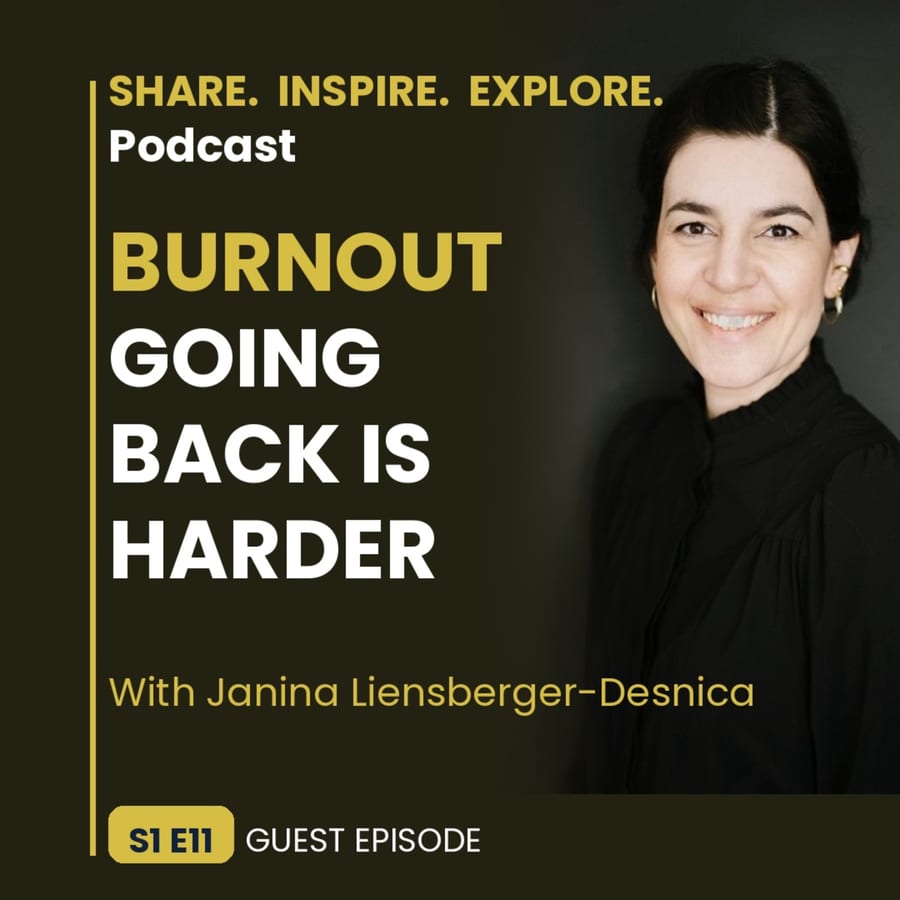
Returning to Work After Burnout — Janina Liensberger-Desnica
Prefer to watch? This episode is on YouTube and the show is on Spotify.
About this episode
Returning to work after burnout is often harder than the burnout was.
Chris Wilson is joined by Janina Liensberger-Desnica, a strategic HR consultant working in organisational development, to talk about what happens once the sick note runs out. The self doubt. The guilt. The expectations nobody states but everybody holds, on both sides.
They also talk about the physical side of recovery and what Chris has been exploring about his own, and about what it means to rebuild a sense of who you are at work when the old version is what broke.
Why going back can feel like a second mountain rather than the finish line How shame and guilt show up during reintegration, and who they protect What genuine return to work support looks like, beyond a phased plan
Season 1, Episode 11
Connect with Janina Liensberger-Desnica on LinkedIn.
Share. Inspire. Explore. is the podcast from Where I'm At, honest conversations on burnout, career change, and what comes next for working professionals.
Join the Where I'm At Community, free to join: https://community.whereimatcommunity.com/store/product/membership Website: https://www.whereimatcommunity.com
Where I'm At is based on lived experience, reflection, and educational support. It is not therapy, counselling, crisis support, or professional advice. Please consult a qualified professional for individual medical, psychological, legal, financial, employment, or specialist support where relevant.
Read the full transcript4,401 words
Automatically transcribed, so it may contain errors and does not identify who is speaking. It follows the conversation in order.
Oh, welcome to the Share, Inspire and Explore podcast, the voice of the where I'm at burnout community. I'm Chris Wilson. And after my own journey through burnout and depression, I'm here to share real stories, inspire personal transformation and explore the path from burnout to balance. Each episode brings honest conversations with burnout survivors, mental health experts and mindset coaches offering lessons, strategies and hope. Whether you're recovering, curious or searching for motivation, this is your space to grow. Let's dive into today's episode.
Welcome back to the Share, Inspire and Explore podcast. I'm Chris Wilson. And today we begin a powerful two part series and what it really means to return to work after burnout. Today's guest is Janina Liensberger-Desnica, a strategic HR consultant coach and expert in organizational development. With deep roots in the tech and the pharma industry, she helps leaders and HR teams create meaningful, lasting change.
Janina combines intuition with structure to foster trust, participation and clarity in teams and organizations. She believes that every person wants to be seen and that workplaces should reflect this truth. Welcome to the podcast, Janina. Thank you, Chris. Can you tell us a bit about you first and your experience supporting employee reintegration after burnout? Sure, I can say it's a common topic. Yeah, often people think burnout, it does not happen often, but people who work in HR see it regularly in companies. And what I can say is it's a highly individual topic, not only for an employee, but also for a company and that a well-structured plan how to return to work pays off.
Before we begin, please note, this episode is for information purposes only. It does not replace medical, therapeutic or legal advice. If you're navigating a return to work after burnout,
please consult with a qualified professional or healthcare provider. From your perspective, what are some of the biggest emotional hurdles employees face when coming back after burnout? I think it's often the fear of being stigmatized, of being seen as weaker than before.
And on the other hand, it's also who can I trust with this topic in the company? Is it my manager? If it's not my manager, who is the person I can talk to? I think those two things are the biggest hurdles. And your experience, do people often feel pressured to return before they're ready? I know I was. Have you had an experience on this side?
In my last company, it was the opposite. So it was a very human approach. Let's put it like this. There was no pressure. If the company sends signals that it's okay to take your time, then the employee can really take his or her time to think about this. And also with a therapist or a doctor. And I think that's really important that if you have burnout and you're planning to get back to work, discuss this with your doctor or your therapist.
And if the company does not send any signals, then it's really important to have an honest conversation with your company, because it's no good for all the parties involved if you feel pressured to come back to work.
I mean, I don't see that the employer puts that pressure. For me, it was the pressure I put on myself actually returned to work. It's like you said, I don't want to appear weaker.
I just wanted to get back to normal and be seen as normal. Yeah, it's a bit of a struggle. But as you said, it's something you need to work with the professional support structure that is available to you outside. But going, you know, going back to the work, there's also the fears of the relapse. Still have that fear on a day to day basis, you know, at the moment. How long have you been back at work? Just over three months. And this is the second return after a period of time off. So yeah, that fear of relapse. But for me, it gives me confidence. I now have the awareness that I spot the signs.
But is this something you commonly see or have seen in the past? Of course. And as you speak from your own experience, it's really important to learn to spot the signs to learn, okay, when do I reach a certain point where I really have to be careful and take care of my energy and talk to my manager, communicate to my manager or communicate to my family? Yeah, that I'm reaching a certain point again. And that's learning. So the fear of relapse is very natural in my eyes, because it's been a really tough mental, but often not only a mental, but also a physical experience. And so this fear is, in my experience, what I know about it is also rooted in your body. So you really have to be careful and accept the fear of relapse as a part of your journey, especially when you return back to work.
And do it step by step by step. And I said, as I said, in the beginning, do it in a well structured way. Yeah. This is key, in my opinion. Yeah, it's important. As you said, the family structure as well. There have been times where I've been given a gentle nudge in the direction of, be careful, be careful. They're spotting some similar old patterns creeping back in. And it's great to have that. And, you know, in the past, the reaction would have been very defensive. But now I'm, I'm so grateful. And, you know, I take that as, okay, thank you. And I, I reply with gratitude and I take it on board. And this is, this is really important because you need, you need, when you get into the autopilot and, and the deliver, deliver. And if that's, for me, I was that person and still am, you know, I'm driving this, driving this community.
But I also have to watch out. Yeah. And it's important to have that support network to, you know, to raise the little, little red flag. It's not a big one at that point. But of course, you know, returning to work, it's like, well, if I'm, I'm not, and I can say I'm not the same person I was before. That's definitely, definitely true. I have the capabilities to be the person I was before, but I don't, I choose not to.
And then comes the point that the imposter syndrome. Am I good enough to be in here? If I'm in my new word, Chris 2.0, am I good enough to be here? You know, how does that show up in your experience during this reintegration process?
The fear of being good enough, again, is something that does not vanish within half a year. Yeah. I think it's something each person has to work on for years. That's the bad news. But the good news is that it's really about how willing you are to, again, and I might repeat this phrase many times today, again, to accept this part of you, that you have this fear of not being good enough. And also give yourself time when you come back to work, yeah, because this is maybe the first couple of months being back at work are not that tough, because everybody is aware of your situation.
But then comes a time when people forget about your situation, yeah, and it's, again, daily routine, and nobody's really talking about it anymore. And I think that's when many people really get tested about this fear, if they are feeling good enough. And what I observed is take it one day at a time, right? And it won't change from within 24 hours. It changes over a longer period of time. So that's what I observed. Take one day at a time and reach out to your community.
That's great. So how can HR or managers ease that emotional load during those, you know, early weeks? Be open, be appreciative, choose communication to this person wisely, be encouraging. I think that's the word, maybe not appreciative, but encouraging. So in my last job as an HR business partner and now as an HR consultant, I would recommend for every manager, organize regular check-ins, minimum for the first six months, if not for the first 12 months. And in the beginning, really do it, like weekly for half an hour, yeah, this on one time is really precious, especially for the employee to just check in. I mean, I recommend this to managers in general, if they are leading a team to have this regular dialogue in a one-on-one setting.
And especially in the case of somebody returning from a burnout, this is a space that has to be organized by the manager and HR can steer this process, yeah.
Recommend this, what I just said to the manager, steer the process. Maybe take part once a month in these check-ins or have their own check-in with the employee, with this employee once a month. So I think keeping the dialogue open is key and support with a plan, what's going to happen in the next six to 12 months.
And I know in Austria, there are some rules and regulations, what you can and cannot discuss with the employee, especially maybe on the topic of burnout. I learned that from previous episodes with Martina Teufner. In terms of those boundaries, how do you see those check-ins?
I mean, it would be great to do emotional check-ins, not just talk about the task lists, right? But how is it possible to approach that with the given rules, so to say, and the playbook?
You mean the emotional check-in, how to approach this, yeah. That's a good point because you have to give the employee the psychological safety to open up to you as a manager so that you are able to do your job as a leader. Yeah, and that's where you have to build trust in this relationship.
Otherwise, the employee won't be transparent enough because, as you said, there are regulations, there are questions that you should not ask as a manager. And, yeah, so I think you have to work on the relationship and build, yeah, psychological safety. Otherwise, the employee won't talk about emotions, yeah. But, you know, when I returned to work, I wanted to be open about it, you know, because I didn't want to be, I didn't want that feeling that I was getting special treatment or I was,
because I have some negative experiences about that, very isolating experiences. And so, yeah, for me, it's important to be able to open up. But with the rules on one side that you can't approach the employee and here, I want to talk about it, but I don't know how to approach it. There's this gap, and I think we talked about it in a previous meeting, right?
Maybe we'll cover that in another episode. We talk about reintegration planning and structure. What steps should be in place before an employee returns to work? So, I made really good experiences with coming up with a reintegration plan for an employee returning to work.
Again, as a company, you have to, you are officially not allowed to reach out to somebody who is on sick leave, yeah. So, it's best that the employee is proactively reaching out if he or she knows, okay, I'm returning 1st of September, and now it's June.
Maybe it's wise to reach out to my manager and HR at the company where I work, because if all parties involved work together on this plan, what will happen beginning 1st of September when the employee returns to work, and talk openly about expectations, I think that's really, really key. Who is expecting what and on what timeline.
It's the opposite of how I say in English, set up to fail, it's set up for success, because it gives also the employee security, I know what's going to happen. But for this, again, I really recommend if you yourself are in this situation and you want to come back, then reach out before day 1. Otherwise, making a plan is difficult.
Yeah, it's rushed and maybe misaligned. Of course. Yeah, correct. It's not like someone's waiting to create the plan. There are busy work schedules on the side. That's a good point. There is no automated process behind, not at all. Can you tell us more about part-time reintegration and how that helps create this softer landing?
Sure, that's something that is available in Austria to employees who have been through a burnout and on longer sick leave because of that. And basically, it's a tool from the government that if you worked full-time before your burnout, you can come back. For example, again, 1st of September, you can start with part-time hours. Yeah, so for example, 20-25 hours a week. And you will get the salary for, of course, 20-25 hours. But you will also get a bit of a compensation from the government if you decide to use this. So, you won't get compensated the 100% full-time you earned before, but there is some amount of compensation at least. And it's there to help employees have a softer landing and not lose all of their salary at least.
So, it's something positive for people returning soft landing, so to say. That's important, yeah, because it, at least for me, even with all of the support here in Austria, it was expensive to be sick, especially for a longer period of time, which also compounds the stress.
But, yeah, that's great to know that it's there. And, yeah, this would definitely be very helpful. Why is alignment between HR and the manager and the employees so crucial in these early stages?
Because it's important to know for all the three parties involved what to expect. What can the company expect from the employee? What is the employee willing to offer? How many hours is the person willing to go back to the old job? Does it need, or is it maybe better if it's a new role with new tasks and a new team? There are things like this that have to be discussed openly and transparently. And this is why the alignment early enough is so important, because the employee, I'm sure, if you return from a long period of sickness, you also wonder, as an employee, what is my manager expecting of me? What should be the milestone be after one month, three months, six months?
I have a plan as an employee, but does it fit with the company's expectation? So, again, all about expectations, because if there is a bad communication, it's not going to be a good reintegration.
I mean, talking about the reintegration, what does a realistic plan actually look like? That's individual, that can look different. So, I can give you an example. You can start with 20 hours for the first two months, and then you can increase gradually. So, you can do the following months 30 hours, then 34 hours. So, you have a four-day weekend after half a year or a year.
If you still feel good, if the situation is how you imagined it to be, being back at work, then you can also go back to full-time. But I also know cases who never went, or at least not until now, never went back to full-time, but said, okay, four-day week is good for me. I can, the salary is still high enough for my life or family. So, it looks very different for everybody, I think. There is no right or wrong in this case.
Yeah, a bit like burnout recovery itself. Yeah. Yeah. And I think it's important to listen to your gut feeling, and also to your family, as you mentioned before. They know you best, and they observe, is this the right approach for you or not?
Couldn't agree more. Yeah. If we talk about the hybrid work, how can that help? Maybe structured breaks? How can that support the recovery from your perspective? So, this is, again, different for everybody, but in general, what I observe is not only for burnout people, for people who had burnout, in general, for people working in a hybrid setting, working from home or remote work allows for more flexible or individual breaks. For example, when you work from home, you don't have the commute, so you can take a walk instead or do sports, whatever is good for you and your body and your mental health.
So, I think this really enables soft landing. Not only the landing, it should have a long-time perspective or it should be part of a long-term strategy how to work differently in the future. And home office slash remote work is a key ingredient here, absolutely.
Yeah. We could talk for hours about this topic, given the big push to get people back in the office. See where companies get, how far companies get with that, but yeah.
Yeah. Then the struggle becomes in the recruiting and retention, right? Absolutely. Absolutely. So, even when it comes to hybrid work and when you're going to work, you're going to need to communicate those boundaries and your capacity.
How can returning employees protect their energy in those first few weeks? I think it's important to communicate realistic, again, expectations. And this is tough for most of us, because I think that's part of how you burn out, that most of us, maybe we would be able to communicate those boundaries, but we want to perform. So, people wait really long to communicate boundaries. And I think the most important thing about this is to prepare yourself and to exercise with other people outside of work. Okay, what can I say in a situation where I feel that somebody is pushing my boundary real hard, yeah? What words can I use? What phrases?
And I recommend to discuss this again before you come back with your doctor or your therapist. Write down sentences. Be prepared. It's like talking points. You have to exercise it like jogging. Sounds maybe funny, but it's all about exercise, communicating, choose the right words, feel confident, or at least confident enough in that situation, yeah? Because if you don't tell people where your boundary is, they will keep pushing.
I think it's a good idea to write them down. Yeah. On the list, the potential challenges and what you're going to say in that situation. I mean, for me, it depended on how stressful that situation was, whether I remembered to say what I meant to say.
It's great when I did, but when I didn't, I didn't beat myself up about it, you know? It's just like learnings. And then I can approach it in a follow-up. Maybe I send an email. I said I would do this, but actually I can't because or not can't, different wording. But we're not going to that today. What are some of the boundary setting strategies that you can recommend? It depends on what kind of job you have, right? Because if you have a job where you have a lot of meetings, for example, where you are getting a lot of meeting invitations,
then I clearly recommend defend your calendar, especially your lunch break, yeah? For example, what I did for many years, because I realized otherwise my lunch is going to get canceled on a daily basis. I blocked, for example, the lunch time, 12 to 1 o'clock, because I think having regular breaks should be sacred for everybody on a long-term basis. And that's what I recommend. That's a minimum that I recommend to people returning from burnout. But also think about and write down how do my boundaries in real work life on a daily basis look like now.
Be really clear about that. It gives you the instructions that you will need once you are coming back, even if you are in an emotional state in a conversation at work and somebody is crossing that boundary, but you go back and you look at your list, okay, that's what I'm going to do next time.
Yeah, the important topic is capacity. All right, so have you any scripts employees can communicate their capacity? I don't have scripts, but I mean, many of us use GPT, for example. Yeah, don't trust everything ChatGPT answers you, but I think it's a really good assistant if you look for things like this and prepare yourself. Talk to other burnout, people who had burnout and yeah, build your own script.
That's interesting. I might build a ChatGPT for such situations and maybe share it within this community. Yeah, thank you for the idea. Helpful for everybody in a stressed working environment, I'm sure of it.
But we talked already about the fear of the relapse, yeah? So how should an employee approach their manager if they start feeling this overwhelm again? We have to talk about the step before, so not when it's already happening, but when you return to work. I really recommend from an HR perspective, talk to your manager and align on the following. Together, what is your plan if this situation occurs, if the employee is overloaded, yeah? Agree with your manager, ask him or her, should I organize a one-to-one? Should I call you? Should I send you an email? Because I'm not sure with what communication style I will be able to communicate this to you. So would an email be okay for you or what do you expect me to do, yeah?
So I think coming back, discuss this case. How can we meet each other if this occurs, this relapse? I really like that. That's like a preemptive approach. So you're not ruminating in your head. What are they going to think? You've talked about it already. So then it's just about executing it. That's really, really cool. Name the elephant in the room, yeah, from the beginning.
Super. That's a great one. And I just thought about the availability outside of work hours before we close today. You know the feeling of these emails late at night. And I was guilty of it myself, but I realized I was mirroring the behavior of those around me. It became the norm.
I don't see that in my current job. It's really great. And I love how the configuration of teams, at least in my current organization, is that meetings do not last one hour. They finish five minutes before by default.
Because when you're going back to that, it's a really fantastic setup. But what's your take on availability outside work hours? You know, emails after five, for example. Because this really comes from the top, and that sets the tone for my experience.
It's an important issue, and it's a widespread issue, unfortunately. And in my work with people managers, so in my work as HR consultant, I work closely with managers and managing directors. And if I observe this kind of behavior, yeah, for example, sending emails at 8, 9, 10, 12 in the evening or night, and also on the weekends, I proactively say to said managers, hey, maybe it's not putting stress on you, but it might put some stress on your team because they want to perform and they would want to reply to your emails soon.
So it's great that we can write emails and then, how do you say in English, you can save the option that it will be sent on Monday, 9 o'clock, yeah? So please, please use this possibility that the IT and the tools are offering nowadays, especially for people who are on the edge of burnout, like all the time. This puts an immense amount of pressure, yeah. So that's what I do and that's how I see it.
And again, this is highly individual, of course, but especially people manager have to make, create boundaries for that team here. Yeah, set the example. Yeah, absolutely. Feeling lost in the aftermath of burnout, you're not alone.
Where I'm at is a new community, created for those in recovery, those at risk, and those supporting others. It will be a safe, evolving space to recognize, reset, and reinvent with live sessions, peer support, expert Q&As, and more.
It will be free to join in the beginning, and while not everything will be there from day one, this will be a community which is built by us and for us.
Click the link in the description to join and shape what's next. My name's Chris Wilson, and that's where I'm at. Thank you. Thanks, Janina. So today we explored what, you know, reintegration can look like when it's handled with care and attention. In the next part, we'll dive into more complex dynamics, talking with your manager, handling stigma, and securing long-term support.
Janina, thanks for your professional insights, which I'm sure our listeners will have some takeaways from. I'll put a link in the description if any of the listeners want to reach out to you professionally, and I look forward to our next episode.
Thanks for having me, Chris. That's great. Thank you. If anything in today's episode resonated with you, we encourage you to reach out for support. Remember, this content is meant for insight and encouragement, not as a substitute for clinical or legal guidance.
That's it for today on the Share, Inspire, and Explore podcast. I hope something resonated with you, a moment of clarity, encouragement, or just a reminder that you're not alone.
If you find this helpful, share it with someone who might need it. Hit follow or subscribe to join us for future episodes. If you're new here, please check the link in the description to join the community.
Burnout is tough, but it's also a chance to heal and rediscover what matters. Thanks for being a part of this journey. And until next time, take care, keep exploring what's possible.
I'm Chris Wilson, and that's where I'm at. I'm Chris Wilson.