
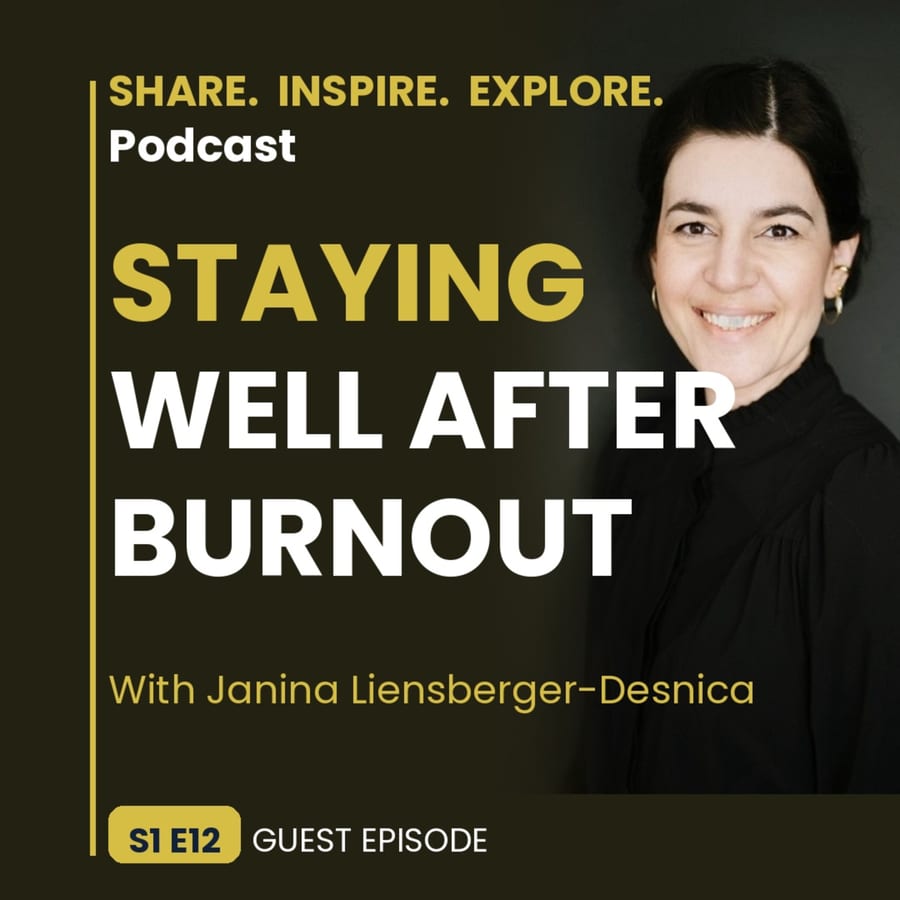
Sustaining Recovery at Work — Janina Liensberger-Desnica
Prefer to watch? This episode is on YouTube and the show is on Spotify.
About this episode
Burnout recovery is not finished the day you go back. Staying well once you are there is a separate problem, and mostly not one you can solve alone.
Chris Wilson speaks with HR consultant and workplace wellbeing advocate Janina Liensberger-Desnica about what makes recovery hold. They get into the stigma people meet on returning, the gap between a policy that reads well and one that meets an actual human need, and the conditions under which relapse becomes likely.
Janina brings the view from inside HR on what support looks like when it is real rather than performed.
The stigma people face coming back, and where it actually comes from Why flexibility and trust do more for long term recovery than programmes The relapse risk when recovery is not supported once someone is back at work
Season 1, Episode 12
Connect with Janina Liensberger-Desnica: https://www.janina-liensberger.com/ (German)
Share. Inspire. Explore. is the podcast from Where I'm At, honest conversations on burnout, career change, and what comes next for working professionals.
Join the Where I'm At Community, free to join: https://community.whereimatcommunity.com/store/product/membership Website: https://www.whereimatcommunity.com
Where I'm At is based on lived experience, reflection, and educational support. It is not therapy, counselling, crisis support, or professional advice. Please consult a qualified professional for individual medical, psychological, legal, financial, employment, or specialist support where relevant.
Read the full transcript4,423 words
Automatically transcribed, so it may contain errors and does not identify who is speaking. It follows the conversation in order.
Welcome to the Share, Inspire and Explore podcast, the voice of the where I'm at burnout community. I'm Chris Wilson, and after my own journey through burnout and depression, I'm here to share real stories, inspire personal transformation, and explore the path from burnout to balance.
Each episode brings honest conversations with burnout survivors, mental health experts, and mindset coaches, offering lessons, strategies, and hope. Whether you're recovering, curious, or searching for motivation, this is your space to grow.
Let's dive into today's episode. Welcome back to the Share, Inspire and Explore podcast. This is part two of our reintegration series. I'm once again joined by Janina Liensberger-Desnica, a strategic HR consultant, coach, and expert in organizational development. With deep roots in tech and pharma industry, she helps leaders and HR teams create meaningful, lasting change. Janina combines intuition with structure to foster trust, participation, and clarity in teams and organizations. She believes that every person wants to be seen and that workplaces should reflect this truth. Welcome back, Janina. Hi, it's good to see you again, Chris. Today, we focus on navigating conversations, sustaining mental health, and building workplace support systems after burnout. Janina, before we dive in, can you briefly recap the role reintegration plan plays in setting
employees up for success? Sure. I'm happy to. So, um, the role of the reintegration plan is really to provide clarity and stability to both the employers, so HR and the manager, and also the employees. So I think that's, that's key. Uh, that's the biggest benefit about this. That's great. Before we begin, please note, this episode is for information purposes only.
It does not replace medical, therapeutic, or legal advice. If you're navigating a return to work after burnout, please consult with a qualified professional or healthcare provider. Let me start by those conversations with managers or leaders, hopefully.
What's the right amount of, you know, disclosure when talking to your manager about returning to, to work after burnout? So there is no good enough amount of disclosure. I think it's really important that you yourself feel comfortable with the amount you're sharing. That's the first, um, that's the first thing that, uh, has to be fulfilled. And the second part is, um, because if you think, uh, from the perspective of your company or the manager is how much information does the manager need in order to be able to lead you to plan your resources, the amount of resources you're available to put in performance and time. So I think those two parts are key. If you think about how much you want to share and that's, that's individual from case to case,
I'd say. Absolutely. And what, what do you suggest employees say if they're not ready to take on their full workload? If we talk about timing, I think it's really important to communicate this before they want. Talk to your therapist, to your doctor. If you think about what was on your plate before you went into burnout, realistically,
what can you handle now? I mean, that's, that's, that's the plan you come up before you return. And it might look different once you've returned, you might be able to do more or less. So it can go into both directions, but it's really important for yourself before you return, how much realistically can you do and communicate, uh, this to the company and also be realistic. Um, it can go in both directions once you're back, but that's just the best you can do. Yeah, couldn't agree more, but how can someone maybe prepare for that first, honest conversation with their manager? We, we mentioned it briefly in our first episode for a great help are talking points.
Yeah, because you should expect that this is going to be a really stressful conversation for you. So, um, prepare yourself for the situation when you get emotional and your mind just goes blank. Then look at your notes and write down phrases that will support and help you in conveying your message. And, uh, again, be realistic. You don't have to fulfill the expectations of everyone in the company because it will go sideways. If you approach it like this, be true to yourself and yeah, really see what, what can you offer from day one? So it's, um, this leads me to my next question. Uh, it's very important, uh, to feel psychologically safe with your manager. What can employees do if they don't feel the safety?
Uh, that's a tough topic because that's, that's a realistic scenario to be honest. And then I recommend to reach out to HR. That's, that's the first thing you should do. And if you're lucky enough to have a works council, as we say in a German language, then also reach out to this party. At least one of the two parties, uh, HR or the works council should be able to help you in this situation, because this could also mean, okay, that maybe you should apply internally to a different role with a different manager and team. Okay. Sound advice. Sound advice.
There is this stigma and, uh, the team perceptions. It's not just the manager. It's definitely how the colleagues react. And if, if your colleagues listening right now, please have empathy for those returning back to work. Uh, if I could speak to myself, I just wanted to get back to normal. I wanted to share what happened, but I also didn't want to be giving me special treatment, even though you do need it in this part-time reintegration phase. But the drive was to get back to normal, whatever that. And let's talk about normal. It's not the old normal. It's a new normal. Yeah, absolutely. If this happened during the COVID years, yeah, what's the new normal? It's the same,
the same thing because it's, uh, this is, it's a contrast of the before and after. About the stigma, how can someone handle the feeling that colleagues might see them as fragile, you know, or getting this special treatment? That's tough, uh, situation to be honest. And, uh, it's, uh, really important that, uh, when you are in the first months of your transition back of your reintegration back, then I would really recommend that you have somebody who is, um, helping you on a regular basis. This could be a therapist, um, uh, to HR, uh, uh, uh, people. I also recommend, um, offer those employees, maybe an external coach, because there is no solution how to handle feeling stigmatized. The only solution I can think of at
least is to take it one day at a time, one week at a time, and one experience at a time, and to have an external party to discuss difficult, uh, situations in a team event or in a project meeting or, or whatever, and to get back feeling grounded and to stay in your lane and not get distracted by what other people might think of you. So really reach out to external help. And the best companies can do is to organize or at least offer this kind of help within the first, for the first year, for example. Definitely. And, uh, in a previous episode with Martina Teufner, I mentioned a situation from the past in the canteen where there were managers making reference to this guy had burnout. And I think
I just want to get that point across. It's how you treat those coming back and it's how you speak of other people who've had this situation. It's so important. And, and burnouts, it is on the rise. It has been on the rise. It's there, you know, it's not, it's not going away in the near future. And, uh, yeah, it's, it should be in the culture. Yeah. And that's the tricky part. If nobody talks about it and only uses, uh, communication like, oh, that's the guy with the burnout, then it's not part of the culture. Right. And that's also important what you said, Chris, um, that's not up to you. Yeah. It's, it's not your role to defend
yourself or to get defensive or to explain yourself. Yeah. Or to, if somebody says something like this in the canteen, it's more, it's mostly about them and not about you. I think that's really important and it's all about culture and, uh, yeah, it's, uh, not easy. It's not easy. So what role does HR or leadership play in creating that stigma free or integration culture? Yeah. They play a key role. They play a key role. What can they do? HR can organize, uh, for example, trainings for people manager or for the leadership team, how to build, as we already use that work, ecological safety in the teams, uh, because this starts with every team and with every manager.
And that's how it becomes part of a company culture. Of course, it also is important. What does the, or how does a CEO or a CFO tackle that topic, right? Is there a mental health day in the company each year where there are different courses and the workshops who, who support education on mental health? I think those are possibilities for the company itself. And also, as we discussed in the last episode, uh, people, managers, leaders are role models. So how they behave, team will behave.
So Janina, you know, once someone's back, what kind of long-term support should HR be offering? So HR should definitely offer open door policy, um, actively communicate to the employee. Hey, my door is always open. If there is some kind of obstacle you're facing or you feel insecure, please give me a call, drop me an email and we can discuss. I will not share this with your manager
unless you tell me otherwise. So that's the best thing an HR, uh, employee can offer and do for long term. Um, and just, just to reassure the listeners, it's, it's definite that there is this employee confidentiality in that situation. Well, should, should be, should be. Yeah. I always ask, or I always explicitly mention it to the employees and always explicitly say, Hey, this is confidential unless you tell me otherwise. But I think it should be part of the job description of every HR person, but, uh, employees should be aware or maybe also ask. Yeah. That's also what I recommend. Hey, dear HR person. I think this is confidential, but I just want to be sure. So I recommend that.
And if you talk about these check-ins, should they be monthly or quarterly? Yeah. I think in the beginning monthly, for example, and then after a while you can just reassess, is this still the frequency of check-ins that we need or that you need as an employee. And then it became, uh, can become less frequent. So it's really helpful. And then you can just reassess I think, right. Great. Great. You know, and not all companies are as advanced as we maybe, you maybe talk about them. Right. So what can employees do to advocate for themselves in that situation? You know, for the companies that don't have this reintegration policy in place. Yeah. I mean, the internet is full of good advice. I know myself. So I think it's important to really
educate yourself on the internet, but not also on the internet, you know, in Austria, for example, you can, um, also contact, uh, for example, it's, it's an institution that supports employees in particular. And I'm sure they have loads of good advice, how to prepare yourself for, for example, for the reintegration phase in case the company is not as advanced as you need it to be for your, um, comeback. So there's a worker and working council outside of the company, right? Yes. It's a union just for the employees. Yeah. So there's the Wirtschaftskammer and the Arbeiterkammer. The Wirtschaftskammer is for the employers and the Arbeiterkammer is for the employees and they have experts for everything. What's your advice to HR teams wanting to support burnout
recovery and they don't know where to start? I think a good place to start is to write like something like a script, right? For the HR teams, like a process or a policy step by step. What is our role as an HR team? If an employee is in burnout and comes back, but also policy or a script for leaders, for people managers, what is the role of a manager in this case, and what are my responsibilities? So something written down like a guidance is a really important first step to professionalize this. Totally. That's great advice.
It's about sustainable balance, right? Coming back to our, um, we maybe covered this in the first episode, but just again, how can someone tell if they're actually ready to return to work? Well, that's really difficult to answer because that's something very, very personal and looks different for everybody. I'd say you might never feel ready enough. That's just maybe a thought from my side. At one point you have to jump, right? But at least you have, you should feel some level of stability and confidence. I think that's the, the, the word I was looking for. Confidence in yourself and believe in yourself that you will be able to manage. Um, and uh, yeah, it's highly individual and best again to discuss and align with your doctor or therapist.
Yeah. If I can think back to when I returned to work, it was for me too early. I wasn't honest with myself. I didn't listen to my gut. That's important. Yeah. Yeah. This is of course learnings, but on the other hand, if you, you can, I think you can also wait too long and you've got, there comes a point where you, you have to try and it can, it can be that that workplace is just not suitable for you and it's, it's not, it's not healthy for all parties. And that's a really important point, Chris, because what I observed in the, my HR career is that not every organization is the right fit for, uh, for, for, for, for, for an employee. There are
organizations where the company culture is not healthy. Yeah. And where most of the people have to survive, uh, to perform. Also one observation is that not a lot of people are returning to the old jobs or to the old, to the former companies. And I think to break habits and the cycle, it can be healthy to start in a new company. But I also have seen successful reintegrations where people come back to the, to, to a similar position in the old company, but that's only possible if a healthy and humane culture is already established. Yeah. And we can put a lot of our hope and faith into the, that that culture exists. But I think when you realize that's not the case, it's, it's better to be working on plan B.
Yeah. And it's important to have a plan B, would you say that goes into a good personal reintegration plan? Yes. Yes, absolutely. Absolutely. Because it also provides options to yourself. If plan A goes wrong, I have plan B. Yeah. And it can decrease the anxiety and the pressure you're feeling. Absolutely. In general, always have a plan B in life, right? Yeah. It's a lot of soul searching. That's, that's what triggered me. I went into a systemic coaching program. Okay. And to find my purpose, what am, what am I here to do? And so I challenged all the old beliefs and yeah, this is what's come out of it. I've said this already on episode one. Yeah. And it can be a new reality. And in your case,
it's working part-time and having a side business. Yeah. That is more aligned with your purpose. And I think that's great. And I think that's great that you have the courage to do that. And I know other people who are doing that as well. And I think we will see more of that in the future, in the new future. Yeah. And, uh, I can tell you, if we talk about listening to your gut, you know yourself inside.
This is aligned to me. This is aligned to my values. It's, you know, you just know. Yeah. Yeah. But it's important to explore also why we have explore in the title of this podcast. That's be curious. Yeah. Be open to the new things, hanging on to that old world, that old job, that old setup. As you say, if the culture is there that, uh, enables reintegration healthily, sustainably, that's, that's great. But if it doesn't really be open to change. Yeah. And curiosity is something great. It fuels energy, right? Yeah. And I think that's also what many, many people with burnout forgot how great curiosity and creativity is and really be courageous and find ways to implement this in your new work life. So if we talk about work life balance,
polarizing statement. Yeah. But how do you suggest people manage their work life, let's say reality, long term? Well, I think you have to get to know yourself really well. What do you need long term? So some people have more energy than others. Some people thrive on pressure better than others and pressure can look different for everybody. And you also have to get to know your work style. Are you a person who prefers to have peaks and lows? Are you a person who needs like more, if we talk about workload, like it's okay if there is always 90% workload. And so I'm gesturing with my hand here. So if it's like always the same level, or are you a person who is handling well peaks that are not
short term peaks. So if the stress is really high, like 70% of the time, there are people who are managing this really well. You have to get to know yourself. That's what I want to convey here. And once you know your work style, and also if you are, for example, more introvert or extrovert, those are just examples, right? Because that connects to your communication style. And if you need more home office, where you thrive on what tasks you thrive, and what aligns with your purpose, and what is a break for you. So you see, I'm babbling here, but there are a lot of aspects here that you should consider. Superb. Yeah. I mean, are there any few non-negotiables people should include in their daily, weekly,
let's say wellness routine? Well, I'm a big fan of breaks for everybody. There is no superman or superwoman in real life. And it will maybe not in the next five years, but I think it will come back to haunt everybody if there are not enough breaks in one's life. And it might not be a burnout, but I don't know. Bad relationships in the family, for example, or sleepless nights. And breaks are for me, really a non-negotiable. Absolutely. The power's in the rest. Yes. If we look in the sports world, recovery and breaks are part of building performance and resilience. Totally. Yeah. What about meditation? Is this something you also practice? What are some of the
strategies that you personally use if you're open to sharing those with us? Sure. Sure. So I have my routines. I also have a small, not so small kid anymore. He will turn four in August. So especially as a mom and balancing high workload, for me, breaks are essential. And for me, what works best is going outside for walks, for hikes. So nature is for me really important. But also on a daily basis, I implement, I have breaks. So for example, lunch break. I mean, it's okay if it's a, of course, if there is important customer meeting or I have a workshop. If I have a workshop from nine to five, there is no break, to be honest. And that's okay. Yeah. And I know my type. It's a, I like to work in a
zigzag. Yeah. So I like to have peaks and have time to recover. I don't like the same amount of workload. That's not where I thrive. I like the peaks. Meditation, for example, if I have a stressful weeks and months, because there is a peak, a longer peak, then I meditate, for example. And I also like to do yoga. But what really helps me the most is community, family time, being outside in nature. Superb. Yeah. We can take a lot from that and those recommendations. You mentioned the community there. Yeah. How can maybe a burnout buddy or a peer supporter help in recovery? Well, it's, it's the best context you can get yourself in because, uh, you won't feel stigmatized.
So, because you know, there's somebody who has a very similar or the same experience and you can speak freely without the fear of being seen as weak. So I really recommend to build relationships like this to reach out to the, to people. And with community, I also mean find the community outside of work. I think this is key to have a healthy work life balance, not only a family, but a community outside of work. And this could be a sports club. This could be a gardening community, whatever. Yeah. But this is a key ingredient for me to be healthy long-term or the where I'm at community or the where I'm at podcast. Absolutely. You see where I was going with that. Okay. No, that's a, yeah.
One of the drivers of course, to, to create this community and Feeling lost in the aftermath of burnout. You're not alone. Where I'm at is a new community created for those in recovery, those at risk, and those supporting others. It will be a safe, evolving space to recognize, reset, and reinvent with live sessions, peer support, expert Q and A's, and more. It will be free to join in the beginning. And while not everything will be there from day one, this will be a community which is built by us and for us.
Click the link in the description to join and shape what's next. My name is Chris Wilson and that's where I'm at. Thank you. Yeah, absolutely. But what you got me thinking there with burnout on the rise and so prevalent in the workforce, maybe setting up these communities within the organizations, just having that platform, it would obviously take the drive from the employee or one brave employee to start that in a work place.
Yeah. Given HR is a difficult role there, you know, but that, that would be. That would be very helpful because then you're within the organization and you have the, the peer support within the organization. And I recommend here, uh, maybe to put it on a wider umbrella, umbrella, for example, mental health, because there are different, um, aspects, uh, and burnout is one of them or there are different aspects in mental health that can lead to burnout. Uh, and I think
with the new generation, for example, the generation Z, they will build communities like that at work. I'm sure of it. Super. I'm so happy for that generation. Me too.
And it's a great job. Uh, the, the parents did with them because in our generation or all the generation, generations, there's so much stigma and then it's really difficult to build such communities. And so it's great that you're building one community example for this. It's, it's really a great job, Chris. Thank you. I'm trying to break the mold. Yeah, that's important. We need people. That's great. That we're almost, uh, at the end of today,
if you could leave one message with someone about to return to work after burnout, what would it be? You're not alone in this. You have people reach out to them either in your personal or in your professional life. Don't rush yourself. It's a really great opportunity to develop yourself and to set up a new way of life for you. So what I want to mention here is this is a big opportunity for yourself. If it's not the old company, it will be a new company. I'm sure of it. And don't rush yourself. Your self-worth is not about your job. And I know that's a tough lesson for many people who have been experiencing burnout, but your self-worth is there. The moment you are born, you are allowed and
you should feel worthy enough. It's not about your job. It was not a short answer, but it's, uh, yeah, that's a wrap on part two of our reintegration series. And thank you again, Janina for your guidance, clarity, and compassion. I'll put a link again in the description of how you can connect with Janina professionally. And to you, the listener, if this conversation helped you, please follow the podcast, leave a review and share it with someone returning to work after burnout. Don't forget where I'm at is more than a podcast. It's a growing support community for burnout survivors. The link to join us is in the show notes. Until next time, take care of yourself and your energy. Thanks, Janina.
Thank you, Chris. Bye. Bye-bye. If anything in today's episode resonated with you, we encourage you to reach out for support. Remember, this content is meant for insight and encouragement, not as a substitute for clinical or legal guidance. That's it for today on the Share, Inspire and Explore podcast.
I hope something resonated with you, a moment of clarity, encouragement, just a reminder that you're not alone. If you find this helpful, share it with someone who might need it. Hit follow or subscribe to join us for future episodes. If you're new here, please check the link in the description to join the community. Burnout is tough, but it's also a chance to heal and rediscover what matters. Thanks for being a part of this journey. And until next time, take care, keep exploring what's possible. I'm Chris Wilson and that's where I'm at.