
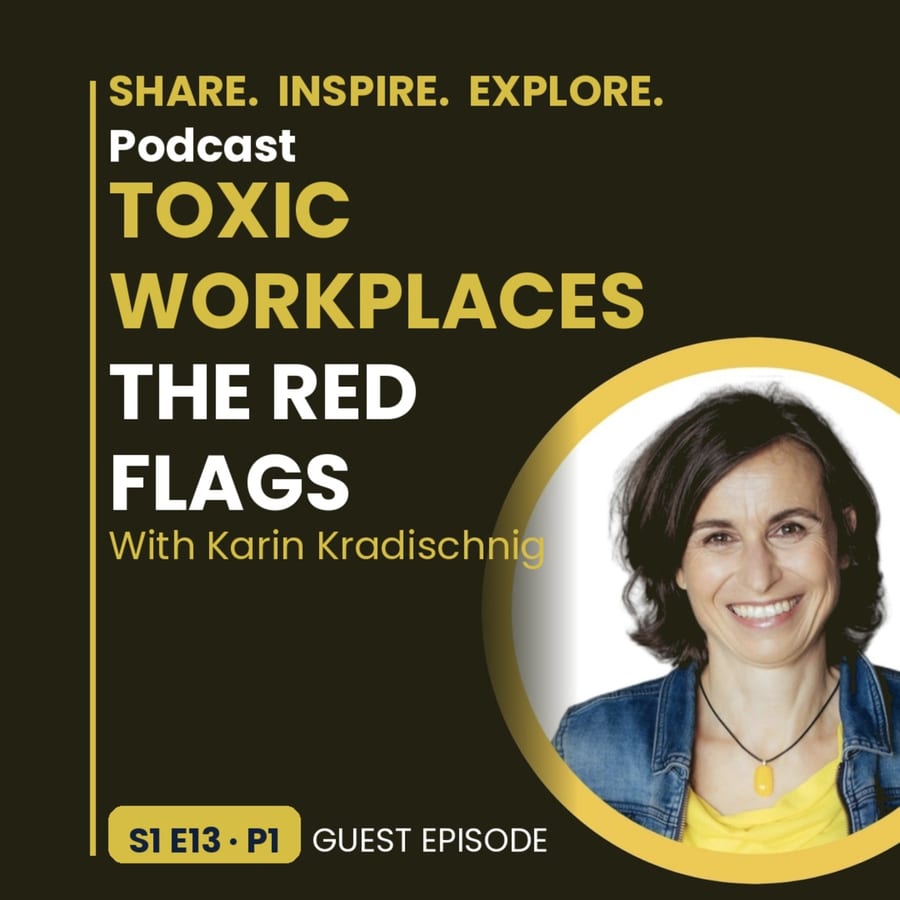
Toxic Workplaces and HR's Role, Part 1 — Karin Kradischnig
Prefer to watch? This episode is on YouTube and the show is on Spotify.
About this episode
What makes a workplace toxic, and why does HR so often end up caught in the middle of it?
Karin Kradischnig, HR expert and founder of Coaching4HR, joins Chris Wilson with twenty years of HR and leadership experience behind her. They work through where workplace toxicity actually starts, what it does to the people inside it, and why HR's position is more compromised than most employees realise.
Part 1 is about recognising it: the signs, the silence, and the reasons good people say nothing.
What defines a toxic workplace, past the word being overused The part leadership plays in creating it, or quietly permitting it Why employees stay silent even when they can see exactly what is wrong
Season 1, Episode 13
Part 2 continues with accountability, rebuilding trust, and what HR can realistically change.
Connect with Karin Kradischnig: https://www.kradischnig.at/ (German) and https://www.linkedin.com/in/karin-kradischnig/
Share. Inspire. Explore. is the podcast from Where I'm At, honest conversations on burnout, career change, and what comes next for working professionals.
Join the Where I'm At Community, free to join: https://community.whereimatcommunity.com/store/product/membership
Website: https://www.whereimatcommunity.com/community
Where I'm At is based on lived experience, reflection, and educational support. It is not therapy, counselling, crisis support, or professional advice. Please consult a qualified professional for individual medical, psychological, legal, financial, employment, or specialist support where relevant.
Read the full transcript5,568 words
Automatically transcribed, so it may contain errors and does not identify who is speaking. It follows the conversation in order.
Welcome to the Share, Inspire and Explore podcast, the voice of the where I'm at burnout community. I'm Chris Wilson. And after my own journey through burnout and depression, I'm here to share real stories, inspire personal transformation and explore the path from burnout to balance. Each episode brings honest conversations with burnout survivors, mental health experts, and mindset coaches offering lessons, strategies and hope. Whether you're recovering, curious or searching for motivation, this is your space to grow. Let's dive into today's episode. Before we start, please note, I'm not a medical or mental health professional. What I share here comes from my own experience with burnout and recovery and is intended for informational purposes only. Welcome back to the Share, Inspire and Explore podcast.
Today, we're diving into one of the root causes of burnout, toxic workplaces. Any employees feel stuck in unhealthy environments and wonder if HR can really help or whether it's time to move on. So what role does HR play in recognizing and addressing toxicity in the workplace?
Joining me today is Karin Kradischnig, HR expert and founder of Coaching for HR, who brings 20 years of hands-on HR and leadership experience across companies, large and small. Welcome, Karen. Thank you, Chris. Before we get into it, could you briefly share a bit about your professional journey and what led you to focus on workplace culture? Thank you for your introduction and thank you for being here. And the answer why I focused on workplace environment is very easy. It's because I've been working for HR for around 20 years. Right now, I've seen small-scale companies and really large-scale global companies. I've been working for different functions from IT to marketing to production lines. And what I found out and what I constantly see is that successful teams and organizations have one
thing in common, and this is a good and motivating workplace environment. And for me, this is also a powerful leverage factor for HR where we can really make a difference. And this is also why I'm part of the HR for HR initiative or network. We found we are some HR professionals with the goal that we support other HR professionals in their fields in various fields. For example, with coaching for HR, we supported all the emotional challenges that HR is facing. With interim for HR, we support with resource management and all other fields. And this is how I think we can make workplace environment better for now and also for the future. So this was in short my journey through HR and how workplace environment accompanies me in this field.
Super. I love the mission to make a workplace a better place. A quick note: I'm not a mental health professional and Karen is not offering legal advice today. Our conversation is based on personal experience and best consciousness for information purposes only. So Karen, if we are understanding workplace toxicity and the term toxic workplace gets used a lot, but what does it really mean from a HR perspective? Thank you for this question, because it's always very important to, well, to have the definition of what we are talking about. And if we're talking about a toxic workplace, first of all, we have persistent negative behaviors. It isn't just once or twice that something happens, but it's really persistent, harmful or negative
behavior. So the common signs or the biggest common sign is poor communication. So what is poor communication? For example, it's that you are not transparent in your communication, or you don't even get information, or you have frequent changes in communication, or there are ambiguous or contradictory instructions, maybe due to misalignment within the management. So this is the communication part. Either you don't know, or you know something, but you're never sure whether it's right or wrong. So this is the first part of communication issues or indicators for a toxic workplace. And the second part is the tone and the style of communication. So what do you hear if you enter the company? For example, do you hear a lot of
appreciation, then you're probably in a very good work environment. If you don't hear any appreciation, it might tend also to be a little bit harmful. And if in addition, you hear lots of criticism, you're not allowed. And as soon as mistakes are allowed, you immediately stop innovation. So you have to really have a close look at how communication is done. You have one major indicator of how the the workplace over there is doing. Yeah, I totally agree on the innovation killer. Just, you know, it instills fear. I'm not going to take any risks. But then it just spirals into double-checking, triple-checking. Yeah, it is a killer, yeah. Yeah. And innovation needs mistakes. You can't innovate if you don't make mistakes. And if you're in a toxic
environment where you're blamed or criticized for an idea or whatever, you can immediately, and maybe you also want to have more innovation, this doesn't go together. This is one aspect. And then you have another aspect, if you listen closely to how people communicate, if they have more of an us rhetoric or a they rhetoric. Meaning, are people talking about what we have to do, what we have to change, what we can make better? This is completely different than if you're talking about, well, but they didn't manage yet, and they didn't do that, and they should do this or that. If you already hear how it sounds, you can hear that if you talk about they, this is a very dividing language,
and it's focusing on competition and not collaboration. Whereas if you're talking about us, what can we do? How can we solve this issue? This is much more about collaboration, much more of going together to reach the next level, or to see how we can resolve a mistake that we've done. Mistakes, anyway, are fields of learning. These are the three central communication indicators that you have in toxic workplaces. So, poor communication, dividing communication, and the tone and the style of communication. What about unfair treatment? Often, the way employees are treated is sometimes not equal. Yeah, for sure. And that's also a very, very sensitive indicator. Do you have fairness within your team or within your company or not? If you have a lack of fairness, for example, who gets the best
project, who gets the next salary increase, who gets the next bonus, who gets promoted, who gets the sales person of the year award or whatever, if you see it's always the same people, then you definitely have a lack of fairness. And those are the obvious signs, but you also have the very small signs. And we,
people in general, are very sensitive about fairness. From childhood on, usually, we always have a look, ooh, are we treated in a fair way, yes or no? And fairness even starts with, do you congratulate all your team members in the same way for the birthday, or do you forget some team members? I had a case where I know that the employee felt really treated in a very unfair way because she didn't get her birthday present on time like the others. So it's a very sensitive thing. And of course, the birthday present is a small thing. But if you have a close look, you can really see it. Who is allowed to do presentation? Who is allowed to take part in special meetings? And is it always the same people? Or has anyone in the
team the chance to get whatever benefit of the company? So fairness is very, very crucial. I never thought of the birthday. It sounds small, but it's actually quite big. It's pretty big, I would imagine. And if I was to put myself in those shoes, you know, we always compare and comparison. I've spoken about it. This comparison trap is dangerous, but I think it's natural. And you mentioned back when we were kids, we go through this already with our two kids and
what's on the dinner plate. And they're counting the chips. And we laugh, but actually, yeah, this, I think does, does come forward as you get older and different scenarios. Yeah, that's true. That's true. So that, I mean, detecting this can't be easy, right? Do you want to explain a little bit about from a HR standpoint? Yeah. So detecting it is very, very difficult, difficult because if like, you can imagine people don't show up at our desk and tell us, "Oh, today there was an incident might be harmful for our culture or is toxic behavior." This doesn't happen because those behaviors of communication, as we just discussed, it's so hard to detect for the people involved as well. So you
have to figure out that there's unfairness. First of all, you have to figure it out yourself. Then you have to figure it out yourself how it goes with the communication. And then all those things, what do those things do? They deteriorate trust. And if you don't have trust, of course, you don't address it. So in HR, really we cannot rely on the people that come to us and address it directly with HR. But what we can do is that we actively listen to those communication patterns I've already mentioned, that we have a close look on how turnover is developed in different teams or in different departments. We might have a closer look on what about sick leaves, how are they developing in different departments or
in the company as a whole. And what we also can do, this sometimes is reported to HR if, or sometimes we also see, but these, those are the things that are sometimes reported are excessive excessive coffee breaks, excessive smoke breaks, misuse of company perks. Then you might have office supply disappearance. And what we, this is something that is also reported if people are still dissatisfied, although they got bonuses or salary increases. So this is something that we, that is, but we also have to listen very closely, but this is reported and you feel it if you gave a salary increase and short time later, there is again dissatisfaction, or if you're granted a bonus and again, there's
dissatisfaction. So those are signs that we can, that we can observe. Then it's clever and crucial from an HR perspective to make exit interviews because in the exit interviews, there's no matter of trust, fear or any else or anything else anymore because people are leaving. And at that point, they are very open. They are very open to us. And well, if you asking them good questions at that moment, you will get many answers. You can learn a lot. You know, it's not about blaming someone else, but it's really from an HR perspective to learn of what went well, to learn about what went wrong and to learn what we can do better and to find out about dynamics, find out, are they more within the teams? Are they more
when collaborating between teams? So this is, this is a very, very interesting part of our job, but a very important one because this is the one where we can develop and where we can do better afterwards. : Totally, totally agree. It's so important. I would say, however, recommendation letter, as it's called here in Austria or reference, as I remember in the UK, this has been dangled, you know, in front of the employee and they only receive this when they go. So the exit interview is not after. And I still think there may be some withholding of truths, maybe. What do you think about that? : Oh no, that's, that's so completely, so that's not even on my mind yet to do that. But still,
you're right. It could happen. The fact is that you, as a company, you're not allowed to withhold references for the so-called Dienstzeugnis in Austria. You're obliged to give the employee a reference letter. And then there are various, well, you can write it this way or you could write it the other way. In fact, you must not harm the employee. So there must not be any negative thing in those letters. This is the first thing. And the other thing is how important is this letter actually for other HR people. And I can tell you it's not at all. If, if I'm doing recruiting, I know that what, what is written down in this letter, that's, that's no, no words. You can, you could also just skip it.
And I want to ask the question, do you really want to work in a company who is recruiting by reference letter? I would call it like that. So if a company says yes or no to you because of one single letter in the end, you wouldn't want to work there anyway. Because if you're in a really good recruiting and application process, people are talking to you, people are talking, you have a good cooperation already in the, in the interview process, but they will not decide because of a single reference letter that might not look that good. And in Austria anyway, the company is obliged, is obliged to issue that letter. So don't worry about the reference letter. You will get it. And it won't matter anyway in the end.
It's hardly worth the paper it's written on actually, just based on what you said. Companies are not allowed to paint a negative picture towards it. However, I do know there are subtleties in the wording that can be, at least from speaking to my wife. Yeah, there's ways around it. But my point was actually just really, can the employee be totally truthful in that exit interview with the dynamics at play, you know? But now we know the reference letter is worthless. So maybe there's, that's inspiring more truth speakers. And you know, it always depends from the HR people. It depends on why do you do the exit interview. So if you want to learn something about the organization, you won't start putting
pressure on the employee if you want to learn. And if you don't want to learn anyway from the exit interview, you just skip it and use your time for something else. So either you do the exit interview in a good atmosphere and then you will learn from it and then you can do something. If you have the impression that the employee still fears pressure or whatever, you can also do the exit interview after the exit. That's gold.
But then it's hard to reach the people. Yeah, it's better to reach them just the moment that they come to you and tell you that they want to terminate. Yeah, so you talk to them immediately or you talk to them after they quit already, but then it's hard to get them because they don't want to talk to you anymore. So it's better to talk to them beforehand. And if you want to learn, you will know how to make an atmosphere that makes the employees speak openly and frankly. And if you don't want to learn, take your time and use it for something different. But of course, we have now the websites like Glassdoor, internationally known here in Austria or the German speaking world. It's called Kununu. That's where
employees can anonymously as well post about company culture and toxic workplaces. I mean, you just have to go and review some companies. It's all there for everyone to read. Does this stand
as valid feedback or from an HR perspective, is this just ex-employees venting and there's not much weight to it? What is your opinion on that? So my opinion on that is like it gives a direction. You can take it one-to-one because we know in any area, if it be employment, might it be
a review of a restaurant or a hotel or whatever, we know that we are five times more willing to give negative comments than positive comments. This is known. So you have to be aware that on those review platforms, you tend to have more negative comments because those employees that are satisfied, they are satisfied anyway. So why should they spend their time on Glassdoor, Kununu, indeed, and so on and so forth? Yeah. So be aware of that. So it's probably unfair to label a company toxic overall, right? Yes, it is. You really have to have a close look. And it can be the case that the company is not toxic, but there might be a team that is toxic, or there might be some areas that are toxic, but not
necessarily the whole company. Of course, the larger the company, the more different cultures you will find within the company. You have a culture, a basic culture, but of course, it varies. It's like within a family. You usually have a family culture and how you collaborate together, but there might be differences. And it's the same with the company. The larger the company is, the more subcultures you could experience. The smaller the company is, of course, the more equal the culture is because you you don't have so many teams. I also worked in a company with five employees. There's one culture, you have five employees, one culture, not more, not less. But the more employees are in the company,
the more cultures you could experience. And can a single individual create or maybe shift a toxic culture? Yeah. Yeah. A single individual can do so, especially turn it worse. So if one individual is acting as we discussed before, doing poor communication, starting with criticism, starting with whatever things, with unfair treatment or whatever, this can negatively affect the team itself, but also within the teams. So if you're collaborating from team to team, it can also affect other teams. And there, one single individual is enough. Whereas if you want to shift workplace environment to a more positive environment, one individual is not enough. If you want to lift it up, you have to be a critical number of people
who are really working persistently and in a very consequent way on lifting and shifting the workplace areas in my environment. So if you want to worsen workplace environment, it's enough. If you have a single individual, if you want to make it better, it's not. You have to be more than one. I guess that's why there's a trend for developing communities within communities to spread these transformational projects and cultures. Exactly. Exactly. And this is also a sign of a toxic workplace if you don't have a good community feeling within the company. So there you really, if you want to, if you want to make it better, try to build communities that are talking positively, communicating in a very transparent and
trustful way. Then you can, then you can treat about this. Right. Feeling lost in the aftermath of burnout. You're not alone. Where I'm at is a new community created for those in recovery, those at risk and those supporting others. It will be a safe, evolving space to recognize, reset and reinvent with live sessions, peer support, expert Q and A's and more.
It will be free to join in the beginning. And while not everything will be there from day one, this will be a community which is built by us and for us. Click the link in the description to join and shape what's next. My name is Chris Wilson and that's where I'm at. Thank you.
So, I mean, there can be toxic and on the other hand, high stress at workplaces. How can we distinguish between the high pressure but healthy environment and the truly toxic one? That's a really good question because, as I mentioned before, one of the indicators for toxic workplaces is a high workload, consistent high workload. But this doesn't automatically mean that the environment is toxic. And I want to give you an example that I experienced many years ago, when I supported a manager who was responsible for a production line with, I don't remember anymore, 60 or 80 employees, something like that. And this was a really high pressure environment. And they knew exactly if they did a mistake, it could cost six figures. So, it was high pressure, but still,
the employees there were really in a good mood and they really did the work well. And it was really, yeah, it was good. Still, although it was a stressful workplace, it was a good workplace environment. And this was just because the manager was really, I mean, although there were, I don't know, 60 or 80 employees. I did development talks with him and I figured out that he knew about every single employee. He knew the personal story, he knew about the strengths, he knew where they should develop. He asked them, he also listened. He asked them when he wanted to have improvements. He involved them in the processes. He was very clear in his communication. And this also meant that he addressed things that didn't
went well, but then he addressed it immediately in a very clear and direct way. And he, you were just very clear what he expected from his employees. And so, they really managed as a team to be quite successful, although there was really, on the one hand, high pressure. And of course, fear about the mistake in this production line is not so funny if you know what you could cause, but they really managed good. So, here you can see that stressful environment needn't be toxic. Whereas, I've also seen examples with small teams with low pressure and the workplace deal was toxic. There were several teams I've seen like that. And the reason was most of the time that their managers were absent for different reasons.
Sometimes, they got just overloaded with work themselves. Sometimes, they just had a real need for harmony and they didn't want to say anything. If there was a conflict, they would rather be absent or they weren't clear about their goals. So, they were not very inspiring. So, they were just absent. And then conflicts arose, they landed with HR and they were talking about, don't know how their desk is organized and things like that. And they were not productive at all. And everyone is suffering. No one is speaking clear. And this creates, from year to year, more of a toxic environment. Because a toxic environment grows, it's not that it happens now. It grows. And if the manager supports the growth or at
least doesn't do anything against it, then it will turn out like this. And so, you can have a very easy-going work task, for example, small team, and still, it could be toxic. So, this distinction, in my point of view, is very, very crucial. So, it's not the workload itself. It's the whole package, so to say. But mainly communication, from what I gather. Exactly. Exactly. It's how you handle the workload. In fact, it's how you handle the workload and how you,
and it's again about the communication and how you appreciate the employees, if they are doing well, and how you can, yeah, to be clear about the goals and also to be clear about how do we want to work together. And not only what do we have to do, but how do we want to do it? And what are the expectations culture-wise? What are actions that I really support as a manager? And what are actions that are just no-goes? And there are just no-goes. And about the no-goes, you have to be clear. Yeah, this movement of the new way of working. I have some experience in that. And it's hard to implement a playbook, so to say, because each team is individual. What we learned is it's our way of
working. And so, you can have this overall culture, at least my opinion, where the values of the company are underpinning the work and how you work together. But the team is built up of also individuals, not just individual teams. And those teams, yeah, have their own way of working. So, yeah, it's learning to adapt. And I think it's very important to have the vision clear from top down, as you mentioned already, yeah? Because I think when the outcome is not meeting the expectations in the end, all that this really has to go back to how it kicked off in the first place, you know? If you're on the wrong course from the beginning, then that is the outcome result.
Exactly. And with the vision, I would like to add something. The vision mustn't only be clear, you also have to act according to the vision. So, the vision is one thing, and what you do is the other thing. And employees always look at what is done. They look at what is done in the executive or they look at what is done in the management team, and they look at what is done in other teams. So, there's something that is written down, and that's good, and that's fair, and that's fine, and it's important to do that. But the more important thing is to act like that and to be vigilant if this is done or not.
Practice what you preach. Yeah, practice what you preach. And this is why you have these visions and these behaviors. This is also why you have to keep them simple. It doesn't make sense to have, like, don't know, 20 behaviors that you should show, and no one remembers what is here and what is now. It has to be very simple and very clear, so that at any time, no matter if it's stressful or not, you can recall them and see, okay, am I on the right track?
So, in your opinion, how can working in these environments contribute to burnout? Yeah, this is, let's have a look. I would like to start to answer this question with looking at first of what are the causes for burnout. We have talked about what are the causes for toxic workplaces, which is poor communication and unfair treatment and several aspects of poor communication. And the reasons for burnout are, first of all, excessive workload, which we heard before might also be a reason for a toxic workload. It needn't be, but might be. So, excessive workload is a match already for the causes for burnout. Another reason for burnout is lack of control. So, if you yourself have the feeling you can't control, you're only passive and you can't control anything, this again
matches with the poor communication that causes toxic workplaces. Because if you never know what to do or the communication is unleading or it's misguiding, then you have the feeling that you have a lack of control. So, this is also where the reason for burnout matches the red flag for toxic workplaces. Then another reason for burnout is if you have insufficient recognition and insufficient support from leadership. And again, it relates to one root cause for toxic workplaces, the style and tone of communication. As we said before, no appreciation, blaming, lots of criticism, maybe no communication at all. So, this is again something that directly matches to the burnout indicators.
And then another reason for burnout is if you have a poor community feeling. So, you feel like isolated and you don't, yeah, you just don't feel integrated. And this again relates to what we talked about before, to the poor communication and to the style and the tone of communication. Because if you're criticized all the time, you won't have a great community feeling. And if you don't get information or if you get it, you get the wrong information or whatever, you won't have a great community feeling and you won't feel trust and you won't feel safe over there. So, again, we have a match between causes for burnout and causes for toxic workplace environments.
I mentioned already the lack of fairness and we talked about quite intensively as well. If you feel that you're not treated in a fair way, that still fosters your feeling of not being safe and not being good enough and can help you to burn out. And what else is a fact that can then can lead to burning out value is our conflict values. Yeah. So, if your values don't go together with how the company, how the company is acting, for example, for you, trust is a very important value. And then you have the feeling, okay, in the company, you can, you are not sure who you can trust or where you can say something or not, then this can be an
issue. If there's a conflict of what the company is saying that the value is that we discussed before. You're clear about the vision. You're clear how to do it. But in fact, you don't do it. You just do the opposite. Yeah. And this can also support if you want to use the word support to get burned out.
I guess, I mean, I mean, I guess values change not only for individuals, but for a company over time. And I guess it's, it's up to us as employees to reassess now and again, is it still, is it still aligned? I guess you'll know, you'll get that feeling. There's something not right. This is not, you often hear is
it's not as good as it used to be working here. That's probably a sign that the company is either growing too fast or, or just completely misaligned. And, and I would like to add that that was a good point that you mentioned. We have to reassess because values, I mean, there are core values that will maintain stable during our lives, but still, you have to reassess values anyway in any relationship, not only at work, but also in your private relationships. Maybe there are friends that you've had 20 years before and it was a good time, but now, well, there's a mismatch of values sometime. Yeah. And the same thing can happen within the company context. Still, it's, it's with every relationship you have, you have to reassess
because you're going to develop, but there are, as I said, some basic values. And it also depends on how important those values are to you. If you are in a constant mismatch of the values, and it doesn't matter in which relationship, if it's a private relationship or the work relationship, if you have a constant and a really, really big mismatch of values, it doesn't feel, it doesn't feel well. And in combination with other factors, yeah, burnout is inevitable, but burnout is never, ever a result of a single incident. Yeah. It's not only value conflicts, and it's also not only workload. It's always a mix of several, of several things that happen over the time. And also, of course,
has to do with your, with your own development and which stage you're in at the moment. Yeah. This episode is just focusing on the workplace, what fuels burnout in the workplace, but there are plans for another episode of outside of the workplace. So let's not do spoilers alert. Yeah, burnout is not an, it's not an isolated topic, but you're right. We're, we're focusing on the workplace and still we can have them, you know, we can see it all. If we are, if we are vigilant, we can see that we have same patterns, different in different areas of our lives. The only thing I wanted to say, now we stick further on at the workplace. That brings us to the end of part one of my
my conversation with Karin Kradischnig. We've unpacked how toxic workplaces develop, the red flags we often miss, and the difficult balancing act HR faces between employees and the business. But there's much more to explore. In part two, Karen and I dive into what accountability really looks like, how HR can set boundaries while still supporting people,
and whether toxic workplaces can ever truly change. Don't miss it. I'll see you in the next episode. That's it for today on the Share, Inspire and Explore podcast. I hope something resonated with you, a moment of clarity, encouragement, or just a reminder that you're not alone. If you find this helpful, share it with someone who might need it and hit follow or subscribe to join us for future episodes. If you're new here, please check the link in the description to join the community.
Burnout is tough, but it's also a chance to heal and rediscover what matters. Thanks for being a part of this journey, and until next time, take care, keep exploring what's possible.
I'm Chris Wilson, and that's where I'm at.