
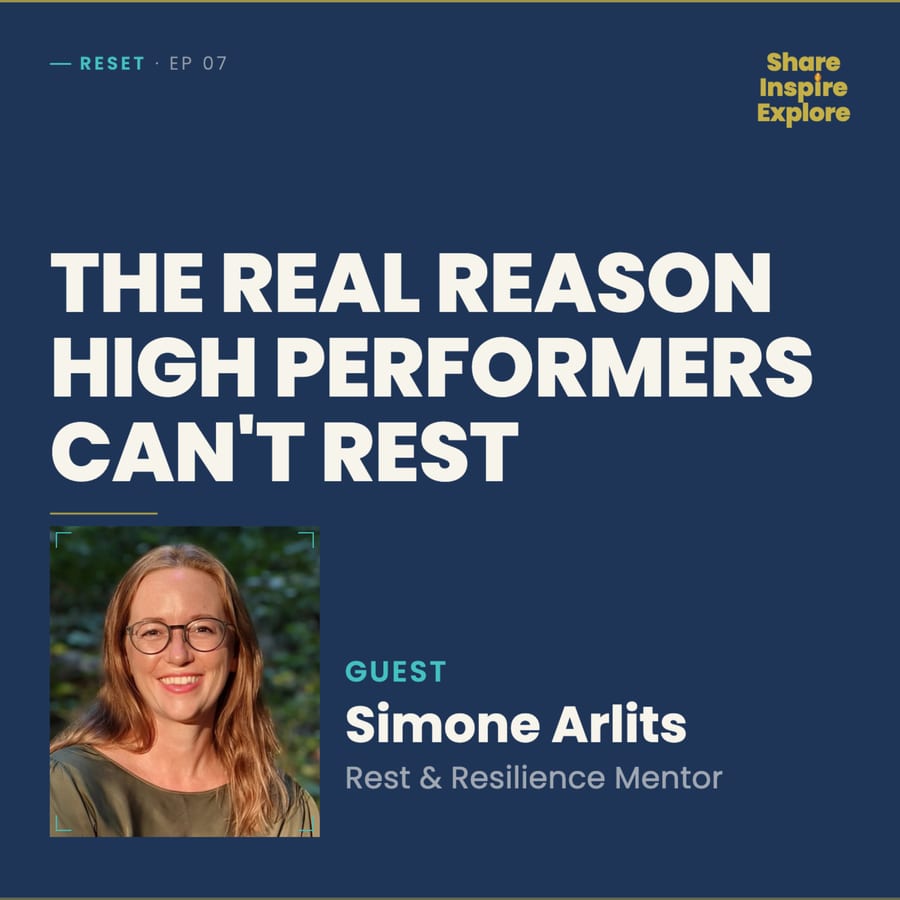
The Real Reason High Performers Can't Rest — Simone Arlits
Prefer to watch? This episode is on YouTube and the show is on Spotify.
About this episode
High performers are often the worst at resting, and it is not because they do not know how. It is because rest has to be earned first.
Simone Arlits spent more than fifteen years in corporate leadership before her body told her what her calendar never had. She talks with Chris Wilson about why rest gets treated as a reward rather than a strategy, about the giver pattern that keeps people available past the point of usefulness, and about the practical changes that make slowing down possible without guilt attached.
They also get into hustle culture, and what she found helped her own recovery.
Why rest gets framed as something you earn, and who that serves The giver pattern, and how it outlives the job that created it Small practical changes that make slowing down survivable
Season 2, Episode 7
Find Simone Arlits on LinkedIn, and on Instagram at for.rest.mentoring
Share. Inspire. Explore. is the podcast from Where I'm At, honest conversations on burnout, career change, and what comes next for working professionals.
Join the Where I'm At Community, free to join: https://community.whereimatcommunity.com/store/product/membership Website: https://www.whereimatcommunity.com
Where I'm At is based on lived experience, reflection, and educational support. It is not therapy, counselling, crisis support, or professional advice. Please consult a qualified professional for individual medical, psychological, legal, financial, employment, or specialist support where relevant.
Read the full transcript10,777 words
Automatically transcribed, so it may contain errors and does not identify who is speaking. It follows the conversation in order.
Welcome. This show is for people in the middle of something difficult. If you're navigating burnout, a career change, or rebuilding something that stopped working, you're listening to Share, Inspire, Explore. I'm Chris Wilson. I've been through it. And I built the Where I'm At community because I couldn't find the conversation I actually needed. Season two is guest-led. In each episode, I sit down with someone who's lived it or studied one of these phases. Recognize. Reset. Reinvent. Real conversations. Nothing packaged. Let's get into it.
There's a belief most of us carry without ever questioning it. That rest is something you earn. That you'll stop when the project's done, when the quarter's over, when things calm down. But then things don't calm down. So the rest never comes. And at some point, the body starts making demands that the to-do list can't answer. So my guest today knows the moment from the inside. Simona Arlitz spent more than 15 years in corporate and agency environments, including a senior leadership role. She never received a formal burnout diagnosis, but her body told her something her calendar hadn't, that she was running on empty.
She took that serious, retrained, and built a practice called 4REST. Working with stressed and burnt-out professionals on resilience, stress management, and what it actually means to recover. She's a certified trainer for mental well-being, a forest bathing guide, and a yin yoga teacher.
Her argument is this. Rest isn't the reward you give yourself when you finally earned it. It's the strategy. So without it, sustainable success isn't possible. Simona, I'm really glad you're here today. Welcome. Hi, Chris. Do you want to just tell our listeners a few words about yourself and your own words? Yeah, sure. So yeah, my name is Simone Arlitz. I'm born and raised in Vienna. And as you said, I worked in corporate for over 15 years, starting in the media industry, working as a journalist for over a decade. And then I switched to marketing, content marketing. And so my last years in corporate, I spent in a marketing agency in Berlin, and then moved back to Vienna. And then I was head of
marketing in a quite well-known Austrian company. And yeah, so that's about my corporate background. And in 2025, I started my self-employment. And yeah, I started Forrest. So that's the name of my company. It's about the forest. So nature plays an important role. And it's also about rest. And it's about stress management, stress competence, resilience training, and mental training. So I'm a certified trainer for all of that, for stress management, resilience training, and mental training. And as you already mentioned, I'm also certified forest bathing guide and yin yoga teacher. Yeah, that's what I do now, helping professionals and helping people and especially women. But I think we'll talk about that later on. Yeah. Yeah. Yeah.
I guess before we get into the work, you do now, I guess, I want to know a bit more about your own story. So you had physical symptoms that were, you know, serious enough to make you take action. Can you tell us a bit more of what that experience was like?
Yeah, sure. So as I mentioned, back then I was in a leadership role with a lot of responsibility, managing both my team and cross-company projects. And as you can imagine, I think I'm not alone with that. My to-do list grew bigger and bigger and bigger and longer and longer every day. So actually, I was constantly chasing a sense of control that I lost over this massive workload on my plate.
So on top of that, I had incredibly high standards for myself. And I think I'm also not alone with that if you're like in this high achiever, high performer state of mind. So for me, it was just sleep, work and sleep and work and on repeat. And there wasn't much else, you know. And I was driven also by perfectionism. That's actually a big stressor. And a lot of people are not aware of that.
So I was driven by perfectionism and a deep desire for recognition and appreciation for the great work that my team and me were doing. So the list of factors that triggered my physical symptoms is quite long. And it all started when I suddenly began to hear my own heartbeat. And I mean, that sounds weird because usually we don't hear our own heartbeat, right? So I heard it so loud in my whole body, it was almost like pounding in my ears. And then came the heart palpitations. So I really had the feeling that my heart almost like skipped a beat. And that was quite frightening to me. So it started usually in the night when I was
exhausted after a long workday and I lay in bed, should be sleeping. And then my heart started taking this roller coaster ride, you know. And yeah, of course, I had feelings of panic with it and then decided to go to a cardiologist and let it be checked. But yeah, my, I think you call it ECG, right? It was completely normal. So I can't say that the cardiologist didn't take my symptoms seriously. She did. So the tests she made were comprehensive. And that gave me at first some peace of mind. And I thought, okay, well, it's, it's all fine. My organs, my heart are doing great. But guess what? The palpitations didn't stop. And this roller coaster ride didn't stop. And so I was laying in bed at one night and then
it really like hit me that I thought this is my body showing me that this lifestyle isn't healthy and that I'm at my limit and that this stress level is just too much. So that was my experience with that.
You know, maybe the tests are not designed to pick up on the signals. As reassuring, as you said, the heart seemed to be fine. How long were you there before, you know, you did something about it?
I'm not really sure. I think it was a few months that I was in that state. And I actually think that the cardiologist, she basically did everything right. So I think it's not about the medical system being bad, but there's still this gap, you know, where you don't feel understood. And the advice that follows falls short. Because once you rule out anything organic, usually doctors tend to say it's psychosomatic, right? And that's just another way, I believe, of saying I can't help you any further. And then what usually follows is a question like, are you stressed? And you're like, well, yes, surprise. Yeah. And then the response is, okay, you need to reduce your stress. And you're like, duh, never thought of that,
not really. And then you go and you leave the doctor. And you actually feel completely left alone with all of that and your experience. And then you're asking yourself questions like, how am I supposed to reduce my stress? And how do I get out of this feeling of being overwhelmed? And what do I actually need to do to feel better again? Or how can I handle stress better in the future? Yeah. So and you're left alone with all of that questions. Yeah, you got me thinking, I remember sitting there and thinking I was the problem. Actually, I'm the type of person that only went to the doctor when things got serious, you know, when maybe there are occasions or other other people who are there, they seem to be there all the time.
And you don't want to be labeled as this hyper contract going to the doctor always. Okay. At least mine. But I knew there was something wrong. But if the doctor, it's very frustrating, right? If the doctor can pinpoint it, but you're coming to them as the professional. But actually, I think the GPs are just maybe the gatekeepers for other things, you know, you get referral to specialists, of course. But it's very frustrating. Yeah, but then one doctor is referring to the next, and then this doctor is referring you to the next. And then this journey, you know, this cycle starts. Yeah. So you eventually left your leadership role. Not a small decision, right? But what made it the
right one for you? And what did the period immediately after feel like? Yeah, you know, when you've been giving not 100%, but 120% every single day for a long time, and never truly winding down during that time, you're just running on autopilot. It's autopilot at some point. So your body can't simply switch from 100 to zero if you leave a position, if you leave a company. So my nervous system was completely fried. And this hyperactive state became my new normal or was my new normal. So of course, it's not healthy, but it was my daily reality, right? And, you know, human beings are creatures of habit. And your nervous system is a creature of habit. So when that habit breaks away, or changes radically,
it triggers this feeling of being lost. So that's what I called it, or that's what I experienced. And, you know, routines may be unhealthy, but they are familiar. And that's the key word on that, because your brain and your nervous system really likes familiar stuff. Yeah. And then this unhealthy habit, or this unhealthy routines, this new normal, is the fallback for your nervous system and your brain. Yeah. Because it's used to it, although it's unhealthy. And then when you leave your company, when you leave your position, your day lacks structure. That's also a big stressor. It's something where your nervous system is screaming danger, because it's new and it's overwhelmed by doing nothing out of nowhere. So the time that you're gaining is not something where I say,
oh, how nice. Now I have a lot of free time. That's maybe what you're thinking. But your body and your nervous system is screaming like, oh my God, we're in danger. It's new. It's nothing that we're used to. And then out of a sudden doing nothing or taking a break or enjoying your free time becomes a threat. So that sounds actually weird, but that's how it's working biologically in your nervous system. So the thing is that your nervous system just doesn't remember anymore how relaxation feels like.
So you've unlearned it through this time of hustling and grinding. Yeah. And this feeling of being lost, for me, it was a feeling of if you imagine the life as a river, for me, it felt just like drifting and not knowing in which direction to go. And instead of just going with the flow and trusting this river of life, I started just to fight against it. And I started swimming, you know, like, oh my God, what should I do? But I had no idea where to swim to in the first place. So I was swimming without a goal. And that leaves you really exhausted and it's draining and it's triggering a sense of insecurity. Yeah. So that's what I felt after leaving. So it was a quite a tricky time.
Yeah. The feeling of lost. So, so true. You mentioned some of the structures there. What, what does that actually mean in practice? That I was lacking structure, you mean? Yeah. And what did you do to circumvent that?
Oh, at the beginning, nothing because I was overwhelmed. But then after some time you start building your own structures and it's, it's tricky. It's, it's not something that came easy to me because if you're working in a company in the office, the day is structured for you, right? There are meetings, there's a schedule. So you start working at nine or whenever. And so the structure is there. You don't have to think about how to, how to structure your day, but then you're on your own. And even more so because I started my business and got self-employed. So this structuring of the day. Yeah.
Was, was quite a thing for me, but then you, you started some point and I don't know, you get, for example, you get dressed, you're not hanging around in your PJs all day. So you're getting dressed. Like you would go in the office or you start, I don't know, for me, I'm not an early bird. So I like start starting to work at 10 AM. Okay. So I started starting to work at 10 AM. Yeah. And not sleeping in until I don't know when. Yeah. So you start step by step to structure your day again. So, and then you, you experience that it helps you. And when you have the feeling that it helps you,
it reassures you and then it's, it's easier. Yeah. Yeah. It's like your bed is made and the pillows are on top. So it's a small, such a small thing. Yeah. That's, that's super important. I always make my bed in the morning. That's a good thing to do. Yes. So I'm maybe jumping ahead here. I think the absence of, you know, a formal diagnosis makes it harder for people to give themselves the permission, you know, to take their symptoms seriously.
Yes. So, yeah, I think if there's not a permission from the outside, like for example, from a doctor, I think it can be really challenging for people who are already exhausted to give them a permission for themselves because you have to be highly proactive, take good care of yourself and stand up for your own needs to do so. And that actually requires a lot of energy. And that's energy that you actually don't have at this point. So it can become tricky. And that's why so many people stay stuck in their unhealthy habits. Because like I said before, even if it's bad for you, and maybe you already know that it's bad for you. But these unhealthy habits, you're used to them. And that's why it's easier to stuck with them,
even if they're unhealthy. So in the short term, this seems to take less effort. But in the long run, if you don't give yourself to take your symptoms seriously, it will completely drain you, right?
So it's just a short term strategy to stay with the old habits. And the long term strategy should be to give yourself the permission and take yourself seriously and take the symptoms seriously. If you have a a formal diagnosis, or a doctor who takes you seriously, or a professional who takes you seriously, and offers concrete guidance, I think that takes a huge weight off your shoulders. And I think you have the same experience, right? And it often feels like a massive relief if there's someone who understands you or where you feel understood. So yeah, if no one from the outside gives you that permission to take your symptoms seriously, it can cause you to stay trapped in
this unhealthy routines much longer than you should. Yeah. Yeah. You kind of feel like you're the problem. Yeah. Totally lost. And just to just to be, you start doubting yourself and everything.
And you're already in a fragile state. It just actually makes it all worse. Yeah. When you, when you've taken that step of asking for help, it should get easier, but it can, it can, it can, can be different. Yeah.
Your work is built on a counterintuitive argument that rest is not the enemy of high performance. It's actually the foundation. So where does this opposite belief come from, Simona? Yeah. So that's my favorite topic to talk about, because now we can talk about hustle culture and, you know, hustle culture in our society glorifies. And I mean, really, it glorifies stress over time, losing yourself, losing yourself in your work, making work, your identity, and self-optimizing open end.
And, you know, it's never enough. And you can always do more. And you're only considered successful if you play along with this game. And with the game, I mean, for example, if you're
the last one to leave the office. And ideally, you're also, of course, the first to arrive early in the morning. So this hustle culture suggests that you're only a high performer or a high achiever if you completely exhaust yourself and constantly push past your own limits. And, yeah, it also implies that you're always on for this, always available 24/7, constantly doing something. And taking breaks, on the other hand, is seen as, yeah, almost a sign of weakness. So doing nothing and truly resting. And I mean, truly resting. I don't mean the two minutes cigarette break in front of the office. It's not really resting, right? And on this truly resting, it's especially looked down in our society. So then it's a weak spot you have if you want to rest or if you feel the need to rest.
And there's one fascinating thing that's happening. These attitudes and values and behaviors from the work place or the work world spill over into your free time. So this concept is known in organizational psychology and it's known as the spillover hypothesis. So this means you take the pressure from work with you and you even perform on your weekends. So you're checking off free time to-do lists. You're optimizing your free time and you're grinding your way through a rigid weekend schedule like you know it from a meeting schedule during your work. So this hustle culture really becomes your identity, not only at work, but also in your free time. And that's crazy if you think through that. And yeah, and eventually the thing is it becomes your identity so much that at the end you don't even
know who you are without your job. And I have mentees and clients who really come to me with that question. Like, who am I without my job? And they don't know it anymore. So, yeah. Yeah, just listen to that. It's all these unwritten rules about first in the office, last to leave.
Yeah. Hustle culture. Yeah, I was definitely on that wave. Why has it become such a dominant story about success, do you think? Oh, it's just something that's deeply rooted in our society, this hustle culture. So, of course, companies promote it because it's all about the money. Yeah, it definitely crept in. Do you think it was the start of social media?
Maybe accelerated it? Or shows like The Apprentice? Do you know? Yeah, media, TV, social media. But I think it goes more in depth like that. So, it's just a thing of capitalism and it's a thing of how our society is structured. So, yeah, I think there are different layers and they go deep. Yeah.
Because I'm not going to lie about it. I was definitely hustling, but it felt good. It felt good when it went right. Do you know? Yeah, that's ego driven, you know, because then you're applauded, you know, and you
feel seen and you have this feeling of success. And maybe you get promoted at your job, you earn more money and you feel like, oh, yes, you know, that's it. So, but eventually, during this journey,
you're forgetting that your body is not a machine, you know, and like you said, rest is not a reward. And you forget about that. And then you get the paycheck at the end, right? With burnout or a quiet burnout.
It's like, but when you, when you, when you identify your, yourself in your job and you lose it, that's when things come crashing down. And that high of the hustle, you realize it was all just a, it was just a game.
Yeah. And it was nothing that had to do with you because when you leave the company or when you leave your job, someone else does it. So it was, you have, you get the, you experience that, oh, it was not about me. And that's also like for your ego. That's a horrible thing to experience.
So it crashes on many levels. The identity crisis. Yes. Maybe it's feeding the, this, this midlife crisis, midlife identity, but that's another topic. So you do one-to-one work, right? Focusing particularly on women.
You've talked about the, the giver syndrome and societal conditioning about being available and productive. Can you explain what that looks like and why it creates a specific kind of exhaustion? Yeah. So I work specifically with women because they experience stress differently than men. And I think there should be more talk about that. So they don't experience it differently in biologically. So the physical stress response is the same for both genders, but on an emotional level. And because societal conditioning means they are more likely to face multiple burdens at once. So just think of care work. And, and this is still mostly done by women in our society. So women often experience burnout as this emotional exhaustion, while men tend to experience depersonalization.
So this can show up as cynicism or sarcasm, emotional detachment, playing the blame game and a loss of empathy. And additionally, women are much more likely to, you mentioned it already, the so-called human giver syndrome. This is the societal expectation that women should sacrifice themselves and always be in In the role of the role of the giver. So the tricky thing is that many women aren't aware of this, because this socio-cultural beliefs and this behavioral patterns are so deeply rooted that they are rarely questioned, even more so in a society that is based on patriarchy. So there's not, there's not a big interest to question these patterns and beliefs.
And while men usually react to stress through fight or flight response, women tend to use the so-called tend and befriend stress response due to their socialization. Tend and befriend, can you explain that? And yeah, I can explain that. So this means reacting to stress by seeking social connection and caring for others to get through this stressful phase together. So actually, this is a very healthy stress response because it brings in the power of co-regulation. I don't know if you heard that. So for your nervous system regulation, co-regulation is very important. So tending to people you trust or even tending to your pet, your cat or your dog. So the thing is, like I said, men are more into fight or flight response.
Yeah. And women are more into tend and befriend, which leads to a less likely to complete their stress response cycle. To complete your stress response cycle, like to get rid of the stress energy, fight or flight is more useful because it includes movement. And movement is the best thing to close your stress energy cycle. So yeah, that's why it's a little bit
maybe more tricky at some point for women to close that cycle than it is for men. And not closing your stress response cycle over a longer period of time can lead to chronic stress. Yes. Is the giver syndrome something women are aware of in themselves or, you know, does it tend to be invisible until it's already doing the damage?
Yeah. Like I said, many of them are not aware because the giver syndrome is something that shows in patterns and behavior and it's often really deeply rooted because of their social conditioning, you know, and that's why they are often not aware of it. So yeah, often the damage is done before they are aware of it. Yeah. Something that belongs to that kind of human giver syndrome is,
I'm sure you heard of that before, people pleasing, for example. Yeah. Yeah. So, and if you're always people pleasing, not respecting your own limits, if you're always saying yes, and more often, yes, then no, that can really drain you and it can lead to burnout.
It's only now that I'm kind of aware of these, these behaviors, right? And when I see it in other people, it's very hard for me to sit back and watch it. You know, I want to intervene, but no, that's not my, that's not my beer, as they say here in Austria. But it's, it's, you just want to put your arm around them and say, look, you don't have to do this, you know?
Yeah. Yeah. But you know, it's, that has something to do with your level of consciousness. So if you're not at that point of consciousness, it's difficult to get through to these people, you know? Yeah. Because it's, it's, it's tends to be obviously doing nice things for others.
And that's very hard to see that as a negative, isn't it? I mean. It's, it's not, it's not about saying that doing nice things for others is, uh, in general,
bad for your mental health. But if you always say yes, and if you're not aware of your own needs, and if you're always putting the needs of others first, and if you always prioritize others, then it's becoming a problem. So it's all about balance, you know, like always in life. And so for the professionals listening to this, they've never thought of rest as something they're allowed to practice, not just earn. What's the first thing you want them to understand? The first thing I want them to understand is that rest is not optional. Rest is mandatory. That's what I want them to know first. And it's a fact that, like I said before, the human body isn't a
machine. It's not designed to function nonstop. So we need phases of tension followed by phases of relaxation. Or let's put it in other words, we need phases of work and we need phases of recovery.
So breaks are not an optional thing. They are literally a biological necessity. So actually, anyone who skips them, and I mean, skipping the real breaks doesn't gain productivity. So that's the misunderstanding. The thing is, people think that if I don't take breaks, I'm more productive because I do more. But that's a lie. That's maybe the biggest lie of
hustle culture. So, and at some point, they break down, right? So the thing is, our attention span suffers if we're not taking a break. We lose focus. We make more mistakes. We become tired. We become uncreative. Solving problems gets harder. Our fuse gets shorter. And we overall become more impatient and irritable. And doing more doesn't always lead to more. So that's the lie. And that's the lie of hustle culture. And if you want to perform sustainably, you have to take breaks, real breaks, real breaks. And anyone who doesn't get this will hit a dead end at some point. And
you can imagine it's like building a muscle or building muscles. If you want to build muscles successfully, healthily and sustainably, you have to take rest days. So if you don't, you damage your body. So if you go to the gym every day, you damage your body through overtraining, right? And you end up paying the price with muscle tears and other signs of overload, like a drop in performance, despite your training heart or a higher resting heart rate or a weakened immune system. So that's actually a good metaphor to think when you think about working and taking breaks and being productive.
That's nice. I'm going to use that one. Can you see this pomodoro? Oh yeah, pomodoro technique. Yeah. I mean, that works, but I think we're talking about extended rest periods now, right? Not just the...
Yeah, it's not only the five minutes, but the five minutes are also important. So yeah. But you have to use this five minutes the right way, you know, not like for smoking a cigarette or scrolling. But the thing you should do, for example, in this five minutes is open your window. And in the best case scenario, you have some nature or at least a tree in front of your window. So open your window, breathe in some fresh air and look at this green space.
And that already helps restoring a little bit of your attention span. So five minutes are already a good start. So that's a nice nice segue into the next chapter. Simona, so you became a certified
forest bathing guide while still working full time. Please tell me what is forest bathing actually? It sounds great. But why did that specific training feel important to you? Yeah. So forest bathing is what's originally known as Shinrin-yoku and it's coming from Japan.
So in Japan, it's thoroughly researched and it's even prescribed by doctors. So you get it on recipe, forest bathing. And just like we here in Austria or also in Germany, we have health resorts and rehab clinics in Japan. They have massive forests and they have massive forests with massive forest bathing resorts. So yeah, it's really beautiful. You can look that up. There are some videos on YouTube. So really cool. And I hope someday we'll have that in Austria too. So to be clear, forest bathing has nothing to do with swimming in the forest. Okay. But it's more about immersing yourself in the forest atmosphere. So it means spending time in the woods consciously. That's the key word. Mindfully and without distractions like your phone or music in your
ears or even a podcast. Okay. So yeah, studies show that forest bathing strengthens weakened immune system by increasing the body's natural killer cells. And killer cells are those cells who fight off tumors and infections. So they're really important for our body. And research has also proven that it boosts the activity of the parasympathetic nervous system. That's basically the relaxed nerve. And at the same time, it lowers our stress level by calming down the sympathetic nervous system. So that's basically the stress nerve, right? Mm-hmm. So a thing that was fascinating to me while diving into the research and forest bathing is that just 15 minutes of forest bathing can actually lower your blood pressure. So, and you know, if you are
really stressed out, you have, you usually have a higher blood pressure. So already 15 minutes in the forest can lower this high blood pressure. So yeah. And so overall, this forest bathing reduces feelings of stress and boost your well-being. So the thing I'm confronted with sometimes is that I hear people say, okay, but to go in the forest, I don't need to pay anyone or get instructions just to go into the woods. I can do that by myself. And of course you can do that by yourself. But there is a big difference to a regular walk. So many people, like I said, distract themselves with their phone or with music in their ears or a podcast in their ears. And also many rush through the forest.
They don't take their time. They aren't mindful. And most importantly, what happens when you, what mostly happens when you go on your own into the forest, you stay stuck in your head. I mean, you move your body, yes, but you stay stuck in your head. So you're looping your thoughts. You're worrying about your problems while you walk through the forest. You're already thinking about the next three things on your to-do list while you walk through the forest. In other words, so you're not in the moment. Most of the time when you're walking on your own, you're not in the moment. So during a guided forest bathing session, I bring people back into the present moment. I invite them to let go of everything for a while,
to just follow me. They can, you know, just lean back and follow my voice and follow my guidance. And I use specific exercises to get them out of their heads and into their bodies. And then I like to say the magic unfolds because the constant worrying takes a break and your attention span recovers and stress levels drop and your nervous system relaxes. So suddenly new ideas pop up in your head. Your creativity kicks in again and you can feel this sense of deep inner peace. And that's really cool because that's often the feedback I get after those kinds of sessions in the forest. So you're selling it to me, Simona. I think I'm going to join you.
Yeah. Yeah. Very good. Join me. You got me thinking, I, because I never heard of forest bathing before, before you, but it took me back to an occasion where I was in this hustle. I was thinking about work and it was during a family holiday somewhere in a forest area in Austria. And I would always walk ahead of the group. So my wife and kids and said, let's get to get through this. Yeah. We're going for a walk in the forest, but I would treat it like another task and I would walk far ahead. We don't have time. Yeah. Let's go. But, but here, here was the interesting discovery. In this forest was a barefoot walking track.
And so you were forced, well, you weren't forced to, you could take off your shoes and socks and walk across these different terrains. So there was wood chips, there were rocks in a stream
and gravel. And so I did this. And then I wasn't at the front of this group anymore. I was right at the back. A couple of reasons. It was very sore on my feet, but actually it forced me to take, and I definitely remember vividly switching off. And I came, I caught up with my family and I said something amazing has just happened, you know? And, and we talked about how I was always rushing forward. And this was, this was definitely very nice experience. Do you also do this, do you also do this? Do you also do this barefoot experience? Yeah. Yeah. Could be an exercise. I do. Yes. Because this exercise is like a lot of exercises I do in forest bathing sessions is about reconnecting to
your senses and actually your senses also like your breath are the top two tools to bring you back into the moment. So that's why it was working for you because your body was activated. Your senses were activated and your attention wasn't about, oh, we have no time. Oh, I'm stressed. Oh, let's do this. So it's all about the sensation that you were, you were feeling with your feet on this terrain that you weren't used to. Yeah. Some kind, maybe also, yeah, like, like a surprise moment. So that feels, that feels weird. So let's feel into this. So yeah. So it definitely calmed me down. I get the same, similar experience when I put my feet in the ocean. Oh yes. That's my, my place, but that's not a forest. And this is
about forest. So no, but it's the same principle. It's also about your senses and it's also about grounding. So that's also something you can do in your lunch break. If you're in the office and you have a park nearby the office, use your lunch break and go into the park and take off your shoes and just stand in the grass and walk on the grass barefooted. So that's grounding and it really works. And don't care what people think or say. Yeah. What, what does the research say about what's actually happening in the body? You know, when we engage with our senses. When we engage with the senses. Yeah. It's all, it's like I said, yeah, you, you, in your head, usually you, when you're in this looping thoughts
and everything like that with reconnecting to your senses, you make like a break, you know? So, um, you're, it's your amygdala that is quite active if you're into this rumination. So, and if you start doing something different and the senses are just a really, um, important tool to do that, you, you, you, you take a break from all this rumination because your brain is like something else is happening. And if it goes along with your senses, it has a massive impact if it has to do with your senses, you know? And you mentioned that it's available to even those in the city, you know, you had your, your example in the lunch break. Yeah. So if you're in the city, you kind of have
to adapt to it if you don't have a forest nearby, but you can go into the park. So I would recommend doing this in your lunch break, but I also would recommend, you know, scheduling forest time on your weekends. So, and then, yeah, to get as much nature and green space in as possible. Also, if you live in the city. How much time in nature is enough to make a difference? So you, but once, once on the weekend or you know, the more time in nature, the better, of course, and there is not the one thing I can recommend, but usually if it's possible for you, I recommend 20 to 30 minutes walk daily in a green
space. So maybe the park or a forest. And, and then on the weekends, like really take a conscious trip into the forest and stay there for around two to three hours, at least, or maybe four hours doing a hike or something. So that's, that's what I recommend.
Excellent. You're also a yin yoga teacher. First of all, can you just briefly explain what yin yoga is compared to regular yoga and how does that sit alongside the forest bathing work?
Yeah. So, yin yoga, um, isn't a yoga style like Ashtanga is, for example, that is aiming for higher, faster and, you know, and it's not about performance and it's also not about having the latest workout outfits. And it's not about having to deliver results. So the asanas in yin yoga
invite you to truly melt into your pose. So in yin yoga, you, you stay in the asanas longer, for example, than in Ashtanga yoga, you hold them for a few minutes, for example, for five minutes. So it's not about using your muscle power to hold them perfectly to perform, but it's more about melting into this pose. And because you hold it longer, it doesn't target your muscles, it targets your fascia. So, and that's really,
yeah, the important thing about yin yoga and why it does its magic. So, and I use forest bathing and yin yoga as techniques in my work. So they are not the only pillars, you say, but there are techniques that I use in my work. Um, I'm blending them into my holistic training approach. And yeah, even though I'm also a certified mental trainer, I know that learning how to manage stress takes more than just having the right mindset. So body, mind, and soul work together always. And that's why they all need to be addressed equally, right? In a training that's about stress competence and burnout prevention.
What can the body access that the mind cannot? A lot. The thing is, like I said before, we're already too much in our heads, right? In the office, we're sitting eight, nine, 10 hours straight, and all the work is happening here in our minds and not enough in our bodies. So in other words, we're masters at overthinking. But when it comes to actually feeling, there's still a room for improvement. So through our body, and also through nature,
by connecting with our senses, like we said before, we learn to feel again. And that's important because I can't think my way out of my problems. You maybe heard this sentence before. It's so true. Yeah. That's why it's so important to involve the body, mind and soul together. And otherwise, the head is already like 10 steps ahead, while the body lags behind with its sensations. You know, that's why it's so important to also invite the body. And here's the thing, the body has access to
those emotions that we might have pushed away with our rational mind. And nature, on the other hand, acts like a catalyst for it. So it helps us reconnect with ourselves, partly because it boosts our relaxation and gives us a sense of safety and fascination.
It's very infectious as you talk about your work. I see it in your face, you light up. Yeah, because it's just so real, you know, and if you experience it yourself, you know what I talk about. So yeah, you have to experience it for yourself. Excellent.
So Mona, putting this into practice in real life, when someone comes to you, you know, at the beginning of working together, what do they typically look like? And in your experience, what are they carrying? And what are they hoping for?
Yeah, so most people, and I'm definitely no exception, we want quick and easy fix, right? Right. We want things to be convenient, requiring as little time and effort as possible. So ideally, we'd love to just snap our fingers and have everything be fine again. But that's not how it works, unfortunately. So often, we've exposed ourselves to these unhealthy conditions for months or even years, establishing these negative behavioral patterns that we constantly repeat without even realizing it. And so that's the state people are in when they come to me. And often it starts with the absolute basics, like checking on sleep and drinking habits and eating habits, because we fall into bad sleep routines, or we don't get enough sleep, we don't drink enough water, we eat irregularly, we barely move, or we push
ourselves through extreme workouts. So in my training sessions, in my one-on-ones, it's all about building this stress competence and naming your core stressors and becoming aware of what you actually need. So the questions like, what do you really enjoy? What brings you joy? How can you build up your resources? How can you counteract stress in your daily life? And it's also about expanding your knowledge,
because it's so important to understand why your fuse is so short, why you're constantly irritable or why you delay going to bed at night. That's my favorite topic. It's called revenge bedtime procrastination, by the way. Revenge bedtime procrastination. And I'm also really good at that, just saying.
So expanding your knowledge helps you see why, for example, making decisions takes an infinite amount of energy for you, or why you suddenly start tripping, bumping into things or dropping stuff more often than usual. So these are all signs, subtle signs for chronic stress, you know, and all of this has to do with chronic stress and the state of your nervous system. And it's really important to learn about that, to understand it better. The bumping into things, I can... Yeah. The thing is, if you're chronically stressed, I don't know if you've heard of "proprioception". I don't know if this is the right word in English, "proprioception" in German, "proprioception".
So that's the feeling of your body in the space that you're in. So, and if you imagine a doorframe, usually if you're healthy and everything's fine and you're balanced, you know in which way to go through this doorframe to not bump into it and hurt yourself with your elbow, for example. But if your chronicle is stressed, this happens more often because this feeling of "proprioception" is all over the place, you know. So things like that. It's interesting. Interesting. You describe one of the big goals as helping people learn to sense their own needs again.
Can you maybe just unpack that? Yeah, sure. So, when we're constantly on this autopilot, right, when we're chronically stressed and stuck in this survival mode, then we lose touch with our sensations. And when we lose touch with our sensations and our feelings, as a result, we lose touch with our needs. And so, if we can no longer perceive our needs, we can't make sure they get met, right?
And we no longer know things like, "What do I actually want?" or the question I asked you before, like, "What really brings me joy? What do I enjoy doing? What makes me feel good?" And we get trapped in this, yeah, let's say, hamster wheel of overwhelm and stress. And we're just trying to somehow keep everyday life running, but ignoring or not knowing what our needs are. So, we act, we do, we hustle, but it's actually never enough, and we never wind down.
So, yet we need those moments of stillness that we don't have at this kind of state we're in, to check back in with ourselves and our needs. So, it's some kind of a vicious circle, yeah, and you need to break this vicious circle. So, this vague sense of unease, this feeling like
something is off causes us to disconnect from who we are and we start feeling insecure and we might experience a sense of losing control because we feel completely off track, you know? And becoming aware of this is the very first step to breaking this vicious cycle. And this means accepting what is right now and realizing that your own needs have fallen by the wayside, recognizing this, you know? And there is an exercise which I call the joy list that I like doing with my clients quite at the beginning of the training. That can help with recognizing what your needs actually are. And my clients reflect and write down a list of things that bring them genuine joy and fun. And this is a point in the training
that often leads to major aha moments with my clients and it really gets the ball rolling because they have this moment where they recognize I forgot what my needs are. Before that, they're often not even aware of that. But then they're like, yeah, like when they're doing this joy list. So, oh yeah, that really brought me joy. They start remembering moments of joy or moments where they really had fun. And that's the moment where they reconnect with themselves, you know? And they reconnect with their needs. And that's really beautiful to to watch for me anytime it happens. I bet, I bet. For someone who can't commit to the program right now, you know, but wants to start somewhere,
what's the most meaningful thing that they can actually do this week, Simona? Actually, a thing that is the entry point to everything is awareness. So what they can do is take some time for self-reflection, accepting what is right now, recognizing it and defining the first step from there. So this might be the realization that you don't allow yourself enough time for yourself. Me time, so-called me time. The first step then is simply giving yourself permission to take that time. And I say
simply giving yourself permission, but it's not that simple, actually. It's especially hard for women, actually, who are often plagued by guilt and find all like the so-called mom guilt, for example, and find all kinds of excuses for why it's not okay to focus on themselves.
Also, we talked about the human giver syndrome. Yeah, you know, it all intertwines here. But from there, pick just one step, one single thing. And what you can do is choose one thing from your joy list,
and schedule it as a fixed appointment in your calendar for this week, like you would treat a meeting or something. And this experience, like, can be deeply empowering and reassuring. And it can really act as an entry point to, you need to make the next steps successful, you know. And I have
three tips or three tools. Excellent. You can use because another great tip at this point is to put together a small curated kind of toolbox for yourself, filled with selected exercises, not too many exercises, because otherwise you will get overwhelmed again. But let's say two or three tools that you have in your toolbox. For example, it could be simple things like activating your senses. We talked about that. So you can walk barefoot on the grass, or you can check in and see what are, for example, three things you can see right now. What are three things you can hear right now. What are three things you can touch right now, or you can smell right now. This activates your senses. So this could be tool number one. Tool number
two could be the so-called ABC method. So when you're feeling overwhelmed or stressed out, you can start finding words for every letter of the alphabet. For example, fruits. So you start with A like apple, B like banana, and so on. So this also activates your prefrontal cortex if you do that kind of thing. Or you can start doing math. Kopfrechnen. I don't know the word for that in English. I think I'll stick to fruit.
Yeah, the fruit. And the third tool in your toolbox can be the, I'd like to call it magic question. The magic question is, do I really need to do this right now? So that is the question you should remember. And when you're doing this exercise, you ask these questions five times. You ask it yourself. So in the first round, you ask, do I really need to do this? I mean, is there at the moment a need to do this? In the second round, you ask yourself, do I need to do this right now? Or can I maybe delegate it? Can someone else do it? Or is it really on me to do it? In the third round, you ask, do I need to do
this? So you think about the topic, if it's really necessary to do this right now. And in the fourth round, you ask, do I need to do this right now? So it's about the urgency. Is it really urgent right now? Or can I plan it and schedule it for another time? And the fifth round is, do I need to do this right now? So is it really important that I do it right now? Or can I maybe just breathe for a minute, lean back and wait? And I tell you some things. Yeah. If you don't react immediately,
it will work out in another way. So you don't have to jump in right away, you know? So these are the three tools that I would recommend. Yeah, the checking in with the senses, the ABC method and the magic question. I will definitely use the magic question. Yeah, it's good. It's good for a self check in because we tend to immediately react, you know, if there's something on our to do list. Yeah, I think the issue is always doing it immediately. So it doesn't make the to do list. That's my issue. Oh, this will just take a few seconds for a couple of minutes. Um, thank you. Yeah, but if you do it like that and never question it, then the to do list gets longer,
longer, longer. Exactly. Yeah. Simone, yeah, you made a point how you described your journey. What you think is important shows, you know, stress management is not something you learn once and then have you still maybe struggle, right? And can you talk about what that looks like for you now and how's self-employment brought up that maybe corporate life didn't?
Yeah. First, I think it's important to mention that it is deeply, deeply human for progress to not be linear. And that is something we should remind ourselves and I remind myself over and over again. So, sometimes there are setbacks or changes in direction and that is totally okay. So, it's actually nothing negative and it's just a part of growing and evolving. That's what I believe.
And I can be an expert in stress management and resilience training and still struggle and that's okay, you know. So, the advantage is that I know plenty of tools and techniques to actively regulate myself again. But this doesn't mean that nothing ever throws me off balance. So, it just means that ideally,
I get back on track faster. But yeah, starting my business for rest was exactly one of those moments that threw me off my balance. So, I had been employed my whole life, you know, we talked about it. So, becoming self-employed was something completely new and overwhelming to me and it was just as challenging as you'd expect it to be. It was challenging, it is challenging and yeah, probably will stay this way. But I'm learning and I'm taking it one step at a time. So, of course, sometimes it's three steps ahead and then two steps back. But yeah, that's life and that's okay. And when that happens, what's really important is that I try to be
gentle with myself because a lot of people get really harsh and strict with themselves. But I really try to stay gentle with myself and give my body a sense of security and safety back and I talk about my worries. So, here we are with co-regulation again. And of course, I spend a lot of time in nature because that really helps me with regulating myself. And what is super important, but it's not always easy to do is it's so important to believe in yourself. And it's so important that you yourself are your biggest cheerleader. And I know this can be hard at times. So, sometimes that cheerleader is a bit quieter, you know, especially when you doubt yourself or when imposter syndrome comes knocking on your door.
But you have to believe that this cheerleader is there inside of you, even if it can be exhausting at times. So, for me, the most important ingredients in this recipe are consistency and trust. And it doesn't matter how small the steps are. And it doesn't matter how many times you have to pick yourself back up again. And it doesn't matter how often you doubt yourself. It's about staying consistent. And if staying consistent means that you eventually turn a corner and choose a new path, then even that is part of your journey. And then even that is okay. So, yeah, that's my belief. Yeah, self-employment is the biggest test. Yeah, it definitely is. Yeah, it's like doing shadow work. Like, yeah.
Mm hmm. Yeah. Yeah. And the question I had was, you know, there's this version of the wellness industry that suggests if you're struggling, you haven't done the work properly. You mentioned the shadow work. Your position seems to be the opposite of that. What would you say to someone who's frustrated that they keep coming back to the same patterns?
Yeah. You really have to be aware that this is a version of the wellness industry that isn't about true self-care. So, what this version of the wellness industry is trying to sell us is self-optimization instead, you know? And you really have to be aware of that. So, it sells us this idea that if you do buy or complete XYZ, your struggles will finally be over for the rest of your life. And then you'll be happy and healthy and satisfied and everything. But in reality, it feeds the exact opposite, you know? It feeds into this narrative of you are never enough. And there's always more. More successful, you can be fitter, you can be healthier, you can be better,
faster, whatever, you name it. But you know what? You will never actually reach that mountain peak because there will always be another thing you're supposed to do or another goal you can achieve. So, that's the tricky thing about this version of the wellness industry.
But what's important to understand is that we don't break old patterns overnight and new routines don't just form within a week. So, commitment is hard and we tend to take
the path that's easier and less hard. But the thing is commitment is hard and our inner critic is loud and change takes a lot of effort. It's just like that. And above all, our nervous system, we talked about that before, initially panics because it's dealing with something that is unknown to it.
So, it will always be easier, like I said, to stay in old familiar patterns and even when they're unhealthy. But growing and evolving simply takes our patience. And yes, there will be setbacks along the way. And that sounds so negative, but maybe we can reframe that and see setbacks as just moments where we take a step back. So, we can see things more clearly when we are ready to take the next step forward. And having learned something new in this setback and doing it, maybe doing it differently next time. So, I think this is a nice way of reframing that a setback is not a failure, but it can be an opportunity, you know.
I totally agree. I actually, this week posted a reel on Instagram about a roller coaster and that's exactly what, you know, the growth and recovery is all about. It's not linear, as you said earlier. Yeah. I think that's the sentence I said the most in the last months, like life is a roller coaster.
And that's just so true. And you just have to somehow get used to this roller coaster ride. That's what it's all about, you know. But what tells you it's actually, the work is actually working, even if it doesn't look like progress? You know, no one can really give you a guarantee that the work you do is working. So, I can't give you the guarantee, your therapist can't give you the guarantee or your doctor can't give you the guarantee. But yeah, and eventually you will experience another setback or eventually you will hit rock bottom again. But while you're going through this and you might question everything and get annoyed and lose your patience or become angry. But most of the time, the thing is that we only realize how much
we've actually achieved and put together and did the work when we look back at it. So, that's tricky if you're in the middle of this phase, but it's something you can experience and learn and then know the next time. Yeah. So, actually, I highly recommend, also as a gentle reminder to myself, to take time for some self-reflection, especially when things get tough. And take a step back and look at what you've accomplished over the last few months and realize it and really tell yourself, you can do this like really aloud. So, I did this, I did this, you know, and let that sink in. And that feels so good and it gives you a massive boost to your self-confidence and self-esteem. Usually, we don't do this kind of thing,
but it's really worth it to take this time and think about that. And yes, there are years that are pretty hard and then there are others that feel rather easy. But if we look closer, even in the tough years, there are things that we have achieved and they might be small, like teeny tiny, but that doesn't make them, you know, any less valuable. And that's so important to have this self-check in moments and then realize, "Gosh, I did this, I really did this." Powerful stuff, Simona, powerful. It all starts with making your bed and putting the pillows on top. So, I sit here, I want to show you something. It's a video so I can show you something. I'm sitting
here at my desk and I always have in front of me this, "I did this." So, yeah, it's always here, the reminder. It's a gratitude practice and so on. Yeah, some kind of gratitude practice. Yeah, right.
What do you wish you'd known at the beginning of this journey that you know now? Yeah, I wish I had known that it's going to be hard and exhausting and challenging to prepare myself maybe for it. And I think that's why it's so important to stay grounded. So, I think I would have told myself, focus on yourself. Take small steps, one at a time. These can be really tiny steps, like I said before, just to avoid getting overwhelmed all over again. So, teeny tiny steps.
Try not to get distracted by what everyone else is doing and don't compare yourself to others too much. That's also what I would have told myself. And trying to take the pressure off
right from the start. You know, not at the point where it's already too late, but right from the start. And the thing is that most of the time we hold ourselves to much higher standards than anyone else ever would, yeah, from the outside. So, that's also a good reminder. And I think it's always worth asking for help and support and guidance. Yeah, it helps you see things more clearly or this talking to a professional gives you new perspectives, brings structure into your chaos and can remind you that you're definitely not alone with this experience. Because I think what's also frightening sometimes is that you think that you're alone with that experience. So, yeah.
Thank you. Thank you. Thank you for sharing all of your insights and your personal journey. My pleasure. You've made your case very clearly. And as I said, it's coming across your enthusiasm for your work. So, congratulations. I love the name Forrest. Brilliant. Yeah, me too.
Thanks again. And maybe we'll see you again in the future. Yes. And, you know, I'm actively on Instagram. So, if the listeners want to follow around, they can find me on Instagram. So, the handle is for.rest.mentoring. And Instagram is where I share insights and practical tips and tools for a busy and challenging everyday life. And yeah, if you have the feeling right now that everything's too much and you feel like you're just functioning and you're running on autopilot while putting yourself last. So, I'm here to support you with my one-on-one mentoring for women. And in addition, I also work as a speaker delivering talks and workshops focused on building resilience and stress management and burnout prevention. And I also collaborate with companies as part of
corporate wellness initiatives to strengthen their employee stress competence. Yeah. And I have a goodie, Chris, for the listeners of your podcast. So, for a quick self-check-in, I've created a free self-care reflection guide. It's a PDF guide. It gives you like a valuable starting point to look at your current status quo and see where you stand right now. And if your listeners are interested, they can just drop me an email and my email address is hello@4-rest.at and I'll send it right over to them. So, yeah, I don't know if you put my email address in the show notes. So, yeah, I definitely will. Yes, everything will be in the show notes. And thank you for that. That sounds really interesting. A valuable, a valuable
podcast today and with some nice takeaways. Thanks again, Simona. And to the listeners, if today landed for you, share it with someone who needs to hear it. I'll see you in the next one. Bye-bye.
Thanks for being here for this one. If something in this conversation is stuck with you, share it. That's genuinely how this reaches people who need it. The Where I'm At community is in the description of today's conversation hit home. Everything else is in there too. Guest links, where to follow the show.
I'll see you in the next one.