
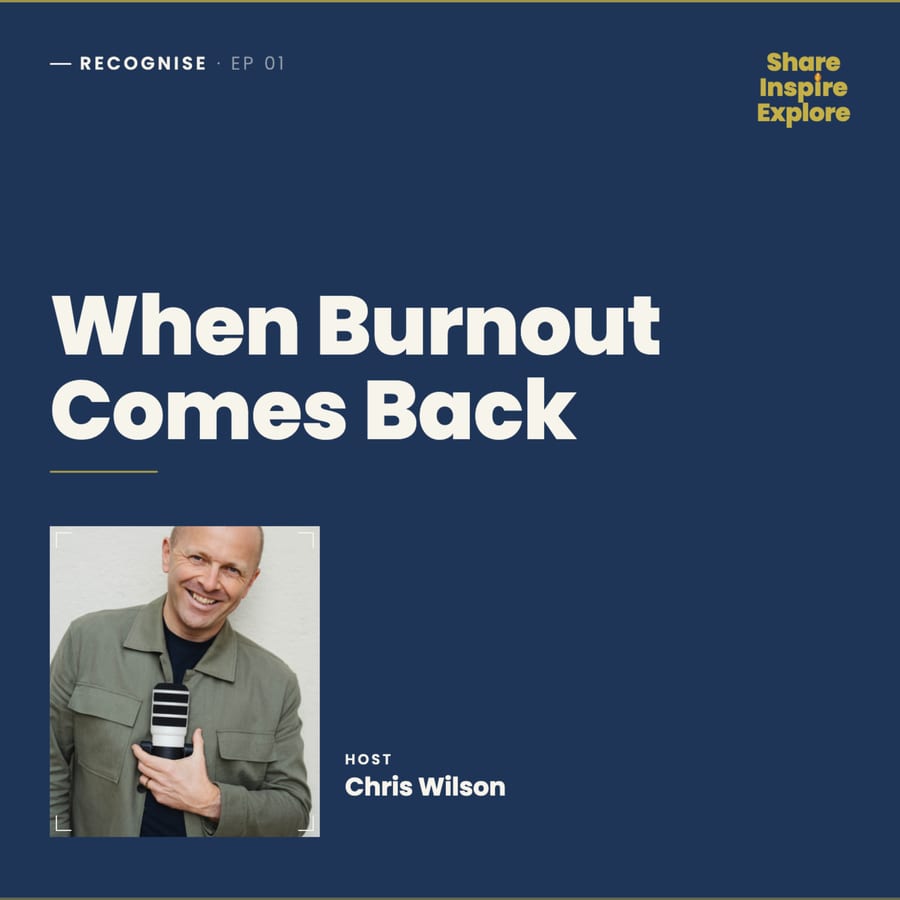
When Burnout Comes Back
Prefer to watch? This episode is on YouTube and the show is on Spotify.
About this episode
Burnout can come back. Even when you have been through it before. Even when the work you are doing is work you built for yourself.
In this Season 2 opener I give the honest account of what happened between seasons. A second burnout, with significant circumstances outside my control, and a part that was genuinely mine to own. The podcast had become an escape. The work addiction found a new vehicle and dressed it up as purpose.
This one is about treating burnout as terrain that keeps demanding respect rather than a thing you survive once and file away.
Why burnout can return even when you love the work The part that was outside my control, and the part that was not Nine months writing my own story, and the relief when it finally went out
Season 2, Episode 1
Season 2 runs to May 2027. Twenty-nine episodes. Recognise. Reset. Reinvent.
Share. Inspire. Explore. is the podcast from Where I'm At, honest conversations on burnout, career change, and what comes next for working professionals.
Join the Where I'm At Community, free to join: https://community.whereimatcommunity.com/store/product/membership Website: https://www.whereimatcommunity.com
Where I'm At is based on lived experience, reflection, and educational support. It is not therapy, counselling, crisis support, or professional advice. Please consult a qualified professional for individual medical, psychological, legal, financial, employment, or specialist support where relevant.
Read the full transcript2,179 words
Automatically transcribed, so it may contain errors and does not identify who is speaking. It follows the conversation in order.
Welcome. This show is for people in the middle of something difficult. If you're navigating burnout, a career change, or rebuilding something that stopped working, you're listening to Share, Inspire, Explore. I'm Chris Wilson. I've been through it. And I built the Where Amats community because I couldn't find the conversation I actually needed. Season two is guest-led. In each episode, I sit down with someone who's lived it or studied one of these phases. Recognize. Reset. Reinvent. Real conversations. Nothing packaged. Let's get into it.
Welcome back. Season two's arrived. If you've been here since season one, thank you. And that's a proper thank you, not a formality. You know, because you showed up for something that didn't really exist. And you listened. You shared. Some of you came in to the community. And that matters to me more than I can probably say often enough. And if you're joining me for the first time, welcome.
You picked a good moment to arrive. I'm Chris Wilson. This is Share, Inspire, Explore. The podcast from where I'm at. Honest conversations about burnout recovery and what comes next. And this is not the version that takes a weekend to fix. It's the real thing.
Season two is around 30 episodes and it's running through to May 2027. And it's going to be over three acts. So first it'll be Recognize, Reset, and then Reinvent. The same framework that runs through everything I build at where I'm at.
And the guests this season are people I'm proud to have on. We'll have some researchers, experts, psychologists, survivors, and just people doing serious work at the sharp end of burnout and recovery.
And when I look at that lineup, I'm still a bit surprised it came together the way it did. The reason I keep building this is pretty simple. When I was in the worst of burnout, I couldn't find what I needed. Sure, you can find a therapist, you can find a book, but a structured, sustained journey through the whole recovery, told honestly by real people, and without a price tag that adds to your financial stress. I couldn't find that. And so I'm building it. And that's the reason I'm still here.
Before I get into what the season looks like in detail, I want to tell you what happened between the seasons. There was a burnout wobble from my side, a real one. And I want to be clear from the start. It never made me want to stop. This podcast and the community alongside it bring me real joy. And that held all the way through. But there were some hard months. And honestly, there's no better proof of concept for burnout recovery. And the platform than the person who built it is going through it again.
And so let me tell you what actually happened. The last year, the wheels came off. Not dramatically, or all at once, but they came off. And, you know, we had some home improvements, unexpected. They hit us financially. Didn't see those coming. Um, there was my workplace. It was definitely the wrong fit. And very triggering in ways I didn't expect. And this, of course, it impacted my sleep, anxiety, anxiety, and everything downstream of those two things. And I responded the way I've always responded. I worked harder. Not at the job. At this, at this community and the podcast, LinkedIn, all social media, seven days a week, on top of employment and everything else. I could feel the pattern reasserting itself.
And the strange part is I could watch it happening, you know, because the episodes were on screen. And when I watched them back, I didn't like what I saw, to be honest. I looked different. And you can see them from around episode 13. You can see it in my eyes. And I was behaving differently. So this was a very public decline. I knew something had to change, you know, and I was looking for a move at work. But my body got there first again, and the way it always does when I don't listen to it. And then came the shame, you know, because this was the second time, but probably the third or fourth, um, if I'm honest, and I'd built a community around burnout recovery. And here I was burning out again.
And that's hard to sit with. But what was different this time, I knew who to call, I knew what to do. And the recovery steps were clear. And so I think for around three months, I stopped posting. I actually stopped everything. I just tried to rest. And something I was told a while ago stayed with me, you know, burnout recurrence is highly likely if you've had it before. And that's hard to accept, you know, because we're built to learn from our mistakes. And so if you've been through this once, I should be immune to it, shouldn't I? So, yeah. But a huge part of what happened was not in my control. Basically the environment, the circumstances,
things going on around me. I couldn't fix those no matter how hard I tried. And I tried. But what I can say is I've learned what I needed to learn from that. And I've moved on from it. But the part that was mine, that part I could see clearly when I stepped back, was just basically this. The podcast had become my escape from what was going on around me. The work addiction I've talked about openly on this show found a new vehicle, you know, one dressed up as purpose, which made it harder for me to see what it was. And you can't burn out on something you love, right? Except you can. And I did. And that realization that I had also contributed to this alongside everything else
changed how I came back. Because there were two things to address. What was happening around me, which I dealt with, and what I was doing to myself, which was mine to own. And that distinction matters, because it would be easy to look at the second burnout and see only the external causes, which were real and significant. But if I look outward, I miss the part that I can actually change.
When I designed the logo for where I'm at, I had no real understanding of the brand archetypes in marketing. What I had was just a feeling. Because I'd been through something enormous, and I was coming back up. And I wanted the brand to reflect that. So I chose the hero archetype,
like a phoenix rising from the flames. And at that stage of my recovery, it did make sense. But what the wobble taught me, and what Dr. Ben Searle reinforced in his interview on this show,
if you recall a man who spent his career researching burnout, and burned out himself, is that burnout recovery is not linear, not feared, respected. The new business doesn't make you immune. And you can't run from your old wounds. They come back in different guises.
Maybe with different labels, but the patterns travel. So the brand archetype, hero, was definitely the wrong fit. You know, because hero implies victory. A battle you win and you move on from. So now I've chosen the guide and explorer, which fits better.
You know, because it's about paying attention, adjusting, and moving at the right pace for the terrain. Not doing less, working more sustainably. So I've been building systems that absorb the drain, so the energy goes into the work that matters. And that's what the last year has been.
New systems, new ways of working. Not to do more, but to keep going without burning through myself. The respect I have for burnout now is different to before. I can use some examples, like a sea swimmer, right? They don't, they don't ignore the tides. And they don't dismiss weather warnings because they're a strong swimmer. They respect the sea. And they pay attention to conditions. And they know their level.
And just like the sea swimmer, a mountain climber does the same. The terrain doesn't care how experienced you are. The weather doesn't care how much you love the mountain. Burnout is the same. It doesn't discriminate. It doesn't care how meaningful the work is, how much you love it, or how good your intentions are. What matters is whether you're paying attention to the conditions, your environment, the people around you, and how you're treating yourself. That's in my control.
You're finishing season one with my story. You know, writing my story took longer than it should have. Much longer. Season one was always going to end with it. But I kept filling the season with other things. You know, better episodes, I told myself. More important conversations. But all the while, I was getting small tasks done around the house, calling it productivity. The truth is, writing it forces you to go deep into where you were, into how you felt, into the version of yourself you'd rather not look at for too long. I wanted to control what was said and how it was said. Not be interviewed. You'd not have someone else shape it. Mine. In mine words. It's not perfect. And why would it be? It's my
story. Not a finished performance. Many people have their own version of it. Most of them will never share it. And that's completely fine. But I know people who want to. And I've already recorded episodes with some of them for this season. Now what surprised me was how it felt when my story went out finally.
Huge relief. The sense that I could almost move on. Like something had been set down. And I can feel this creative space has opened up because of it. The season feels different to build. A bit lighter.
More generally mine. Season two is built around the same three phases that run through everything I do at where I'm at. Recognize. Reset. And reinvent. And just to recap. Recognize is about seeing clearly. What actually happened. What burnout cost you. Really. And what patterns and environments led you there.
Whereas reset is about building steadier ground. We covered the nervous system. Relationships. Identity. Who you are now. And what do you actually need. And finally reinvent is where it gets hopeful. Quietly hopeful. What it means to build something that's more genuinely you than what came before. And these aren't steps in any line. People will move between them right. Return to earlier ones. If you're going through it. Try to use the one that fits the season you're in. So episode two goes out on the 12th of June. It's with Catherine Churts. And it's one of the most honest conversations I've had on the show. It was actually the very first guest episode I ever recorded. This is well over a year old. Looking forward to it. So the season runs to May 2027. Around 30 episodes, as I said, guest conversations, solo ones.
We have a psychology mini series in the autumn and a four part series on life after burnout in the new year. I'm genuinely proud of what's in here. Instagram is where I'm spending more time now. Away from LinkedIn. You know, LinkedIn, things never felt quite right for this kind of content.
And short form is where I'm going now. It just feels more sustainable. And so I've built things behind the scenes so I can show up more consistently, you know, without grinding myself down to do it. If it becomes too much, of course, I'll adjust. I'm in charge of that dial now.
And that honestly is everything. One more thing before I go, the where I'm at community is open. If any of what I've talked about today is where you are right now, you can start a 14 day free trial.
And just the community, no commitment beyond that. And there are two courses built in if you want them, but you don't have to start there. Start with the people. So the link is in the show notes.
If any of this episode landed, share it with one person, not a mass forward, one person you think needs to hear it. And that's genuinely how this reaches the people who need it most, because they won't search for it themselves. Subscribe, follow wherever you listen, and I'll see you on the 12th of June. Take care of yourself. And I mean that.
Thanks for being here for this one. If something in this conversation stuck with you, share it. That's genuinely how this reaches people who need it. The where I'm at community is in the description of today's conversation hit home. Everything else is in there too. Guest links, where to follow the show. I'll see you in the next one.
I'll see you in the next one.