
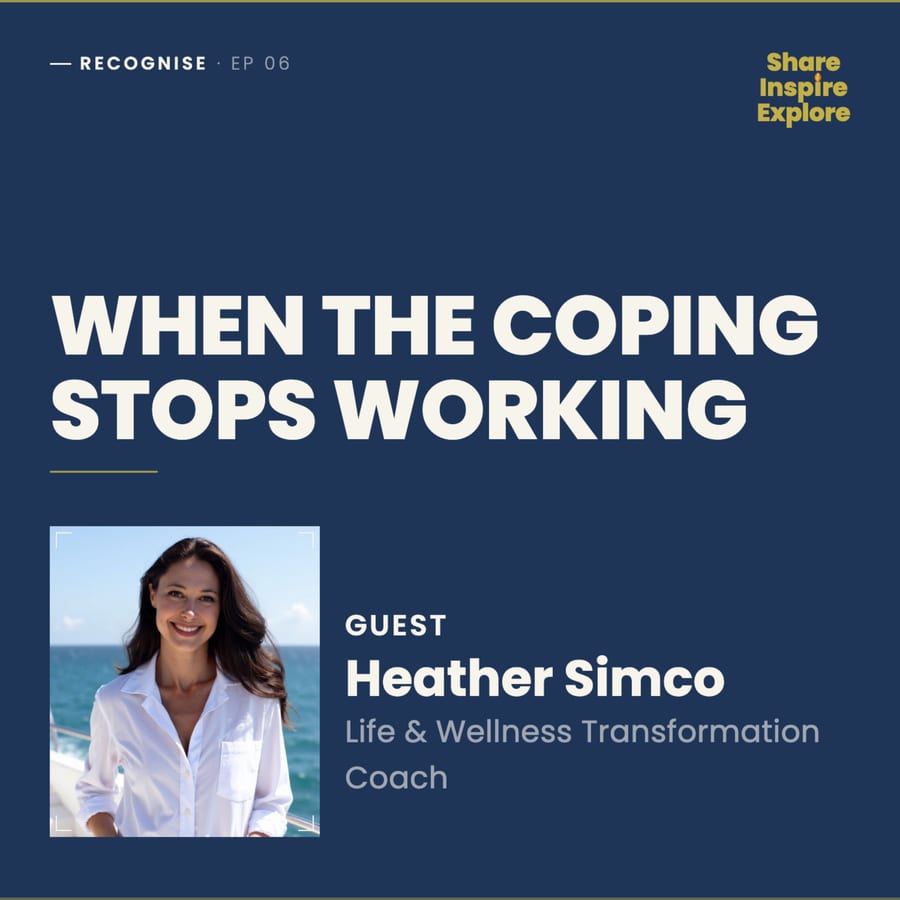
When the Coping Stops Working — Heather Simco
Prefer to watch? This episode is on YouTube and the show is on Spotify.
About this episode
Heather Simco built a career, a business and a polished public life while privately struggling with addiction, and almost nobody around her could see it.
Content note: this episode includes a personal account of addiction and references to suicidal thoughts. If you're struggling, please reach out to someone you trust. If you feel unsafe or unable to cope right now, please contact local emergency services or a crisis support line.
Crisis lines by country: https://en.wikipedia.org/wiki/List_of_suicide_crisis_lines
Heather talks with Chris Wilson about how ordinary coping, from overworking to alcohol, slowly took over, why the people closest to her did not notice, and the turning point that led to more than twelve years of sobriety.
It is an honest look at high functioning addiction and at what we reach for when we stop looking directly at it.
How high functioning addiction stays invisible, including to the person in it Why the people around her could not see what was happening The turning point, and what twelve years of sobriety were built on
Season 2, Episode 6
More from Heather Simco: https://linktr.ee/heathersimco
Share. Inspire. Explore. is the podcast from Where I'm At, honest conversations on burnout, career change, and what comes next for working professionals.
Join the Where I'm At Community, free to join: https://community.whereimatcommunity.com/store/product/membership Website: https://www.whereimatcommunity.com
Where I'm At is based on lived experience, reflection, and educational support. It is not therapy, counselling, crisis support, or professional advice. Please consult a qualified professional for individual medical, psychological, legal, financial, employment, or specialist support where relevant.
Read the full transcript9,658 words
Automatically transcribed, so it may contain errors and does not identify who is speaking. It follows the conversation in order.
Welcome. This show is for people in the middle of something difficult. If you're navigating burnout, a career change, or rebuilding something that stopped working, you're listening to Share, Inspire, Explore. I'm Chris Wilson. I've been through it. And I built the Where I'm At's community because I couldn't find the conversation I actually needed. Season two is guest led. In each episode, I sit down with someone who's lived it or studied one of these phases. Recognize, reset, reinvent. Real conversations, nothing packaged. Let's get into it.
Before we start, a quick word. This episode talks honestly about coping patterns, alcohol, food, perfectionism, busyness, and what it takes to look at them clearly. Everything Heather and I share comes from the lived experience and coaching practice. It's for education on informational purposes only. It is not therapy, counseling, crisis support, or professional advice. If anything in this conversation reflects something you're currently struggling with, and particularly if you have concerns about your relationship with alcohol or any other substance, please speak to a doctor or qualified healthcare professional. You do not have to figure that out alone. And there's real help available. This episode also includes references to suicidal thoughts. So please take care as you listen
and feel free to step away or come back to it another time. If you're in crisis right now, please reach out to a crisis service in your country. Links to international helplines are in the show notes. Now let's get into it.
Welcome back to Share Inspire Explorer. My guest today is Heather Simcoe, a life and wellness transformation coach and founder of Complete Concierge Solutions. She works with high achieving people who look polished on the outside and are carrying something much heavier on the inside. Before she did this work, she lived it. Building a career, a fitness business, and a public life while privately unravelling. In 2014, she reached a turning point. As for help, has been sober for over 12 years.
That experience is the foundation of everything she does today. Heather is also our first guest from North America. She reached out to the show directly. I'm really glad she did. Heather, welcome to Share Inspire Explorer. Thank you for having me. Appreciate it. Would you like to just tell our guests, our new listeners, and our seasoned listeners a bit more about yourself?
Oh, yeah. How much time do we have? Grew up in California. I moved to New York, was there for 15 years, and now I'm in sunny southwest Florida, melting right now. Everyone's laughing. I've been here for about 14 years. I've been married almost 24 years in a couple weeks, and together 30. I have a 21-year-old daughter, and just really passionate about what I do now, being able to coach and use what I've been through to help prevent other women from hitting the same stumbling blocks and pitfalls, and really not go over the cliff and be able to have a turning point in their life to live while they still have their lives to live.
Powerful stuff. So most of the people listening to this have never described themselves as struggling. Maybe they describe themselves as busy, tired, stretched. When does that start being accurate and start being something else?
Those are the warning signs, I would say. Your body and mind have a way of letting you know. And it was funny, I was working with another woman who talked about signs where you can get hit by pebbles, stone, bricks, or a Mack truck. Like, you can choose when you stop getting hit by the warning signs. And for me, unfortunately, with a Mack truck, but looking back, hindsight's always 20-20, all of the signs were there of coping, of escaping, of putting one thing down, picking something up. But yeah, being busy, a lot of those coping mechanisms, what I was doing, all the warning signs were there. But it's almost like a Monet. You kind of step away to see the full
picture. So that's what I'm trying to help other women do is step away before everything falls apart, before they can see the full picture of where they're at. But they're definitely, I find those are the warning signs or excuses to not want to dig deep to actually figure out what's really wrong or what they know is wrong. They're not ready to change it yet.
When you look back at your story, it would be interesting to know what you were using to cope and what was it helping you not? Yeah, when I look back at my story, really just a quick overview of my childhood. My parents were teenagers when they had me. My biological mom ended up not raising me. My dad married a stepmother, which turned into a very typical Cinderella type story. But they were kids raising kids. She was like 14 years older than me. My dad was 20 when he had me. And there was a lot of lies that were formed around pretending we were the perfect family, stays at home, stays here, and don't talk about it to anyone
else. And in adulthood, especially as an addict, it taught me how to keep a facade up and stay broken inside and not let anyone in to see what was really going on. But that duplicitous kind of dichotomy in life hit a brick wall, basically, my freshman year of high school, where I finally let a best friend in. My grandmother is very controlling, but I let them in long enough. And back in the day, we used to actually write letters to one another or email because it's arqueous. She sent a letter from whatever she's visiting her dad and said something really horrible about my stepmother. She found it and then cut her out of my life. And this is where I found my first coping mechanism, which was food.
So I went from being very athletic in high school to one summer, I think I packed up like 40 or 50 pounds in whatever, two months. I went on the seafood dive, my style food, I ate it. And I just, depression hit and I just started eating and then not realizing being depressed and then eating and coping just spiraled to more depression. And then there was more, a lot of verbal abuse growing up in high school with my parents, especially my stepmother, to the point where I felt fairly suicidal at certain points. And they didn't really get into sports anymore. I stayed in like, I was in Nerdville. I grew up in Silicon Valley. So basically where all the kids, parents are IBM nerds and whatnot.
So here I am, I've got three years left. I'm like, okay, suicide doesn't seem so smart. I used to babysit like it was the neighborhood babysitter. I was basically self-disployed since I was 11. And I'm like, I got three years left. Didn't seem like the smart way. I'm like, I can, there's a light at the end of this tunnel. So I just doubled down, focused on getting good grades and getting into college as my way out.
And then my stepmother was actually from New York. So we ended up moving across country after I graduated high school to go to college. And at 17, I was just done being treated like I was a kid. My parents were dropping me off at school, like I'm in high school again. I left and I was on my own,
no car, no driver's license, 3000 miles away from where I grew up at 17 years old in college. And so I just bootstrapped it and figured it out from there. But 17, first year, you know, moving to the dorms, let's go to a party. And that's where I discovered alcohol. Like, what is this magical thing? Because my dad was an alcoholic growing up, but it was in, he didn't drink in the house. He had his own hiding. He's actually been, he's two and a half years sober now on his own sober journey. And a lot of it was swept under the rug. So I didn't really understand what it looked like. He'd come home and
throw up and I thought he was just sick, not drunk. So I really had no concept of what an alcohol looked like, what AA was. And he, it really, I just had no idea. So go to college, college, he gets a one-on-one experience right out the gate. And by my second year of college, that's when I started dating my husband. And he was a little older, he was 25. And he was very well known in the area. And so I got to all the front of the lines and drinking. I didn't have to pay. And so that's where I discovered very early on, I have no off button. And I thought it was cool to
just vlog until I passed out. Problem is when everyone graduated college and the behavior stopped, mine didn't. Oh, and I was going to be a school teacher. So that's not cute either. And no, exactly. Seventh grade, like ninth graders. Yeah. Um, I had a few crazy incidents happen that should have gotten me fired and should have gotten me at DUI. And my husband and I'll, I know you're asking me for the show. We ran at the cusp of the very beginning of mixed martial arts, uh, Brazilian Jiu-Jitsu school. And so he was on the forefront of that industry working on instructional. So we taught cops and all of these different people where I did something wrong. They said,
just make sure she doesn't do it again. So I had the most enabling, like if someone pulled me over, had like, who, how many calls do you want to get? Um, or just let me go pretty much. So I literally got away with everything. I did not suffer the consequences. Most other people do because of my environment and my first year teaching, I absolutely should have lost my teaching license, my driver's license. Like it was, it was very bad. And that stopped me long enough to, we were going to, we were trying to have a kid. So we, I stopped because I was like, well,
I want to have a healthy baby. And that should have been my first indication, aside from all the crazy incidents that had happened before, uh, which I could get into, but I'll be here all day. Like most of us. And so I put down the drink and I managed to keep it down for four years. I've had my daughter was healthy, but what happened, I didn't know what a dry drunk was and I had severe postpartum depression. And, um, I thought because I stayed stopped for four years, I can control it. And if anyone is a full blown alcoholic, you know, that's just an illusion. And I picked up right where I left off in my mid twenties and
I continued to spiral. But despite all of that, our business stayed very successful. We did online instructionals, selling books and DVDs way back and fast. And we actually had art media, self-published books, you know, training. And I was able to actually quit my teaching job and work all time business. And we built it up to 400 members, multiple locations. And it was just, it was a real, real huge thriving business that we were part of it and semi-retired in our early thirties to Florida. Like we lived the dream. I go from homeless at 17 to living in paradise in my early thirties, semi-retired. I'm like, I'm like, I'm going to shop for a Bentley and go to the beach
every day. That was like my goal. I'm like, that's it. I have arrived. It's fun. This is amazing. And within a month of moving down here, I get rear-ended and, um, it ended up causing nerve damage, no drinking involved. I just didn't stop for yellow girl was texting and driving rear-ended us and all the impact hit my hip and knee, which was on the console. And so that's the point at which everything I had fought for, I would look for everything on paper title. I was the purple belt I was willing to just do. I was Mrs. New York, like anything to prove everyone wrong that I was less than as a team to like, I have arrived. All that basically swept away. Like I couldn't work out.
I had to ask for help to bring in groceries. Like everything got flipped away that I thought made me me. And so God's like, all right, Heather, you got to deal with you. And so here we are in paradise. I had built my guilty cage and I couldn't stop drinking and I couldn't understand why I couldn't stop drinking. Like I've got everything. Why am I depressed? Why am I suicidal again in my thirties? I've got a wonderful kid, amazing husband. Like, but I think it was same with everything we succeeded that should build that voice. And I just couldn't stop drinking. My husband, you know, after years and years of all this, we've kind of just got lost along the way.
I initially went to a therapist. We went together and I thought we were trying to help my husband survive suburbia because we come from like upstate New York where we're like kind of isolated to like neighbors right next door, which I grew up in California. I'm like, I got to fix my husband. And so we go to therapy and she sees both of us and then goes, Heather, all right, why don't you come by yourself? Like, okay, great. We're going to come up with a plan, fix my husband. Yes. Like, so I sit down and she goes, okay, Heather. So do you think you might be an alcoholic? I go, no. It's a classic answer. I have a consumption problem. If I can learn how to control my drinking, like I controlled my
husband because I was now a fitness guru. Like I lost all the weight. I'd become Mrs. New York. I'm like, all right, I conquered ice cream. I can conquer alcohol the same way. Not a consumption problem, not an alcohol problem. And that was the last time I ever went to her. And so I was like, I'm glad I smoked in the shape of the mother. I was just like, peace out. She doesn't know what she's talking about. And so a few more crazy situations happen. And finally, my husband's like, we can't do this anymore. We need community. And so he grew up Catholic. He's a recovering Catholic now. I grew up kind of agnostic in church as a little kid, had a few other experiences. I'm like, okay, let's find a church.
So we found a non-denominational church and started attending. And I signed us up for like this group, you know, just basically like a, but whatever, embrace group is what they were called. And which actually I've done my husband. And once I tell you what he does now, he's funnier. He's like, we already go Sunday. Like, why do we need to go again? I'm like, if we're going to do this, we're going to do this right. Like that's kind of our motto. And so I go there and there's two women, one who was seven years sober and her husband happy. Like I'm seven years sober, like laughing. Okay. Why are you saying this out loud? And why are
you happy? Then another woman right next to her goes, I'm 25 years sober. And she's laughing and she's happy. I'm like, and here, I don't even know how much I drank before coming in. I'm like, you know, you sweep this undergrowth. You don't say that out loud. And so I know I was like the first experience I ever had with people in recovery blew me away. And, but luckily because of them, I knew who to go to because I just couldn't stop drinking. And finally we met with like the pastor and different people. And one of the women would become my first sponsor. I go to a meeting, I sit down with my husband and my pastor and I have my
coin and my Bible. I'm like, get off my ass. I'm in the program. Believe me, I'm doing the thing now, but still drinking before meetings, drinking in the bathroom meetings. Like it was just, I couldn't stop. Like I'll do, I did like six weeks, I do two months. So I went about a year and a half just floundering in the program. Just thinking I somehow didn't fit the bill. I compared, I didn't hear my story enough because I really didn't think I belonged there. I was like, and I didn't want to be an alcoholic. Like I didn't want that label in my life. Like I'd already overcome so many other things. I'm like, I'll just do the willpower
things or whatever. But luckily enough, I got in there and that's where April 30th, I finally, I was driving and now I live in a vacation town. So you can drive past a 7-Eleven and pick up a bottle of wine. Like it's everywhere. It's raining, it rains booze in Florida, I tell you. And so I couldn't drive past the place without picking something up. And I finally got home. My husband, who's my best friend, he wouldn't talk to me. My daughter was like, I'm out mom. She's like nine years old, enough trauma for her. And I'm all alone in my room, which never happens. And my pastor wouldn't pick up, sponsor wouldn't pick up. Like she was done with me lying to her. And finally it was the
night and I was like, all right, God, fine. Like I completely and totally surrendered. I put my face on the floor and just said, fine, just take this from me. Cause I don't know. I didn't know what else to do other than just, just surrender it all. And that was a moment that that compulsion of drinks was finally completely lifted. And that's where I've been over 12 years now. It's just now doing the program, going through the summer things. But once you put down the drinks, that's when all the work begins and it's like the rewiring, all the hard work, all the events.
So that's my, where I, you know, I hit my, my sober date and rebuilding my life thereafter. But in the process, we lost our business because me and my shareholder, who was probably also an alcoholic, one hungover email, he stood it in from the inside out. And so the 20 years empire that we built completely crashed. I had ended up working in retail to start all over again. My husband started working for our church. He's now the lead pastor, which is hilarious. I'm thinking of like a third degree black belt. I'm personally jujitsu, the first author and American author to lead pastor of a church. It was like complete flip and working in recovery and just finding my footholds and rebuilding
myself. But again, once I put down the drink, I picked up the food again. And then if I put down food, it was just the same thing. I realized it was chasing the same road, different branch and really getting to the whole person rewiring my thoughts, my emotions and just building a well-balanced version of myself that wasn't living in extremes anymore and making sure that I was doing that. And now being able to help women do that all the way. But that's what, that's, that's my journey and how I got here. So my, my sober journey.
Well, thank you so much for sharing on some very sensitive topics there. And I just like to, to go back. Do you think this, I mean, you're, you're obviously a high achiever, right?
What was this, was this a drive from you inside to prove your worth? This is a burnout podcast, right? But the pattern is similar, right? Entirely. It's a different addiction. It's just, unfortunately, you know, it's also a more, more negative connotations publicly because, you know, and, but it's essentially the same patterns, right?
And to yourself, your worth through your work. And I guess the alcohol was the coping mechanism. So I would, would you consider yourself as being burnt out during that time? I mean, you must have at some point had a crash, you know? Oh, definitely. I, I just think I numbed it so much with alcohol. I didn't notice it along the way. Even teaching, like that's where I had to quit because I was burning too many different, I was too many different personalities. Like here I am, I'm hanging out with some seriously like high level individuals on the weekend and then teaching something great on a Monday morning. They're like, what'd you do last week? And I'm like, I can't tell. I had a good,
I had a good weekend. I can't tell you many of the details, guys, but it just, living that many lies and that many versions of myself was exhausting. It was entirely exhausting. And that led to a lot of the burnout. So I had to put down that version of myself. And then I found new life being self-employed. You know, you can't fire me. I can, I'm in control of my environment. And then I would just chase extremes. How many people could I sell? How much money could I make? How, how I got a mile already. How fast could I drive that car? Like I love living in those extremes. And so if something, you know, I burn out in one area
and then go in something else or go toward a goal, see it in sight and then move to the next one. I'm like, okay, I'm done with that. But burnout throughout the way, what happened? The bowl, I think, crashed. I think I lived like just above bowl, crash and burn right up until the final descent, April 30th of just having to get sober because it was just living that many lives and versions of myself just didn't work anymore. So, but throughout the way, yeah, different burnouts. But all I think happened, like when I was postpartum depression, that was super difficult. A lot of depression in that. But then I just channeled it. I was like,
all right, great. I'm going to go do pageants now, or I'm going to go, you know, I just put another, another obstacle to, to not, you know, to avoid dealing with something else, to attack something in the meantime. And then you get the adrenaline of the, of everyone giving you the accolades. The more you succeed, the more everyone, you know, gives you the affirmation, which is addictive in itself. And so even if you burn out one area, you're like, okay, I'm like, I'm done with that. And you move something else. The minute you succeed in that, you get more affirmation. So it's just almost like hopped from the burnout to go to do something else. And then the final burnout was toward the end. But in sobriety, I've noticed a lot more
is when I'm exhausted. I need sleep too often where I'm cranky, where even just recently, I have my own coach I work with, just too many jobs, too many, too many things on my plate. I was like, nope, I'm, I'm feeling this again. I want to take something off my plate before someone else decides that it's coming off my plate. So I'm a lot more aware of hitting burnout than I was before without coping. So that's the, that's the magic little, you know, cocktail of life at that point. That's an interesting way to put in a cocktail of life. It's the chase, right? It's these patterns, Heather, you know, the alcohol, food, perfectionism, the busyness.
What would you say they have in common? And what's that underlying mechanism that makes them all reach for the same thing, in your case, alcohol? It's the, I found it's the dopamine hit. It's the high of something new. It's almost like every time you get like a new planner, you buy a new car, like it's that initial adrenaline.
And then learning how to live in the middle makes you uncomfortable again that you look for the next dopamine hit. And, and for anyone listening, at least for me, what I found out is yes, alcohol is part of my coping mechanism, but I also have ADHD. I have other issues that I have to deal with. So normally it's never just one thing. Everyone's got a different mixture of, of the makeup that makes them whole that I would, I've been, I chased that adrenaline, like even shopping. Like I can literally turn anything into addiction, but it's that dopamine hit. It's that like initial, that high of whatever that is. Then when it's gone, I'm moving on to the
next thing. And I think that's why as addicts or high achievers, you're just, you know, if for alcoholics, you're chasing that, the feeling of the first drink, but you're just keep chasing that initial high, whether it's a new hobby. I mean, how many of us pick up like, I'm going to start golfing and you get in the middle of golfing and then you start golfing and you're like, I'm bored now. And I need to move something else. And so we keep shifting because we're looking for that initial high as opposed to learning how to live comfortable and that growth, which is where I think a lot of people have the hardest time, especially if you get so much affirmation of your job. If there is no
limit or there's no, like you can go to the next promotion. And the worst thing, like with money, you can always make more money. Like the things that are limitless, those are the most dangerous, like alcohol is less substance abuse, food, like anything that's limitless, that's where it's dangerous because you're, you're chasing that next high. And in certain worlds, especially work, that it comes with notoriety, it comes with titles, it comes with money, which then feeds all your other addictions. It's just, you know, for me, it's like, and that's what happened. The more money I made, the more alcohol, I got free alcohol. I didn't even just pay for it anymore. I'm like, I didn't realize the more successful you are, the more free stuff people give you.
I remember those poor kids shopping at Target, like checking at the Ritz Carlton, getting handed free booze. I'm like, I don't have to pay for this? What are you? Okay. It's a completely different world. And so you just keep chasing that over and over again. And so, I mean, I got to the point where there's no amount of shoes, booze, handbags or fast cars that could fill that void. Because I just kept looking for it. And it's like, and that's where the danger starts to happen. How fast you're going to drive? How much food are you going to eat? How much money are you going to make? How much are you going to ignore your family? Like how many areas of your life are you going to live in that
extreme until, you know, either you burn out or it comes all crashing down. But yeah, for me, it was, it's that adrenaline. It's a dopamine hit. Like it's that high. Yeah. You mentioned you've got ADHD. I mean, I heard that alcohol is, that is the chase, right? For ADHD. That seems to be the one that calms you down. Yeah. Yeah. I haven't mentioned it in this podcast, but I also just recently got ADD diagnosis. It's interesting. There's a lot of parallels in our stories, but we've just gone taking different paths. But if you can, I was thinking of my own story there. Were there times where you find yourself watching you do the thing and saying,
what are you doing? Stop. But of course you can stop. Yeah. A hundred percent. Like what, especially toward the end of my drinking, I would drink. I'm like, what are you doing? Like, I didn't even want to. And the next thing I know, I'm picking up wine and just slugging it down. I'm like, well, I had a perfect clue that there was no reason for me to drink. Why am I even drinking? And even like, even sober, like, why am I eating? Like, I've been caught myself a few weeks ago. I went to a meeting with a client and I was like, I thought it was going to be a bad conversation because I'm an awfulizer. I'm like, great. I got
to prepare for the worst. Whatever. Going in for war. Comes out. It's like completely opposite of what I thought it was going to be. It was amazing. And so of course, instead of just celebrating the win for the win, which was the adrenaline already, like, yeah, this is awesome. Like, let me go get some ice cream too. Here, I go back to my ice cream. But it's like, I'm like coming out of the meeting. I'm like, let me go celebrate with food. And I was like, why do you need to add something on top of the win? Take the win for the win. And I literally caught myself. But yes, I've been in those moments
where I'm like, well, in the middle of it, wondering why I'm in the middle of, why am I doing this to myself? And then that's the shame, the guilt, remorse. I'm like, well, screw it. I'm already halfway through it. We'll just keep going. Like, you know, so I think that was just, it's catching the middle part. So I don't, I don't keep going over the cliff. I call it guardrails now, but oh yeah, I more times than I can count. I've been through that mental process.
Yeah. And Sam can relate to the food as well. We shouldn't go shopping emotionally. That's the angry, lonely, tired. No, don't go shopping. And any of those hungry, angrily, lonely, they halt. I don't know if you've heard that acronym in the recovery room. Hungry, angrily, lonely, tired. Don't, don't make any decisions when you're in any of those modes, especially food. Very bad.
Were you getting to the point, you know, it's a dangerous tipping point, right? You mentioned you've had suicidal thoughts. Where it becomes, the drink becomes like, this is, I'm just going to do this until something stops.
Yeah. It was because you're, you've talked to yourself, even as you're doing it, why are you doing it? But it just gave up. And then at one point, maybe you just give up. And so it's like, well, this is me. This is me. And then the negative self-talk sends you in an awful spiral, right?
Well, for me, I was like, I can't, the justification started taking in, which is the worst, is I'm hurting everyone so much. If I just off myself, then I'll stop hurting them, even though that's the worst thing that I could do. That's the worst hurt you could put on anyone is doing that. But when you're in the frozen, it's that addiction and that, that level of depression and intoxication, it seems to be the only reasonable answer. That's how unreasonable your mind gets. And that shame, the guilt and remorse of putting everyone through that you can't find a way out. That seems to be the only viable solution when you're in it. And, and I've been, I mean, I've tried a couple of times, obviously not successful,
but been through a couple of situations that were, that seemed to be the answer in that moment. And God, I mean, so happy the fact that I'm still married at this point, what I've put my husband through. My, you know, my daughter's come out, she hasn't even drank, she's 21 now, but to, to show her the awareness of it all as well. But, oh yeah, like where your mind takes you when you're in those throats, just, I don't want to hurt anymore. I don't want to hurt anyone else anymore. I'm done. Like, I can't do this anymore. And to come out of that, like, that's the miracle, honestly, I think with anyone who gets sober, just coming from that depth, like your hair away from
hell, like, and to come out of it is just, I don't know. Fantastic. Yeah. Fantastic. You've, you've managed it and that you're, you know, your family stuck by you. If we can maybe go back to maybe underneath it all, when you stopped the things you'd been reaching, what was underneath for you? Um, and what did you actually find when that numbing was gone?
So much brokenness. I didn't find value in myself. I didn't love myself. Like, I don't think I believed anyone. Well, there are too many negative words. I was so mean to myself. Anything that I heard from my, as a kid, I internalized. But like, I realized my drive is more to prove everyone wrong, not to make myself feel good about myself or for self-love or because I valued myself. And I think that's where the true change happened in sobriety was doing it, being healthy for the sake of being healthy for myself, not for anyone else. Being sober for myself before anyone else. Like that I was worth being sober for myself. Like that, that sense of self-value and
love. And I'll, even when I went into the rooms for the first time and I'm like, we will love you until you learn how to love yourself. And they really, truly did. They loved me back to life. Like that was, I mean, literally one day, one stitch at a time of just understanding that my life was worth living for myself. That, that just, there was a broken four-year-old in there that just hadn't been like nurtured or loved for so long. I just kind of walked her away and was like, I don't know if you've seen that Don movie, Rocket Man, at the end when he hugs himself as a little kid, like I burst out in tears. I was like, that's it. It was like this broken version of myself down at the core. I had
to like rebuild her back up from the depths and let her know that she was loved and worth it to, to be here. And I put on a great decide, but woof, it was broken little kid in there for a very long time.
And what you, you mentioned faith obviously has played a significant part in your recovery. How do you work with the people who don't share that, you know, frame or who don't have a spiritual dimension in their life at all?
It's their own journey. Like I, I, for me it's attraction, not promotion. I, everyone's relationship with their higher power for me, that's Jesus, that's God. It's for them to discover. I'm just, I'm supposed to be the light there. However they find that path is up to them. And so I can share my journey, my strength and hope and theirs is their own. And so I let them, you know, I'll get women who are, you are Christian, but I wasn't as a, as a, when I was a teen and even in twenties, like if someone threw scripture at me, I was like, I like, get away from me. Like I literally repelled it. And so that's where I know it's just, it's the most important thing for someone to discover what
their spirituality is on their own. I'm here if they have questions, but that's, that's for them to decide for themselves. Everyone's relationship is, is their own to figure out. And so that seems like that's the best way to handle it. And honestly, being a pastor's wife out in the world, I feel rare. I'm a normal human being. And when I normally, that's the last thing I lead with. And so I'll be getting my hair done or like some of like beauty treatment. And I'm like, so what are you, what are you, I'm like, they'll find out. They're like, I've been talking to a pastor's wife this whole time. I'm sorry. I swore. I'm like, but it allows them to let their bar
down and let them know that I'm human. Like everyone's on their own dirt. So for me, it's most important for someone to be able to be themselves first. And then if they have questions, they can come to me. It's better that I'm here when they need me as opposed to force. It didn't work when people forced their faith on me. So I don't do it to others. It's not, that's not how it works. Or it didn't work for me. Same thing with AA. If you went around telling everyone they needed recovery, like how many people in the bar would be like, oh sure, I'll come all right along. Like I'll follow you at an AA meeting. It's the same thing. And that's
where even in our faith, we're just the, everyone needs it, but not everyone wants it. And so we actually run our church very much, very similar to the AA program, which is actually based on the Bible, which is hilarious, that we just come in line with that. It's just, it's so much more fellowship and love for where people are. And so that's, that's the approach that I take that I think is much more different than what the rest of the world experiences that, you know, at least especially for me, we're not, we're not normal in the way that we do our ministry at all. So it's very, it's much more online. So that's funny. Yeah. And if we move on from the faith and you did mention you burned out and you're more
burnout aware now, what has changed from those, those other coping patterns like the performing and what have you done to address those parts of your life? The strength for performance?
Yeah. I've had to learn how to balance it all. First of all, age kind of slows you down. Life kind of throws curve balls at your, even if you want to perform, your body's like, you know, we're not 25 years old anymore. You can do leg day and not walk for two days. So normal life has, has, you know, humbled me enough to know how to take things much slower. Like if I have goals, they're much more realistic than they were before. And then they're more achievable. And that's where, that's why my program and even what I do is called Balance because I've learned so much more about, I even, my most recent, several years ago, the last addiction I think I broke were fitness,
like weight loss competition where I join it, do a four week program, like lose a whole bunch of weight, get it all back, sign up again. So again, I was chasing the shiny balls, chasing like that, the carrot at the end of the deck. And it just wasn't serving me anymore. And so I realized I'm like, okay, I need to take this at an appropriate steady pace, which is why I work with a coach to keep me accountable. Someone in my life who can make sure like, okay, you're either moving fast or you slow down. Like we kind of play better markers that are there now so that I'm not living in those extremes that are unhealthy. Cause I got sick and tired of doing that over and over again. And that's really
where I found my last coach where I was like, I'm tired of just, I keep chasing these weight loss. I need to just do it again. Still fixing that four year old girl. I need to do it for the sake of being healthy, not for the sake of winning the competition. And that's where that finally, I broke that chain about two or three years ago where that was the final epiphany of like, wow, I got addicted to something else and even noticed it at this point. Cause it wasn't unmanageable. Like, so a lot of the signs were there, but same thing. It was burning out, it was working out too much. But now it's just
really, a lot of the signs are there and, um, being way more in tune. A really good, healthy routine has been tremendously different. Just reorganizing the way that I do my life so that I'm not chasing those highs because I'll chase the high, get tired and move on to something else. And then that now that whether it's content or my body, anything else that I'm doing, it just falls to the wayside and I forget that you go back to it anymore. So no, that's kind of really, Josh.
As somebody with ADHD, can you maybe describe those, those new routines that you have? Because it's this all or nothing, right? This is the fight. How have, what have you changed there to bring this balance or maybe more and more in tune with your energy levels?
Yeah, for sure. Yeah. Basically making sure I get enough sleep. That was the first thing that had to, like, I thought I could function on little mass of sleep, like almost like a badge of honor. Like how much caffeine could I drink to get through the day? So sleep was first and foremost. That's where I fixed it the most is getting at least as close to eight hours as humanly possible. Because I was waking up way too early to work out. So I could get in all my, you know, whatever I thought I needed to do. So I just, I put myself in a much healthier routine. I meal prep a lot. Like surprisingly, as boring as it is, I've eaten the same dinner for like the past
three months. Like I found something I really, really like and I just, I prep it about every week and I don't have to think about it. So if I, it's almost like I have to beat my ADHD if I run to an extreme instead, I know what to expect. So I have to kind of set those markers for myself. Getting up at the same time I go to the gym, even if I don't really do much there, I get up, I go there. Even if I only get 15 minutes on a treadmill, I make sure I stick to my routine no matter what it is that I'm doing. And that's helped tremendously. It's just having very clear
routines that I don't break. And for me, that felt very uncomfortable because I like the extremes, but I live the success and the marked improvement in my overall health has been so much better pacing it out as opposed to the other way around. And again, if I'm tired and I've learned, you know what? You've had a day. It's okay to go home at 4.30, cut things off like I'm self-employed. I can kind of make my day around it, but just listening to my body more and then adjusting like, okay, that didn't work. Now how do we readjust? So it's a lot more routine and discipline that's required to stay level. And then I have my vacations. There's other times where, okay,
this is when you can have fun. These are the times where you can kind of go wild. But outside of that, this is what I know I need to have a much healthier routine. And my daughter's ADHD too. So I have to like lead by example to keep her in check. It's like, even for her, I'm like here to water. Like, so it's almost like leading by example, making sure I'm doing it so I can teach her how to manage her hers as well. So it keeps me in check for sure. But I'm having to like manage both of ours, which could be my poor husband.
So maybe touching on that, your relationships have obviously flourished under the new Heather Simcoe 2.0 or 4.0, whatever that is. Is it something you've had to work on or is it just elaborate on that for our listeners? Yeah.
No, because a lot of it, a lot of it, the rebuilding is not just us, right? No, it's, oh gosh, the trust. Yeah. I mean, I'm told you're sober. I mean, building the trust back with my husband that, you know, feeling again, feeling feelings again, communicating that, what, you know, rebuilding a marriage around that, how we communicate when I'm in extremes, because he's afraid. Like, am I going to go back and do something that's unhealthy? Am I going to go back to being, you know, to drinking? Because if he knows that that behavior, same or a different branch. And so we've gone through a lot of, you know, our own counseling together, a lot of trust
building, a lot of communication we've had to just really dig in deep. And that's where my coaching, he's gotten his own help. Like we've had to work through what each of our triggers are and be able to communicate that with each other because he has his own stuff that every human's got something. But unfortunately, sometimes our, well, my triggers, our triggers, his triggers and working through all those. But thank God, like we just, we stuck it through. We're very committed people and we truly love each other that we just, we made sure to just stick it through. And even if things get bad, we just, I learned a lot of the tools from the program work to have a conversation that's kind of
like know when to shut things down, know when to have proper, you know, proper conversations. And the more open I was about what was going on, because I just, I shut things inside. It's kind of very, it seems like I'm very open now, but to really articulate my feelings prior where I was so used to holding them being verbally abused that to express how I was feeling, I would get punished for that. So to learn how to do that as an adult, that's what really saved our lives is finally like, it's not you, I'm feeling this, this is what I'm going through. And we just, we had, it was a lot of, a lot of talking, a lot of conversations and a lot of growth back and forth, you know,
that really did a lot. And thinking with my daughter, I'd rebuild trust with her. I used to drive drunk with her in the car, like to then teaching her how to drive, you know, to, you know, rebuilding our relationship. We're like best friends now, but it just, it took a lot of suiting up, showing up and just living that amends that I can be trusted, that I can face over, that my addiction or these issues aren't going to run me. I'm, I'm going to do that. But it was just a lot of action over time to just prove it. And I still am, but I'm in a much better spot now than I was a long time ago. But the time I made it, 24 years married
now, very soon, oh, 30 years together. But, but it takes, it just, it took a lot, a lot of work, a lot of self-improvement, a lot of communication and self-reflection and articulating that throughout. And his patients too, you know, just got us both there. So, but if you have a relationship that's worth it, you know, do it. Thank you really. That's very personal. So thank you very much for sharing that. I guess there's a lot of shame that can override these situations, right? How have you coped with those? Well, you've had to cope, but, and you're very open on how you've, you articulate your story. How did you work through that?
That, well, that, that's where the faith for me came in for forgiveness. Um, I realized if other people could forgive me, like if my God could forgive me for what I've done and the people I'm closest to in my life could forgive me, why am I so arrogant that I can't forgive myself for what I've done to myself and to others? And so that, that forgiveness is the key for me in letting go. I've been able to forgive other people. And I'm like, what? They, and I, even to this day, they're like, I can't even believe you're talking to that person. You have your, you're made in amends with them. And to have put myself in that equation
was the most important because I realized that I, again, going back to that four-year-old that I was worth it to forgive myself, that if I, if everyone else has forgiven me for the wrongs that I've done to them, why, why can't I forgive myself? And so that, that's just an ongoing, cause everyone's smile. You've got like, Oh gosh, I forgot that I did that one too. So you kind of build that built in, you know, okay, I'm not that person anymore. Am I planning on doing that again? No. Am I new now? Yes. Okay. So forgive that. And I, you know, I've learned how to move on from it, but that was, that was a huge process. Forgiveness was the key part inside
you know. Absolutely. And, uh, I mean, you've been sober, what, 12 years now? What does give you, what does it give you that coping never could? A new sense of peace and clarity. I've found clarity is almost like a new high, almost like the better I feel naturally. I could, I never felt this good. Anytime I tried to escape, whether it was food or any of the mechanisms that I use to try and escape feeling anything, even if it was good feeling. Actually, I liked keeping good feeling for the back. I was used to that. That was easy. Great. I got a bad day. Fantastic. Give me a good day. I'm going to escape. Weird, but learning how to feel all the feelings and be present has been
such an amazing experience that I didn't, I didn't understand that not having that coping cloud those feelings. I mean, cause I live in paradise. Like we get, I mean, to be able to absorb life moments where I'm at, what I'm doing, like that, that's its own high in clarity that I'm, I'm so grateful in sobriety that I can experience now. And the more I recognize if I'm using a coping mechanism and like that food's really easy, what I'm not allowing myself to feel that could be much more beautiful than escaping from it. And that has become kind of almost, that's the new highs and that's it. It's just like being high on life, like literally trying to live things in a clean and sober
manner and experience it. Cause I'm, we were, I'm about halfway through at this point and it's gone really fast. And there's so many other wonderful things to experience that I'm to eat, to have so many more of those now at this point in my life, these wonderful moments that I'll, you know, I don't know if your phone does it, like, do you remember this? And I'm like, I'm glad I took a picture cause I wouldn't have otherwise. But to now to still really be able to have those memories now is, is such an amazing high to have on a regular basis over anything that's helping mechanisms to give me.
I mean, we talked off air. Um, I'm not, I wouldn't consider myself an alcoholic. I just have abstained from it since, since my burnout, but definitely the patterns are there. And maybe to the listeners listening who also don't think that they have an alcohol problem and maybe they do think they're having alcohol problem for those who are listening and maybe not ready to commit to sobriety as an identity. You just want to look honestly at what they've been reaching for and why, what is the one thing you want them to take away from this conversation?
Yeah. First of all, you don't have to be an addict to be addicted. Every human has their vice. And the one thing that I learned in my journey of sobriety is every human has their vice. Are you controlling it or is it controlling you? And if you think that something is controlling you, I always recommend just try living without it for a week. It doesn't have to define who you are. And that's where my new message is like being sober as a human, it doesn't have to be, you know, specific. And quite frankly, like every human, I mean, as long as humans have been alive, we have escaping mechanisms, coping mechanisms. We like to escape from life. That's just who we are
as humans. So you don't, you don't need a label. You don't need to be considered an addict to look at your behavior and see if something is, is it constructive or is it deconstructive? It's really as simple as that. Is it helping you or is it hurting you? So you don't have to go to a recovery program, rehab, or go through anything strange to just look at, is this pattern of behavior helping me or hurting me? Why am I doing it? And can I do something that's a little bit more productive? And it's really, it can be just as simple as that. It doesn't have to be this off, you know, the stigma that we're still working for as a society that I can work through personally,
but it doesn't have to be a stigma just to be a better version of yourself. And if you're, if you're thinking about it, then you'll probably think you need to get rid of it. Excellent. Excellent. Excellent. Yeah. It's just the patterns of a very, very strong episode on the pattern recognition here today. Thank you. Where can people find you and learn more about the work that you do? Yeah. My website, heathersimcoe.com. I'm on all the social medias. Think, think, heathersimcoe. I think I'll give you my link tree. There's, you can, you know, people can connect with me with consultation, but all the social medias, I manage them, me and myself and my daughter. So you'll get me directly. I like, I'm very, very hands-on, very one-on-one because that's what makes
the change is having someone in your corner. So there's all the ways you can reach me. Excellent. So you're also a social media team as well. That sounds great. I must get my daughter to help. Well, it's easy, but she's good. She keeps me, keeps me well informed of what I shouldn't say. I'm like, thank you. Thanks. I appreciate that. Don't get canceled, mom. She's very good at that. Well, thank you for reaching out and coming on the show, Heather. It's been fantastic. And the fact that you've built your whole career now around helping people see what you had to see in yourself says something about what that kind of clarity makes possible. So congratulations. Thank you.
And to the listeners, if something in this conversation landed somewhere uncomfortable, that's not a bad sign. That's recognition. And that's what this episode is actually for. You might not be ready to put a name on it, what you've been reaching for. You might not want to, but somewhere in this conversation, I think you've heard yourself in something Heather said.
The question Heather left us with is the one worth sitting with this week. Not what you should do, just what you've been reaching for and what it's helping you not feel. Links are in the show notes. If this one stuck with you, share it with someone who might need it. It's genuinely how this reaches the people who need to hear it most. I'll see you in the next one. Thank you once again, Heather.
Thank you. Thanks for being here for this one. If something in this conversation stuck with you, share it. That's genuinely how this reaches people who need it. The where I'm at community is in the description of today's conversation hit home. Everything else is in there too. Guest links, or to follow the show. I'll see you in the next one.