
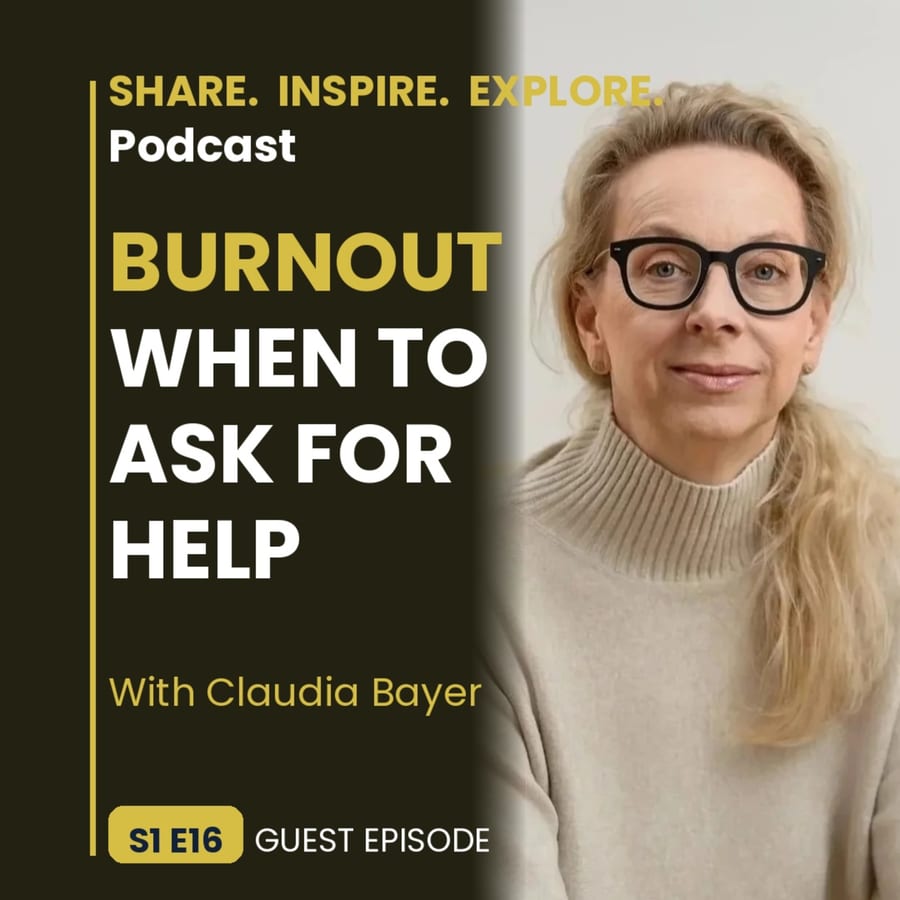
When to Seek Help for Burnout: Therapy, Coaching or Support Groups — Claudia Bayer
Prefer to watch? This episode is on YouTube and the show is on Spotify.
About this episode
If burnout has left you exhausted and questioning yourself, working out when to ask for help, and what kind, is its own problem on top of the first one.
Psychotherapist Claudia Bayer joins Chris Wilson again to look at the options people reach for in burnout recovery: therapy, coaching, and peer support. Not to rank them, because they do different jobs and the right one depends on what is actually happening for you. They cover how the three differ, what stops people asking at all, and the signs that what you are dealing with needs a qualified professional rather than any of this. Claudia is Head of Psychotherapy at Lebens.Resort Ottenschlag and runs a private practice in Vienna.
- How to recognise when burnout needs professional support
- What actually separates therapy, coaching and peer support
- The barriers that keep people from asking, long after they have noticed
Season 1, Episode 16
A reflection to sit with: what kind of support have you been avoiding, and why?
Share. Inspire. Explore. is the podcast from Where I'm At, honest conversations on burnout, career change, and what comes next for working professionals.
Join the Where I'm At Community, free to join: https://community.whereimatcommunity.com/store/product/membership
Website: https://www.whereimatcommunity.com
Where I'm At is based on lived experience, reflection, and educational support. It is not therapy, counselling, crisis support, or professional advice. Please consult a qualified professional for individual medical, psychological, legal, financial, employment, or specialist support where relevant.
Read the full transcript3,449 words
Automatically transcribed, so it may contain errors and does not identify who is speaking. It follows the conversation in order.
Welcome to the Share, Inspire and Explore podcast, the voice of the where I'm at burnout community. I'm Chris Wilson. And after my own journey through burnout and depression, I'm here to share real stories, inspire personal transformation and explore the path from burnout to balance. Each episode brings honest conversations with burnout survivors, mental health experts and mindset coaches, offering lessons, strategies and hope. Whether you're recovering, curious or searching for motivation, this is your space to grow. Let's dive into today's episode.
Welcome back, everyone. Today's episode is for anyone who's struggling with burnout, burnout and wondering, should I get help? And if so, what kind? Do I need therapy? Would a coach help? Or maybe I just need a group of people who understand what I'm going through. To help us navigate this, I'm happy to welcome back Claudia Bayer, a highly experienced psychotherapist specializing in systemic therapy for individuals, couples and families. She is head of psychotherapy at Leibens psychiatric resort in Ottenschlag, Lower Austria, and runs a private practice in Vienna, supporting adults, children and adolescents. Her deep expertise in mental health makes her a valuable guest and the resident mental health expert on this podcast. Welcome back, Claudia. I'm excited for
another conversation today. Hi, Chris. Thanks a lot for having me again here. So defining the options, as we mentioned, can you maybe explain the core differences between therapy, coaching and support groups?
Yeah. Therapy is more for, I'd say, deeper emotional or mental health struggles, trauma or chronic stress. If you happen to experience, for example, also recurring conflicts with others, but also for better understanding yourself, your emotions, your needs and your patterns. And coaching, I'd say it's more for goal setting, mindset shifting, or if you're in a decision making process, if you need some help with your career planning, for example. And that's, it's then ideal when you feel all right, but somehow stuck just regarding one question, for example. And then support groups. They are for sharing experiences, emotional safety, and peer-led connection.
When would somebody typically benefit most from each? Well, it depends. If you have general problems with setting boundaries, I'd say a group or especially a support group with no therapists, no therapist is not the right thing. So it's better to go on a single therapy in this case, or a coaching, depending on the question. But I'm really a fan of group therapy. So that's also very good if you need to share experiences, if you're able to do that. And if you're able to set boundaries, to see and that you're not alone, that's also helps a lot.
You know, you just said, Claudia, about the power of peer support. I mean, that really hits home to me. Obviously, it's exactly why I'm creating where I'm at, community. You know, for people who feel like they're barely holding on and keeping it together, just trying to rebuild after burning out. Yeah, as you said, safe, private space, connecting with others, because they know what you're going through. Yeah. And there's no, there will be no pressure to fix yourself or perform just honest conversations, sharing tools, support from, from people that have walked that same path. Yeah. So for you, the listener, if you've ever felt like you're the only one struggling where I'm at, we'll be here
to remind you, you're not alone. And that where you are right now is a valid place to begin. So Claudia, what, let's cover what therapy is. Yeah. There are so many misconceptions about therapy. Can you maybe break down what, what therapy actually is, please? Right. Therapy is, or, and has to be a very safe and confidential space to understand your emotions, your patterns, and your challenges also.
And place where you can process your healings and your emotional regulation. And it's always guided by licensed professionals with a real extensive clinical training. That's also very important. It's a very long training, actually.
How many years? At least five years. That's the minimum time. And then you go on and on with where you're interested in. So actually, it never stops, I'd say.
Well, it's very necessary. You know, it's such a sensitive topic, right? Right, right. Can you maybe explain what therapy is not? Certainly, it's not a place to get fixed overnight by therapists.
It's not like putting your car into a garage and getting it fixed by a mechanic because humans are very complex systems. It's not complex systems. It's not like a machine where you know what's wrong or what's not working and you just replace it by another part.
And then you have to take, that's also very important, you have to take responsibility for your life. It's not the therapist who fixes anything or is in charge. So it's your responsibility and you're also an expert for your life. So it's not the therapist. You know yourself very well and the therapist is just helping you for some, making some small steps at the time.
And then also, it's not some people think they just talk about their childhood. Sometimes we refer or talk about childhood or other past situations, but the focus, at least with systemic therapy, is really on this here and now and also on the future.
Finding solutions, coping, finding coping mechanisms, things like that. And very important, it's not a sign of weakness or failure. It's also not only for people in crisis, I'd say, because you can use it preventatively. You can focus on, for example, developing resilience skills.
It's like seeing a personal trainer for your mind, I'd say. Yeah, totally. I, it was a long time ago. I remember I first went to see a therapist and I went in with the false mindset. I, I thought they would fix me, uh, as you mentioned, funny you say that.
Um, and I think Hollywood has played a role in our perceptions of what therapy is. You know, you, there's the chaise longue and you lie down and you talk about your childhood. And, uh, it's, um, I think we shouldn't wait till we break or burn out, break down, however you want to call it.
Uh, it should be more, as you said, a personal trainer. That's a, that's a really nice way of putting it because it's, uh, just like you go to the gym.
Um, you're, you're preparing yourself for a healthier or balanced version of yourself, right? And I think the mental side is just as equally, uh, important as the physical side.
And you're definitely not weak for seeking a therapist. I think this is what we should really, uh, bring to the table because anyone that's willing to look inward is a strong person, you know? And I don't mean any judgment in any way, either side. It's just, it should be seen as a position of strength, right? Right.
I'm so happy. I, I went to see, uh, a therapist. And as I mentioned that first time I wasn't ready. I, I only went one time and I dismissed it. And of course, later in life, trying again, I was the one that waited till the, the breaking point to really go again.
And, uh, I just don't recommend anyone waits till that breaking point. Yeah. Um, so it should think more on the preventative measures as opposed to straight from recovery, uh, because it's a, it's a happier, less painful path and less, possibly less expensive. Yeah. But we'll come to that in a moment.
So from your side, uh, let's talk about maybe knowing when to seek help. What are the signs someone is no longer stressed, but really just needs that outside help?
Hmm. If you are constantly, for example, um, sleeping, uh, very badly, or if you are in a very, if you're feeling exhausted, if you feel that emotional numbness or this detachment or cognitive fog. Also, these are red flags, I'd say also when you wake up and in the morning and you feel really drained and you can't, you think always the, the same thoughts. That's also something when I think outside help is, is very good. Someone who's not in your system, also not part of your family, for example.
What would you say to someone who feels like their burnout isn't serious enough for therapy? Well, I'd say if you're asking this question, you probably need support. Some people think that I don't go to therapists because I'm not crazy.
Some people think they are not worth it. They don't want to spend that much money or even not some money because often it doesn't take hundreds of hours. There's, for example, in the systemic therapy, there's also a short term therapy and, um, you don't visit a therapist depending on the method every week. So, it's, uh, just a question, do I, uh, feel that I need it and also that I'm worth it spending money and investing it in me, I'd say. Yeah, I think, um, maybe, um, culture plays a part and I think, you know, in America, it's definitely more open there. Everyone seems to have a therapist and is openly talking about it, but here in Europe, maybe less so, but you see that trend changing?
Yeah, it's changing because some, some VIPs or other people, they just mentioned that they went to a therapist or they are in therapy and it's changing, but it's changing, um, not quickly enough, I'd say.
And also because this whole system and our state has to pay for it, I think it's not a personal question of paying all yourself. I think the generations also play a factor. The younger ones are seemingly more open about mental health topics and, um, at least my generation and older, uh, less so from my experience. Yeah, but it's so important to get the therapy and the help. So what are the risks of waiting too long to seek support from your side?
Well, it's better to get support early than wake, wait for a breakdown because then it takes longer. Then you're in a, in another state. You're, it's much more difficult afterwards. You further the climb.
Right. So let's, let's talk about those barriers. Um, a lot of people struggle with the guilt, the stigma, you know, a fear of reaching out. Uh, I, I was once that in that position. Yeah.
What advice do you give to those who are hesitant? Well, I'd say normalize help seeking. Uh, you're not alone. No one is alone here. No man is an island. You can also say, and it's not a weakness. It's wisdom. It's just a very old wisdom actually.
And what are some realistic first steps if someone can't afford therapy or coaching right away? Mm-hmm. Yeah. There are some free support groups. Then there is this, the community mental health system. There are clinics.
In some companies you have employee assistance programs, or you can also start by talking to a friend or a doctor. Just take one step. Take one step. So important.
And just talk. Don't, don't let it bubble up inside. Finding the right therapist or coach or, or group as we've discussed. How can someone make sure that either one of those is the right fit?
You have to try it out. You have to trust your gut. You should feel heard, but not judged. That's something very important. Then credentials matter, but most importantly, it's this connection you feel to the coach or therapist or group. The method isn't, isn't that important.
You mentioned the gut feeling. Yeah. That's, that's how I gauged my, uh, my therapist. And, um, luckily they came through and, uh, since been over two years now together sitting in the chair, but it's just, uh, finding, finding is quite challenging. And here, at least I speak from Austria. When I go to the doctor, they're not allowed to refer anyone, even if they know someone.
So there you are then pushed to a website where everyone is registered and they have their picture and what type of therapy. It can be, it can be very overwhelming to someone that doesn't know the types of therapy.
Uh, so that's, that's one point. Um, so then you're also going by what the picture looks like, a profile picture. Um, and then comes the availability. Are they available?
I remember when I was searching, uh, first of all, for a psychiatrist, cause that's the, that's the process. First the psychiatrist. And then they refer you to a therapist. Then you get your form talking again here in Austria.
Um, but it's, when you're in burnout, it's so overwhelming that process itself. I just wanted to, to mention to the listeners, you're going to need help with that. Just get someone to sit with you and make those calls. Cause even making the calls take some energy actually. Um, in my case, I needed also some translation.
So it was very, very difficult. I think I sat for about four hours and three hours were just wait, sitting, waiting to build up the courage to pick up the phone. I remember vividly and it would have been better to get someone to help me in that situation. Uh, so I just wanted to mention that recommendation because if that is the, the, the, the blocker or the, the thing that's holding you back from making that call on that step, just get additional help because the danger is you don't make that call and you don't get the help.
So I just wanted to share that piece. But as we talk about the gut instinct, what other red flags should people look out for on seeking that professional support? As I said, it's very important to try out more than one provider or coach or therapist or group.
Try, just try out a few, a few different groups, uh, really look for a space where you feel safe to share. And the red flag would be that you leave feeling more drained than supported.
And that you listen to all these stories or after therapist, um, visit, you really think you, you, you, you just feel really heavy and that shouldn't be. So you should have had any experiences or heard something you've had. I mean, you have up and down. You can't expect every session, at least from my experience that you feel uplifted. So granted that, uh, I wouldn't judge that one case where you've left feeling more drained because maybe what you were talking about was super exhausting and it shouldn't be, the blame should not be shifted towards whether that therapist is good or not for you. I think this is also part of the process, right? And that goes to the point where it's not a quick fix.
You know, you should expect to be going there quite regularly, at least in the beginning. Um, and then sort of, as we call tapering it off. And that's, uh, that's, that's at least my recent experience, uh, tapering it off. And, um, and on the subject of gradually decreasing, you know, there's a feeling of, um, at least now after two years, over two years, I feel so, let's say connected and I've put all of my trust and told this person opposite me, everything about me and my life. Yeah.
And then you get to the point where you think, um, either financially or you feel better. Maybe you want to take a temporary break, but then the guilt comes in and breaking that connection and breaking that bond.
And so this is from the person in the chair's perspective. Uh, do you have anything to say on that? Because, you know, uh, I've heard of stories from friends who have sought therapy. There's a feeling that they feel pressured to come every week, almost like being treated like a revenue stream.
I know it is a business. It's someone's profession. It's, um, it's how, you know, they put food on their own table. But do you have anything to say on, on those points?
Yes. Um, that very important trust you got. And if you feel like, um, you have to come because your therapies need something to eat, then that's, uh, some red flag for me, I'd say. And, and on a professional level, it's always no therapy lasts forever. So there's always an end. And the end has to be where both the client and the therapist, they define it together because also we define some targets and things together. Um, what, what, what the, or you want to reach and they can change over the time of the therapy, but there has to be some sort of, uh, red line. It's always has to be not, you know, talking about coffee and cakes, but it has to be something not serious.
I'd say because laughter is also very important, but you have to develop yourself. And if there's no more development, then it's time to end it and don't have any bad feelings because that's a professional.
When your house is built, someone says, okay, I'm leaving you now because it's done. I don't, you know, I don't stay with you because it's my, it's the best house I've built. Um, yeah, yeah, the builder doesn't need to keep coming back for tea and biscuits. Uh, good. Uh, no, there's somewhat, some good points there. And, um, I think is, you know, yourself when it's coming to a natural end. And I think it's also important to know that that help is there in the future, even if it is a temporary break or, you know, because, uh, as we go through life, we have different challenges, different times, different.
Needs and support is required, right? Right. So, yeah, it's important to keep that, uh, connection and hopefully they have availability. Um, yeah. Today's conversation reminded me that burnout recovery doesn't have to be a solo journey.
So whether you reach out to a therapist, work with a coach or find support in a group, I mean, you have options and you deserve support. Claudia, do you have some takeaway points that you'd like to mention in addition?
I'd sum it up by just do it, uh, pick up the phone, reach out for a therapist or coach or group, and then trust your gut. That's the most important thing I'd say. Thank you so much, Claudia. Once again, uh, for sharing such grounded, compassionate guidance. I look forward to our next discussion.
Looking forward to it too. Bye, Chris. Thanks. Thanks, Claudia. And for you, the listener or the viewer, I will leave a link to Claudia's website in the description. If anyone wants to reach out to her professionally.
And to you, the audience, if this episode resonated with you, or if you know someone who needs to hear it, please share it. And if you haven't already hit follow on your favorite podcast app, leave a review and join our community waiting list.
You're not alone and help us closer than you think. Thanks very much. And goodbye. Feeling lost in the aftermath of burnout? You're not alone. Where I'm at is a new community, created for those in recovery, those at risk, and those supporting others.
It will be a safe, evolving space to recognize, reset, and reinvent with live sessions, peer support, expert Q&As, and more. It will be free to join in the beginning, and while not everything will be there from day one, this will be a community which is built by us and for us.
Click the link in the description to join and shape what's next. My name's Chris Wilson, and that's where I'm at. Thank you. That's it for today on the Share, Inspire, and Explore podcast.
I hope something resonated with you. A moment of clarity, encouragement, or just a reminder that you're not alone. If you found this helpful, share it with someone who might need it. Hit follow or subscribe to join us for future episodes.
If you're new here, please check the link in the description to join the community. Burnout is tough, but it's also a chance to heal and rediscover what matters. Thanks for being a part of this journey, and until next time, take care, keep exploring what's possible.
I'm Chris Wilson, and that's where I'm at.