
Burning Out? What Fuels the Fire Outside Work
Prefer to watch? This episode is on YouTube and the show is on Spotify.
About this episode
Burnout is not only about work. Plenty of people carrying emotional exhaustion are also carrying a load outside the workplace that keeps it going, even when the job itself is not that bad.
This solo episode covers the stressors that sit outside the office and the personal patterns that make them heavier: perfectionism, people pleasing, fear of failure, and the running commentary of negative self talk.
It also covers the practical ones nobody counts as burnout risk, like money worries, caring for someone, broken sleep, loneliness, and being permanently reachable.
Perfectionism, people pleasing, and where the fear underneath them comes from Financial stress, role overload, and caregiving, and why they compound Small realistic steps when you are stretched in every direction at once
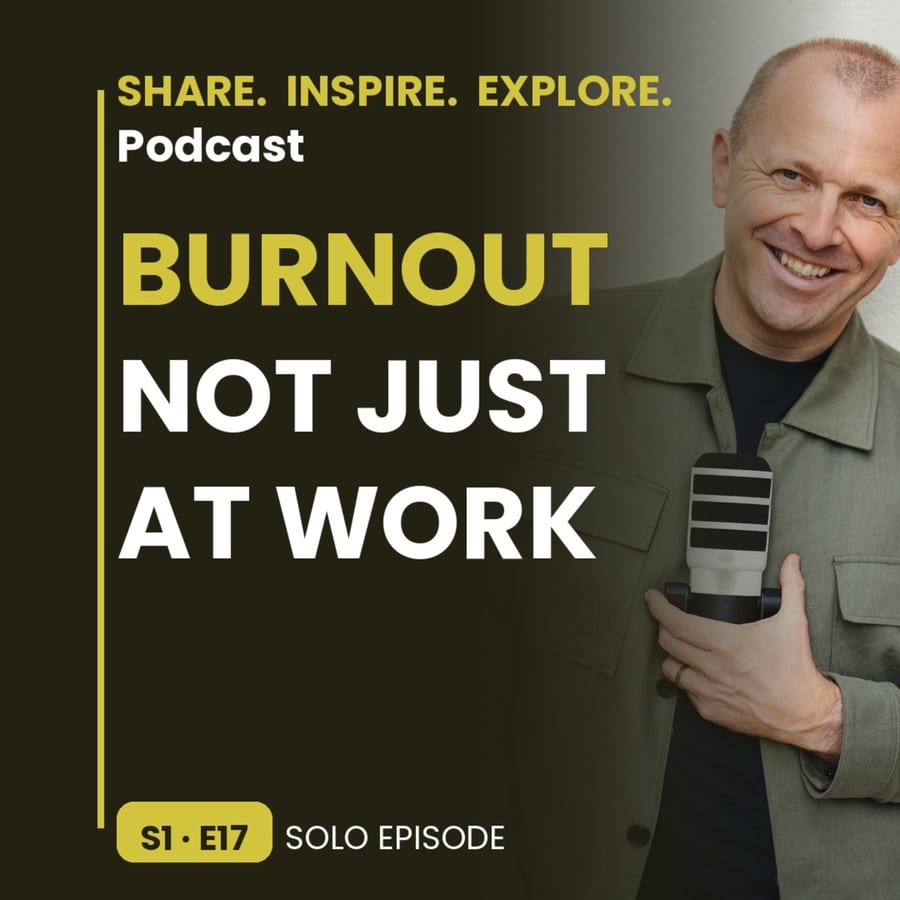
Season 1, Episode 17
Share. Inspire. Explore. is the podcast from Where I'm At, honest conversations on burnout, career change, and what comes next for working professionals.
Join the Where I'm At Community, free to join: https://community.whereimatcommunity.com/store/product/membership Website: https://www.whereimatcommunity.com
Where I'm At is based on lived experience, reflection, and educational support. It is not therapy, counselling, crisis support, or professional advice. Please consult a qualified professional for individual medical, psychological, legal, financial, employment, or specialist support where relevant.
Read the full transcript3,001 words
Automatically transcribed, so it may contain errors and does not identify who is speaking. It follows the conversation in order.
Welcome to the Share, Inspire and Explore podcast, the voice of the where I'm at burnout community. I'm Chris Wilson. And after my own journey through burnout and depression, I'm here to share real stories, inspire personal transformation and explore the path from burnout to balance. Each episode brings honest conversations with burnout survivors, mental health experts and mindset coaches, offering lessons, strategies and hope. Whether you're recovering, curious or searching for motivation, this is your space to grow. Let's dive into today's episode.
Welcome back to the Share, Inspire and Explore podcast. If you're a first time listener, I'm so glad you're here. In episode nine, we explored the workplace stressors that fuel the fire. But in today's episode 17, we're asking the question, what fuels the fire outside of work?
Think of burnout like a fire. It needs fuel to keep burning. And sadly, in our modern world, there's no shortage of kindling. We'll be digging into those external factors that pile on and even those personal predispositions that can make some of us more susceptible to burnout.
Before we begin, a quick note. In this episode, we'll discuss burnout, financial stress, caregiving responsibilities and chronic illness. If any of these topics feel difficult for you, please take care while listening and seek support if needed. This podcast shares personal experiences and general insights into burnout. I'm not a medical professional or financial advisor. So please consult a qualified expert for advice tailored to your situation. And remember, this conversation is about building awareness, not about assigning guilt or shame. If anything here feels sensitive or familiar,
know that you're not alone. We're here to explore and not to judge. So what is burnout? Burnout isn't just about being tired. It's a state of emotional, physical and mental exhaustion caused by prolonged stress. According to the World Health Organization, the WHO, burnout is an occupational phenomenon, not a medical condition, but a significant issue that affects mental well-being. It was officially included in the 11th revision of the International Classification of Diseases in 2019.
The WHO defines burnout as a syndrome resulting from chronic workplace stress that has not been successfully managed. In episode two of this podcast, we explored the Maslach Burnout Inventory, which outlines three key dimensions. First up, the exhaustion, feeling emotionally and physically drained.
Then cynicism detachment, developing a negative or detached attitude toward work. And lastly, reduced professional efficacy, feeling ineffective even when performing well. Burnout doesn't have a single cause. It's a perfect storm of various factors. Let's break the predisposition and external stressors down. And if you haven't listened to episode nine on the workplace stressors, I recommend checking it out first. I've linked it in the description.
First up, the personal predispositions. And burnout isn't just about external stressors, it's also about how we process and respond to stress. Certain personality traits and thought patterns can make us more vulnerable. I'm not saying personality alone causes burnout, but these internal stressors can fuel the fire. Some common predispositions include perfectionism. That constant pressure to meet impossible high standards can lead to exhaustion and frustration. It's like running a race where the finish line keeps moving further away. An example, a marketing manager rewrites the report 10 times because they feel it's never perfect enough. They stay late every night, but the exhaustion makes them less productive.
Certain traits like perfectionism can make managing stress harder. But awareness can help us set healthier boundaries. And people who prioritize others' needs over their own may struggle to set boundaries, which can contribute to stress over time. And those who have difficulty setting boundaries often find themselves overcommitted and overwhelmed. Individuals with perfectionist tendencies may set unrealistically high standards for themselves, leading to dissatisfaction and increased vulnerability to burnout when those standards aren't met. At one point, I remember many occasions sitting at my desk at 11pm, re-editing a PowerPoint presentation for like the fifth time. My eyes were tired, but I couldn't let it go.
That's when I realized perfectionism was draining me. Then we have people-pleasing, which is always prioritizing others' needs over your own, which can leave you drained and resentful, with little energy left for self-care. For example, a team lead agrees to take on extra work because they don't want to disappoint their boss, even though they're already struggling with their own workload.
I'll be honest, I've struggled with a few of these myself and recovering perfectionist at work, constantly chasing that unattainable standard. But at home, it was far from perfect, instead chaotic and a reflection of the busyness in my head. I used to believe that if I just worked harder, I could control everything.
The truth is, perfectionism was burning me out. And there's difficulty setting boundaries. Saying yes too often can lead to over-commitment, making it hard to recharge. As an example, a freelancer constantly responds to client emails at all hours, afraid of losing business. Over time, they feel trapped with no real separation between work and personal life.
Next, we have the fear of failure. The relentless worry about not being good enough can create chronic stress, even in the absence of external pressure. It's like carrying a heavy backpack of doubt every day.
In this example, a new employee hesitates to take on challenging projects because they're terrified of making mistakes. Instead of growing in their role, they stay stuck in their comfort zone, feeling unfulfilled.
And then there's the negative self-talk. The inner critic can be relentless, making every challenge feel unsurmountable. If you're constantly telling yourself you're not doing enough, no amount of achievement will ever feel like enough.
In this example, a teacher tells themselves they're a failure because one student didn't pass, ignoring the dozens of students they've helped to succeed. The constant self-criticism drains their motivation and joy for teaching. I've also battled negative self-talk, questioning whether I was capable enough, smart enough or simply enough. That inner voice can be ruthless, but I'm learning to challenge it. Instead of thinking I'll never get this right, I try to say I'm learning and that's enough for today. I'm learning to be kinder to myself, to let go of that need of control and to accept that good enough is often good enough.
It's a work in progress, but I'm trying. Then we have the financial stress and money worries, which are a major culprit. When you're constantly worried about bills, debt or just making ends meet, it's hard to focus on anything else.
That chronic stress can seep into every area of your life, including work. Beyond concerns about bills and debt, unexpected expenses like medical emergencies or urgent home repairs can intensify financial stress. In this example, living paycheck to paycheck while trying to perform at a high level is like running a marathon with weights.
I remember back in the day I was freelancing and this feast or famine cycle of income was a constant source of stress. One month I'd be flush and the next I'd be scrambling to pay the rent. It was impossible to relax and enjoy work, but that financial worry was always looming in the background.
Money worries don't exist in a vacuum. They sit inside a bigger system that many of us are trying to survive in. Next up, systemic and societal pressure. Beyond our personal circumstances, there are also bigger systemic pressures that quietly turn up the heat. Many of us are living in a world where the cost of living keeps rising, job security feels shaky, and there's this constant message that we should always be doing more, earning more, or optimizing every hour of the day. That always on, always improving culture doesn't stay at work. It follows us home, into our evenings, weekends, and even our rest.
For some people, there's the added pressure because of gender, culture, or background. Maybe you're expected to be the main caregiver, the emotional support person, or the one that always has to have it together. When society expects you to be everything to everyone, burnout isn't a personal failure.
It's often a completely human response to an inhuman level of expectation. In this example, imagine Sam, who's working full-time in a demanding job, helping to support their family financially, and also expected to be the emotional anchor at home. On paper, they're coping, but underneath, the pressure of being indispensable in every area of life leaves them exhausted and constantly on edge.
Now to relationships at home. When work stress affects home life, and home stress affects work, it's a downward spiral. And let's not forget about relationships. Problems with our partners, family, or friends can add further fuel to the burnout fire. When our personal lives are in turmoil, it's hard to show up as our best selves at work. For me, working life was impacting my family life. As my normal responsibilities felt like they were just getting in the way of work. Ongoing conflicts with family members, such as disagreements over parenting styles or household responsibilities, these can create a tense home environment. Make it challenging to relax. Another piece of this puzzle is role overload. Try to juggle too
many roles at once. Most of us aren't just employees, we're also partners, parents, friends, caregivers, caregivers, volunteers, or the go to person in our social circle. Each of these roles comes with its own expectations and emotional load. And our energy doesn't magically reset between them. When one role drains you, it spills over into the others. Burnout often shows up not because one single role is too much, but because all of them, together, leave no room to breathe. In this example, think of Alex, a working parent who manages a full-time job, handles most of the school admin for the kids, and checks in regularly on an aging parent. Individually, each role feels important and meaningful. But when a sick child, a deadline, and a parent's medical appointment all land in the same
week, Alex feels like every part of his life is asking for more than they have to give. Then there's the toxic relationships outside of work. Not all relationship stress comes from inside the home. Toxic friendships, family dynamics, or even social circles can be emotionally draining and contribute to burnout over time.
Then there are caregiving responsibilities. Whether you're caring for children, aging parents, or a loved one with chronic illness, those demands can be physically and emotionally draining. With the rising aging population, balancing full-time job while caring for an elderly parent with health issues can lead to physical exhaustion and emotional strain. Especially when resources are limited.
I hope to dedicate an episode to caregiving burnout in the future, as this deserves attention. So stay tuned. Significant transitions such as moving to a new home, starting a new job, or becoming a parent can be overwhelming. These changes require substantial adjustments, adding to stress levels. In this example, Sarah, a 35-year-old marketing professional, recently relocated to a new city for work.
While the job is exciting, she struggles with adjusting to a new environment, finding housing, and making new friends. The uncertainty and transition leave her feeling overwhelmed, and she finds herself exhausted even before she starts work every day.
Lacking a supportive social network or experiencing feelings of loneliness can exacerbate stress, as individuals may not have outlets to share their concerns or seek advice. In this example, Emily, a remote worker, moved to a rural area to save money and rent.
While she enjoys the peace and quiet, she struggles with loneliness since she rarely sees co-workers in person. She feels disconnected and unmotivated, contributing to burnout. Living in areas with high noise levels, pollution, or unsafe conditions can contribute to chronic stress,
affecting overall wellbeing. In this example, Maria lives in a noisy apartment in a crowded city. The constant traffic noise and loud neighbors prevent her from getting enough rest. Despite her efforts to wind down after work, the overstimulating environment makes relaxation nearly impossible.
There's also a more subtle kind of stress that many people feel, but don't always name, the weight of what's happening in the world. Constant headlines about conflict, economic instability, or climate disasters can create a background hum of anxiety. Even if these events aren't happening on your doorstep, just seeing them day after day can leave you feeling helpless, overwhelmed, or stuck in a sense of "what's the point?" This kind of global or climate-related distress doesn't usually show up in one dramatic moment. It's more like a slow drip that wears down your emotional resilience over time, making you more vulnerable to burnout in other areas of your life. In this example, take Nina, who cares deeply about the environment. Every time she reads about another extreme weather event
or climate report, she feels a mix of fear and guilt. She still goes to work, still does her job, but underneath there's a constant heaviness about the future. By the time everyday stress is piled on top, her emotional tank is already half empty. Technology doesn't just blur the lines between work and home. It also feeds us non-stop stream of information and comparison. Social media can make it seem like everyone else is thriving, productive, and perfectly balanced, while you're barely holding it together. The constant comparison can quietly erode your self-esteem and add another layer of pressure to keep up. On top of that, many of us are doom-scrolling through negative news at night: economic worries, global crises, conflict,
and climate change. Our brains never get a chance to fully power down. Even when you're living on the couch, our nervous system is still on alert, which over time can feed into emotional exhaustion and burnout.
Picture Jamie who finishes work at 7pm and spends the evening switching between Instagram, news apps, and WhatsApp messages from colleagues. They tell themselves they're relaxing, but after a few hours of scrolling through bad news and other people's highlight reels, they feel anxious behind in life and too wired to sleep.
a lack of rest is a major contributor to stress. Some examples are sleep deprivation, so not having enough sleep to restore your body and mind, not taking breaks, working continuously both at work and and at home. And no recreational activities, failing to make time for hobbies or things people enjoy.
So when someone's life is all work and no play, stress can build quickly due to lack of recovery time. Managing health issues alongside work responsibilities can be exhausting. Dealing with chronic pain while meeting work deadlines is like running two marathons simultaneously. Managing a chronic condition like diabetes, for example, requires constant attention and lifestyle adjustments adding to daily stress and potentially impacting work performance.
And now for some approaches that might help manage external stressors. To better cope with these pressures, try setting small achievable goals. Prioritizing self-care. Seeking support from friends, family or professionals.
Managing time effectively and setting boundaries. And addressing traits like perfectionism through coaching or therapy. Try exploring financial wellness resources. Identifying and distancing yourself from toxic relationships when possible. Setting emotional boundaries with people who drain your energy.
Reassessing obligations in friendships or social circles. What I found has helped me. Managing internal stressors. I practiced self-compassion. I really challenged those negative thoughts. And I tried to set realistic expectations on myself.
A hard one, but it's doable. Create clear boundaries. And the best one of all. I sought professional help. I can only recommend it. You see, awareness is the first step. Recognize your stressors before they lead you to full burnout.
Self-awareness and proactive self-care are your first line of defense. Once again, I highly recommend seeking help from trained therapists as this will be individual to you. So this week, as you think about these external stressors, try taking five quiet minutes, maybe with a journal or just your notes app, and ask yourself two questions.
Which one or two stressors feel most present in my life right now? What is the one small thing that is actually within my control here? And what is one thing that I can give myself permission to let go of?
Even a little. You don't have to fix everything at once. Sometimes the first step is just naming what's weighing on you and choosing one tiny act of kindness towards yourself in the middle of it.
So there you have it. From those personal predispositions to the financial stressors, there's no shortage of things that can fuel the burnout fire on top of the workplace. Once again, the good news is, understanding these contributing factors is the first step towards taking control. Burnout is a complex issue with many contributing factors. Combating it requires effort from both organizations and individuals.
And remember, creating a supportive environment at work, at home, and prioritizing well-being are key to preventing burnout. Thanks for joining me today. Remember, recognizing the signs is the first step to reclaiming your energy and passion. And you don't have to do this alone. Seek professional help if you need it. I'll see you in the next episode.
Bye-bye. That's it for today on the Share, Inspire and Explore podcast. I hope something resonated with you. A moment of clarity, encouragement, or just a reminder that you're not alone.
If you find this helpful, share it with someone who might need it. Hit follow or subscribe to join us for future episodes. If you're new here, please check the link in the description to join the community.
Burnout is tough, but it's also a chance to heal and rediscover what matters. Thanks for being a part of this journey. And until next time, take care. Keep exploring what's possible.
I'm Chris Wilson, and that's where I'm at. I'm Chris Wilson, and that's where I'm at.