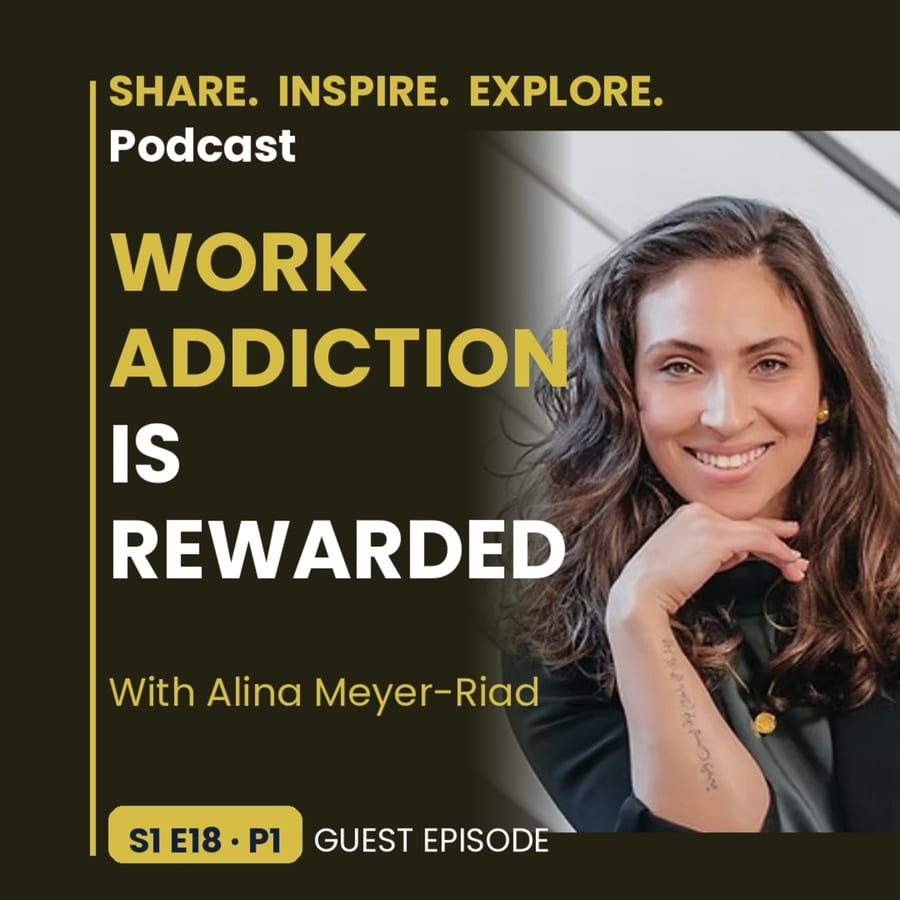
Addicted to Work? The Psychology Behind Work Addiction, Part 1 — Alina Meyer-Riad
Prefer to watch? This episode is on YouTube and the show is on Spotify.
About this episode
Work addiction is harder to spot than most patterns, because it is the one that gets rewarded.
In the first half of a two part conversation, Chris Wilson sits down with Alina Meyer-Riad to work out what work addiction actually is and why it stays misunderstood. They get into the difference between working hard and having lost control of it, the way validation and output start standing in for identity, and how hustle culture makes the whole thing look like a virtue.
This may land for anyone whose sense of their own worth has quietly attached itself to what they produce.
What separates working hard from something that has taken over How reward and dopamine keep reinforcing the overworking The early signs that work is occupying more space than you chose
Season 1, Episode 18
Part 2 goes into where these patterns come from, and what recovery and healthier boundaries look like.
Connect with Alina Meyer-Riad: https://www.linkedin.com/in/amrresilienzstaerken/ and https://www.amr-resilienz-staerken.de/
Share. Inspire. Explore. is the podcast from Where I'm At, honest conversations on burnout, career change, and what comes next for working professionals.
Join the Where I'm At Community, free to join: https://community.whereimatcommunity.com/store/product/membership Website: https://www.whereimatcommunity.com
Where I'm At is based on lived experience, reflection, and educational support. It is not therapy, counselling, crisis support, or professional advice. Please consult a qualified professional for individual medical, psychological, legal, financial, employment, or specialist support where relevant.
Read the full transcript3,350 words
Automatically transcribed, so it may contain errors and does not identify who is speaking. It follows the conversation in order.
Welcome to the Share, Inspire and Explore podcast, the voice of the where I'm at burnout community. I'm Chris Wilson. And after my own journey through burnout and depression, I'm here to share real stories, inspire personal transformation and explore the path from burnout to balance. Each episode brings honest conversations with burnout survivors, mental health experts, and mindset coaches offering lessons, strategies and hope. Whether you're recovering, curious or searching for motivation, this is your space to grow. Let's dive into today's episode. Welcome back to the Share, Inspire and Explore podcast. Today we're diving into a topic many high achievers avoid thinking about. Work addiction. Is it ambition gone too far? Or is there something deeper going on? I'm honored to welcome my next guest, Alina Meyer-Riad, a social
worker, resilience coach and addiction counselor. In her business, she empowers individuals and organizations to reflect on unhealthy work patterns, build in her strength and form healthy habits. In our conversation, we'll explore work addiction, stress culture and how resilience can be your strongest ally. Welcome, Alina. So happy you can join today. Hi, Chris. Thanks a lot for having me here. Greetings from Cologne.
Greetings. Thank you. I'm, yeah, I'm very happy to be here and talk about my topic. And I really, really love my work. I feel it's a very important topic to talk about. So I'm very happy that you, like me and the topic, the stage that it needs, like that's how I feel about it. Yeah, I'm doing my job now since actually 10 years, which is a long time. So I worked in many companies and help people with like different kind of addiction. So from behavioral to like alcohol addiction, by example, and also stress management and yeah, healthy, like new lifestyle after addiction or before is, yeah, one of the basic things we need to learn together. Excellent. Before we begin, a quick reminder, this episode is for
informational purposes only and is not a substitute for medical, psychological or legal advice. Please consult a qualified professional if you're struggling or need support. So Alina, I think maybe we start with the simple question. What is addiction? Yes, this is not a simple question, but a good question. So I feel that question can't be answered so soon, but it's still a question we should talk about it. So I try to explain it like very easily. Um, actually the problem with being a human is that we can be addicted from everything, which is like really crazy because normally we are, we are very like, we know how to manage life. We are so like, try to be healthy and try to like, see everything before someone else see it. Like we really want to
manage everything. And which is very funny that I work with people who are really in control. So they are trying to be in control of everything. And this is very paradox that addiction is like the opposite, but still like the same. So it's like very close to control. So people try to control something the whole time while they're losing control while doing it. And this is what I see like over 10 years now that I work with people who are very in control of the rest, but not of one thing or two or three. This is, or can be work. This can be something else. This can be also, I don't know, cigarettes, whatever. But, and this is the problem of the question. It's not easy when the person
is not aware of his or her own story. So I can't tell someone, okay, I think you're addicted or maybe your wife think you have an addiction when the person is like far away from it. So you can't like easily tell what it is while the person don't want to see it. So this is the thing. Just want to make sure that we talk about the same thing. But yeah, I feel addiction is hard to explain, but still it's a thing with control or losing control in a kind of way. Um, while I just making an example, maybe it's easier. You, you tell yourself today, okay, today I'm just working till five and then I start working,
everything flows and there's like an email coming in and maybe there's a phone call and maybe there's a colleague and there's another topic and you just want to do just one thing, just one thing. And then
like the time is ticking and yeah, it's eight in the evening. Now your family is waiting, maybe, and you haven't ate anything or drink water. And yeah. So this is like losing control
in a way, because before you said yourself, I don't want to work today later than five. And then, yeah, you're sitting there like till eight. And this is kind of part of addiction too. So yeah, when we talk about addiction, um, yeah, they're like, it's a diagnostic actually. So, um, important to know is that it's nothing about the people are like stupid or they could do it better or like the thought of, yeah, someone just needs to try it harder than he or she can maybe stop doing it. Like this is not what addiction is about. Actually, it's really losing control. And it's also
something in your system is like not, um, working out well. So it's kind of a regulation of emotions also. So you can understand it. Like when you do the same thing the whole time, your brain is actually like marking it and marking like, okay, work is dopamine in your, in your head, which is like feeling, making you feel very good. And this is actually like addiction that you, you did something the whole time you, your dopamine, like your reward system is like recognizing it.
And you want to do it like more and more and more. And this is like how addiction can be worse. It starts like maybe slowly and it starts like nothing is really bad because like the, the reward system is like working and feeling good about it. But, and this is the problem about addiction. It ends like always the same. It's always like, yeah, losing something maybe around it, losing your, your own power, maybe using your will of losing your will of life kind of. And this is what people talk about. Like they really try to stop and yeah, kind of your brain can't make you stop anymore. It's like kind of from liking to wanting. This is actually what changes when people get addicted.
Liking to wanting. Yes. How do behavioral addictions, as you mentioned, like overworking compared to substance addictions? So, um, a behavioral addiction is kind of like for me trickier because it's not so easy to tell. For example, I'm doing a digital detox courses and there I try to explain like the difference between, yeah, maybe alcoholism or something because there you can just leave something away. And then we try to like manage your life, stress management and stuff, but you can't tell people, please leave your job or please leave going to work. And this is not working. And also with digital and emails and stuff, you can't leave it because we're living in a, yeah, in a world where
we can't just, you know, not go to work. Yeah, that's it. And this is the thing what makes it so hard. This is maybe the difference. So there are addiction, like behavioral addiction, which you like can leave away, like gaming, you can stop gaming. Or maybe if we talk about other stuff like pornography, pornography, I don't know, those kinds of things, you, you need to leave it, but you can't do it like with work. And this is like a hard thing to understand for your brain, actually. So the work addiction is more than just working a lot. It's the emotional why behind it. Is this right? Yeah, yeah, yeah. I think this is a good explanation for it. So it's, you can love your work and you can
love going to work. But like I just said, it's from liking to wanting. You start maybe liking your work for sure, but maybe you end of wanting it and needing it, kind of needing it in a way which is not good for your health. And this is the point where we need to look at and behavioral addiction, how you feel behind it, like how you really feel. So when I ask my clients, how are you feeling today? And they say, good. I just try to answer, good is not a feeling. And this is how you can try to understand behavioral addiction while like, like digging a bit deeper. You need to really talk about what's
behind. And if you're really happy with your job or maybe you like before burning out, I don't know. I mean, we think about, if we talk about entrepreneurs, you know, they love their job. I guess this is dangerous balancing act from working, working, working on your passion. Do you have any experience in your coaching work with the entrepreneurs, for example? So actually, I have experienced a lot of people who really love their jobs. And this is like the thing. It's really hard for them to understand that work is important, but it's not the whole life. And this is a point where it starts to get like very hard because they are already in their, their addiction.
I had a client who really loved his job. He was like traveling the whole time. She studied so many years for this job and she had like a very high position. The money was good as well. So everything went good, but he always had conversations with, with her, his partner and also with the child's like who telling him, you're, you're never home and you always working. And I think this is the point, which is always the same that people just think in a, like in a small time slot. And this is how addiction is, is why is addiction is working that well because like humans, we can't like think so far in the future. We always say we need to think in the future. We need to change something. But
reality is our brain isn't, is not like, like this. We need like something. Our dopamine system is like very close to the time. And this is the problem with work addiction. And this was also the problem with my client. So he did this like many years and he really loves his job and working really hard, like for one thing. And some years later, his wife told him like that she will leave with the, with the kids
because nothing worked out. And then he started to wake up kind of. And this is also addiction about, like he was in this the whole time and it felt kind of good in this point, but all around, like everything around was going down and he couldn't see it after, yeah, everything passed away. Yeah. Like a horse in a race. But the dog was still there. Like a horse in a race with what we call blinkers. So they just see what's ahead. Okay. Yeah. Yeah. Yeah. The work was still there.
So if we talk now about how the work addiction shows up, how does it develop? Is it gradual or kind of take over quickly? So this can be very different actually. So there are many ways how a person can get addicted. It can be very slow. So we have seen that alcoholism is kind of slowly going on and people are normally, I say normally like around 50. And when we see like behavioral addiction, when we talk about gambling, this is going very fast. Gambling is really going fast, fast down and also gaming. To be very honest, we are not sure like why those kinds of things are going that fast, but we think that it, yeah, that it can be something, um, with, you know, like gambling is like you try to,
to get the money back, you just put in and you need to do it very fast, you know, like, because you want to get the money back. And this is like, you're going down, down, down. And the problem with gambling is as well, that you are losing not just your money, you also losing the money of everyone else around you, maybe your family, I don't know what it is. And this is going very fast. Also, yes, like cocaine is also something which is going very fast because it's like going crazy in your dopamine system. And this is also like something you need to mention that your reward system, um, you need to have a look on your reward system and how many dopamine is going out while
you're doing something or why you maybe eating is also giving your brain like dopamine and drinking coffee, same, but it's not so much than alcohol or maybe. I guess this is a thing.
I guess it comes down to, uh, some of them are more silent and can be well hidden from others, family members, friends, gambling, for example. I mean, it's so easy to gamble. I've seen the adverts. You can do it on your phone, on the toilet, whereas the alcohol, people can smell it and then it's harder to hide. Yeah. Oh, yeah. Same. Sure. Yeah. That's also the drugs. Maybe behavioral issues are noticeable, but still hard to detect, maybe. So with the work, it's totally invisible, especially like in a hostile culture that were sold on social media where it's, it's been normalized, right? Yeah. Yeah. You're totally right. That's, that's another, uh, like point of view, but yeah, you're
right. And this is also a point for me, while it takes so long with the alcohol addiction, for example, but let's talk about the work. The problem behind it is that if it's very common and it's also very like encouraged, yes, encouraged and also positive, you are a good person when you work very hard and this is something you want to have. And this is something you want to be seen as from others. It's a very good thing to tell someone you're working really hard and this is something you want to, yeah, you want to go with it. That's kind of flow, but yeah. And this is the thing while it, um, yeah, you can do it very, very long because there are nothing like negative about it. Kind of like,
for example, the example with my client, if his wife was like chilled, you know what I mean, but easy and also maybe working very hard, maybe it will never be a problem. And yeah, this is the thing too. Your environment counts kind of. Yeah, totally. And you know, it's, it's also, there is a reward system. If you work hard, society rewards you, you get promotion, you get more money,
then you can buy, you can buy the lifestyle that you aspire to have. And so that can obviously then be addictive itself because where, where is the upper limit here? And you keep going and growing. Yeah. So what are the early warning signs that someone might be addicted to work? Yeah. So it's like we, we already said, it's not so easy to tell, but one thing you just mentioned is also that you are very, um, kind of not addicted, but it's very important for you what others say, like kind of the validation from, from outside. And those are like first signs could be that negative feedback is not like your favorite kind of. So, because work is like everything for you. And if
someone wants to take it away from you while telling you you're doing your work, not good, or maybe you could do something better. Sometimes you see people who are addicted to work, they are going up, like they, they going crazy. Um, if someone mentioned something negative and also if, um,
maybe a member of the family or a friend tells you should maybe work a bit less, this is also a thing which you don't want to hear if you're addicted already. Also could be, um, yeah, a very high level of stress and also maybe, yeah, before burnout, kinds of like feeling very hard about it, but still want to do it. It's, it's kind of like paradox because the people are really want to like run, run, run, but in the inside they feel, to be honest, I can't run any longer, but I need to because it's my reward system. And this is very hard to tell because if you don't have any self-reflection, it's hard to tell
someone else how you feel. But this could be also a sign. Yeah. If someone is just living for work, kind of, if everything else around will get like down and down, you're not doing your hobbies, you're not going to sports any longer. You're not maybe making music if you did it before. Like, this is very important. If something is change, changing what you did before and you laughed doing before, this could be a sign that work is like, like too central in your life. Like compulsive checking emails, no lack of, or lack of boundaries, or as you said, like your self-worth tied to productivity. Yeah. And, and what I said, when you try to go, go home at five and you're sitting there
like three, four, I don't know, hours longer, um, while and forget to eat or forget to drink water, this is also a sign like self-care is not, not there kind of. And you think self-care is work. This is also a problem because it's not. It's a minimum. Yeah. It's a minimum. You need to do it like to earn money, of course, but it's not like the whole package of self-care. It's just a part of it. Yeah. I think I've learned that the hard way.
Before we close part one of this two-part conversation with Alina, let's reflect on what we've explored so far. In the first part, we unpacked what work addiction actually is and why it can be so hard to recognize, especially in cultures where overworking is often praised and mistaken for ambition.
We talked about how work addiction is not just about working long hours. It's about losing control, the shift from liking work to needing it, and the deeper emotional drivers underneath it, including validation, self-worth, and the way we can start to crowd out rest, relationships, and self-care.
We also explored some early warning signs, from per-boundaries and compulsive overworking, to neglecting basic needs and tying a density too closely to productivity. In part two, we go deeper into where these patterns may come from and what recovery, resilience, boundaries, and healthier habits can start to look like.
So if this conversation resonated with you, head straight into part two and continue with us there. That's it for today on the Share, Inspire and Explore podcast. I hope something resonated with you, a moment of clarity, encouragement, or just a reminder that you're not alone.
If you find this helpful, share it with someone who might need it and hit follow or subscribe to join us for future episodes. If you're new here, please check the link in the description to join the community.
Burnout is tough, but it's also a chance to heal and rediscover what matters. Thanks for being a part of this journey, and until next time, take care, keep exploring what's possible.
I'm Chris Wilson, and that's where I'm at.