
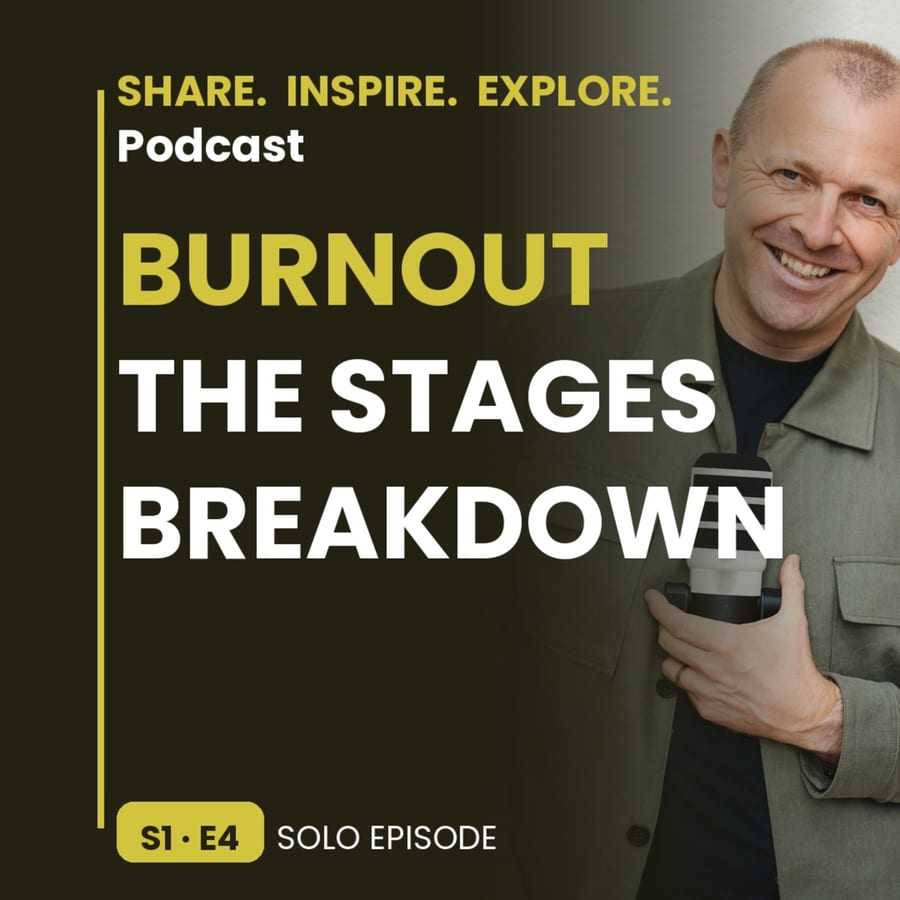
The Burnout Breakdown: Stages of Burnout
Prefer to watch? This episode is on YouTube and the show is on Spotify.
About this episode
Burnout is a gradual process, not an overnight collapse. It arrives in stages, and most of them look like something else at the time.
This episode walks through two models of how burnout develops and stays with the five stage version, because it is the one you can actually recognise in your own week. It starts with the honeymoon phase, where the work feels good and personal time quietly disappears. Each stage comes with the red flags I missed and what I would pay attention to now.
Why the honeymoon phase is where it begins, not where it is safe The point where chronic stress turns into cynicism and detachment What listening to your body actually means when you are already depleted
Season 1, Episode 4
Share. Inspire. Explore. is the podcast from Where I'm At, honest conversations on burnout, career change, and what comes next for working professionals.
Join the Where I'm At Community, free to join: https://community.whereimatcommunity.com/store/product/membership Website: https://www.whereimatcommunity.com
Where I'm At is based on lived experience, reflection, and educational support. It is not therapy, counselling, crisis support, or professional advice. Please consult a qualified professional for individual medical, psychological, legal, financial, employment, or specialist support where relevant.
Read the full transcript2,637 words
Automatically transcribed, so it may contain errors and does not identify who is speaking. It follows the conversation in order.
Welcome to the Share, Inspire and Explore podcast, the voice of the where I'm at burnout community. I'm Chris Wilson. And after my own journey through burnout and depression, I'm here to share real stories, inspire personal transformation and explore the path from burnout to balance. Each episode brings honest conversations with burnout survivors, mental health experts and mindset coaches, offering lessons, strategies and hope. Whether you're recovering, curious or searching for motivation, this is your space to grow. Let's dive into today's episode.
Welcome back to episode four of the Share, Inspire and Explore podcast. We talked about what burnout is and the science to watch out for, but today we're going deeper. We'll be diving into the stages of burnout so you could recognize where you might be on the spectrum and what to do about before we begin today's episode. I want to remind you that I am not a mental health professional.
This podcast is for information purposes only. If you feel affected by anything discussed in this episode or suspect that you're experiencing burnout or other adverse mental health conditions, you might be surprised to learn that burnout doesn't just appear overnight. It's a process, a gradual erosion of your energy and enthusiasm that can happen to anyone at any point of their lives.
The good news, understanding these stages can be key to addressing symptoms before they become overwhelming. Before we dive into the details, let's talk about the two popular models for understanding burnout, the 12-stage model and the five-stage model.
The 12-stage model was developed by psychologist Dr. Herbert Freudenberger, as mentioned in previous podcasts, and Gail North in 1974. It provides a detailed breakdown of how burnout progresses from initial enthusiasm to complete exhaustion. While comprehensive, this model can be complex to follow and basically apply it to everyday situations. On the other hand, the five-stage model is more recent and a simplified approach. It condenses the burnout process into five distinct phases that are easier to identify and understand. This model is often attributed to various researchers and psychologists who've built upon Freudenberger's work to create a more accessible framework. For our podcast today, we'll focus on the five-stage model, as it's more practical for us to apply in our daily lives.
Let's break down each stage, and I will share some personal experiences and discuss red flags I've learnt and tips for each phase, which I now follow, but some I will be applying in my new job for the first time.
Stage 1. The honeymoon phase. Picture this. You've just started a new job. You've taken on an exciting project. You're full of energy and enthusiasm, optimism. Everything seems possible. And you're ready to take on the world. That's the honeymoon phase of burnout. And you're ready to start a new job. You're ready to start a new job. You're ready to start a new job. I remember the feeling from getting that new job offer, you know, after a painfully long job application process. And when accepting that job and feeling so smug-handing in the resignation letter in the old company, as if to say, well, I wasn't appreciated here. Look, someone else sees my potential. To feel wanted by another company, I would develop an unhealthy sense of blind loyalty. I start the job and everything is fresh and welcoming, which fuels again that commitment to the cause.
I would use this euphoria to drive my new workload, work longer hours and put my family and self-care in the backseat. I get why there's a probation period in companies, but for someone like me, it's dangerous as it uses doubt on both sides to send you into an all or nothing frenzy.
The three or six month period for me was surrendering to a work first, no matter what approach. Let's look at some of the red flags for the honeymoon phase.
First up, neglecting personal time for work. I would often skip my evening runs or just to finish projects. Next up, over committing to tasks. I would volunteer for extra tasks, even when my plate was full.
An unrealistic optimism about the workload. I believed I could manage all responsibilities without feeling overwhelmed. And here's some tips I've learned and continue to try to put in place.
Set realistic expectations from the start. For example, create a list of your job responsibilities and discuss them with your supervisor. Establish healthy work-life boundaries early on. Try setting specific work hours and sticking to them.
Remember to maintain hobbies and relationships outside of work. Schedule regular time for activities you enjoy. And treat them just as important as your work commitments. Stage two, the onset of stress.
As time goes on, the initial excitement starts to wear off. You begin to notice the stress creeping in. Tasks that once energized you now feel a bit more challenging.
Welcome to the onset of stress stage. For me, six months into the job after probation period, I would start feeling the pressure. Deadlines seemed tighter. Project sources were harder to reach. And the constant need to be on began to take its toll.
The realization of, you know, what I had agreed on top of my core responsibility was coming to light. The job I applied for looks very different in reality to what I signed up for.
The accomplished person I painted myself to be in the interview was equally as flawed as the company job description. Here are some red flags for stage two. Increased irritability or impatience.
I found myself snapping at co-workers and family over just minor issues. Then there was difficulty concentrating. I struggled focused during meetings or while writing emails. And changes in sleep patterns or appetite.
I would often lay awake at night just worrying about deadlines. Here are some tips for the onset of stress stage. Practice stress management techniques like deep breathing or meditation.
Even five minutes of mindfulness during your lunch break can make a difference. I would do this in the toilet break to avoid judgment. Prioritize tasks and learn to delegate when possible.
Use a task management system to organize your work and identify what can be shared with colleagues. I would drive for transparency on team tasks because it's very hard to assign or prioritize without that visibility.
And finally, communicate with your supervisor about your workload. Regular check-ins can help address issues before they become overwhelming. However, I know this depends on your relationship and trust with your superior.
So only you can decide when to play that card. This is where things start to get really tough. You're constantly tired. Productivity drops. And you might start feeling cynical about your work.
It was usually my second or third year into the job. I would feel a full weight of chronic stress. I found myself dreading meetings, procrastinating on writing emails or presentations.
And felt increasingly disconnected from the topics I was covering. As I found it hard to say no, it became so desperate I would actually try. But framed it in a negative sentiment like, don't you see I have enough to do? Why me?
Without actually saying, I don't have capacity for this right now. In some cases, I realized it was not just me to blame for my situation. But there were people actually feeding off my vulnerable state and going out of their way to make it worse.
When holidays would come, it would help. But during a two-week holiday, I would only start to relax at the end of the first week. And then the thought of going back would eat into that remaining relaxation.
It is only in times of holiday where you start to reflect and wonder, why do I even do this? Some red flags for stage three. Persistent exhaustion. Even after a full night's sleep, I felt drained in the morning.
Procrastination and missed deadlines. I started submitting tasks late or not even answering emails at all. Then there's the increased cynicism or detachment from work. I began questioning why I even chose this career path.
But here's some tips. Reassess your workload and responsibilities. Consider which tasks are essential and which can be eliminated or postponed. Take a holiday or a mental health day, if possible.
Even a long weekend can provide much-needed rest and perspective. I know of people who, instead of using the two-week family holiday, they take regular long weekend breaks. Seek support from colleagues, friends or a therapist.
Talking about your stress can often lead to practical solutions and emotional relief. This has helped me a lot and be less of a burden to close family, who themselves have enough on their plate.
Stage 4. Burnout. When chronic stress goes unaddressed, you hit full-blown burnout. This is where you feel completely overwhelmed, exhausted and unable to meet the demands of your job. It's a critical stage that requires immediate attention.
My burnout moment came during a big project. I accepted the job late November, due to start in January. And after accepting this job and turning down an offer externally, I realised very soon this was a mistake.
Senior management, in their wisdom, agreed to roll out a new platform and product on the 1st of March, having no experience launching digital products themselves. So this was around 8 weeks from my official start date.
I challenged this insanity, but this felt like a gun was being pointed to my head. I told them this now feels like life or death. But I'd been asked to come in and be the hero of their project, so how could I let them down and ruin my reputation?
And so it began. The fear of failure was too much to bear that I say no. I delivered that project and broke records. But by the end it broke me and my speech was becoming impaired. I'd get dizzy, exhausted and my anxiety was through the roof.
With anger. Raging. That was my wake-up call. Some red flags for burnout. Physical symptoms like headaches or stomach issues. For me, frequent headaches began affecting me and my work.
And then the emotional exhaustion from feeling overwhelmed. I mean, every task felt like climbing a mountain. Then there was the decreased performance and, you know, inability to meet basic job requirements.
My quality of work suffered dramatically, which led me to work even longer hours to maintain an acceptable standard. And some tips. Seek professional help from a therapist or a counsellor. They can provide strategies tailored to your specific situation and needs.
Talk to your supervisor about reducing workload and taking leave. Many companies have policies in place to support employees facing burnout. I've worked in a company with a solid support system. But unfortunately, I've experienced others where I was left to deal with everything myself to the point of disrespect.
Focus on self-care activities like exercise, healthy eating and rest. Prioritizing your physical health can significantly impact your mental well-being. And this is part of my toolkit going forward. If burnout isn't addressed, it can become a chronic condition known as habitual burnout.
This is where feelings of emptiness, depression and chronic, physical and emotional exhaustion become the norm. It was only until I got help, I fully realized the extent of what I had done and the impact it had on me.
This burnout was unlike those which happened before. This was a realization that I was hopping from one burnout to the next at different phases. I was depressed. I learned during those meetings with the psychiatrist and the psychologist, it was not the first time.
On top of obsessive compulsion disorder. This was habitual burnout according to the five stages. But I personally didn't label it that, to be honest. I just knew this was rock bottom.
A moment for me to change and focus on getting better. This pattern over many years became so familiar, it became a habit and perhaps one I was addicted to.
Do I wish I had learned this sooner and jumped off the burnout train? No. I see that this was meant to happen to me and it's part of my acceptance going forward.
Do I want anyone else to go through down the same path? Hell no. Which is why I'm doing what I'm doing now. To bring awareness, to stop others and stop the hustle by day, hustle by night culture.
Some red flags of habitual burnout. Some red flags of habitual burnout. Chronic physical and emotional fatigue. Simple tasks felt insurmountable. Even getting out of bed was hard. Persistent feelings of hopelessness or depression. I mean, I often felt like there was no way out of my situation.
My keyboard was merging into one giant escape button. Complete loss of motivation and passion for work. The thought of going to work became unbearable. And some tips. Consider a career change or an extended break from work.
Sometimes, despite our best efforts, a job may no longer serve us. And it's okay to explore new paths. Seek long-term professional help to address underlying issues. Chronic burnout often requires ongoing support to fully recover and prevent future occurrences.
I put my trust in the professionals. I can only recommend doing the same. Focus on rebuilding your identity outside of work. Explore new hobbies. Volunteer. Reconnect with the passions you may have neglected.
And finally, I want to be clear to everyone. I'm not fixed. Recovered. I just accept who I am. And I'm adapting to life as a result. And today, I feel ten times better than I did last year.
I know there will be difficult times ahead. And I still struggle with old habits and behaviours. However, I'm exploring and will continue to experiment ways I can recover through this community.
Experts from burnout survivors. From people I have spoken to on their experience of burnout. It's very different. And it's from these perspectives, I believe we can get inspired and grow and get the encouragement to change.
Understanding the stages of burnout is crucial for maintaining our mental health and work-life balance. By recognising the signs early and taking proactive steps, we can prevent burnout from taking over our lives.
Remember, it's okay to prioritise your well-being and seek help when needed. Your health and happiness are worth it. I've listed many tips today. But the biggest tip I can give you is listen to your body.
It tells you when something is too much or not good for you. Honour that with a pause and then a polite rejection to the thing or person. I want to hear from you, the listener or viewer. Can you see yourself in these stages?
How do you recognise the signs? And what strategies do you have in place to get off the burnout train? Let me know in the comments or reach out. Thanks for tuning in to share, inspire and explore on the stages of burnout. Until next time, take care of yourself and each other.
Bye-bye. That's it for today on the Share, Inspire and Explore podcast. I hope something resonated with you. A moment of clarity, encouragement, or just a reminder that you're not alone.
If you find this helpful, share it with someone who might need it. Hit follow or subscribe to join us for future episodes. If you're new here, please check the link in the description to join the community.
Burnout is tough, but it's also a chance to heal and rediscover what matters. Thanks for being a part of this journey. And until next time, take care. Keep exploring what's possible.
I'm Chris Wilson, and that's where I'm at. you