
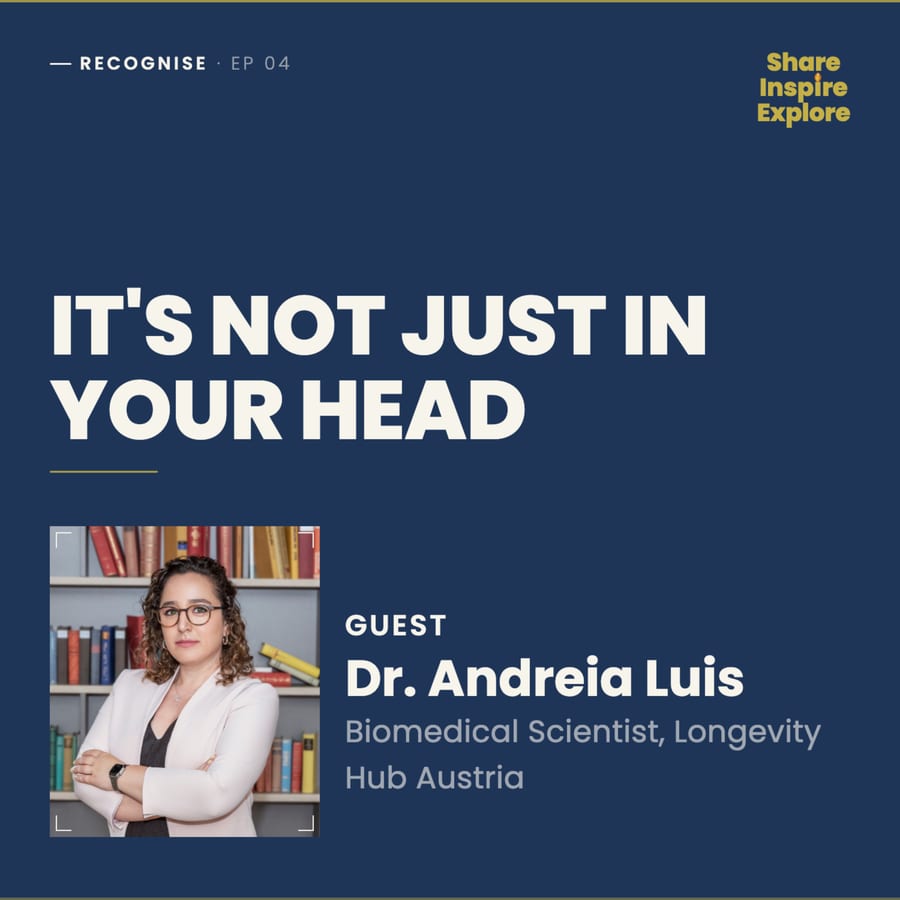
It's Not Just in Your Head: The Science Behind Stress — Dr Andreia Luis
Prefer to watch? This episode is on YouTube and the show is on Spotify.
About this episode
Chronic stress is not just in your head. It shows up in your DNA, your inflammation levels and how much energy your cells can actually make.
Dr Andreia Luis is a biomedical scientist with a PhD from the Medical University of Vienna, and her research examined how the body responds to extreme physical stress, the same process that plays out slowly in burnout.
She walks through what is measurably happening inside the body, and she also talks about burning out during her own PhD, and the signs she did not recognise until years afterwards, despite studying exactly this.
What chronic stress does inside the body, from DNA to cellular energy Missing her own burnout while researching how cells respond to stress Why recovery turned rest into prevention rather than repair
Season 2, Episode 4
Dr Andreia is building Longevity Hub Austria, a community focused on science, innovation and lifestyle for long term health.
Connect with Dr Andreia Luis: https://www.linkedin.com/in/andreiavluis/ and https://longevityhub.at/
Share. Inspire. Explore. is the podcast from Where I'm At, honest conversations on burnout, career change, and what comes next for working professionals.
Join the Where I'm At Community, free to join: https://community.whereimatcommunity.com/store/product/membership Website: https://www.whereimatcommunity.com
Where I'm At is based on lived experience, reflection, and educational support. It is not therapy, counselling, crisis support, or professional advice. Please consult a qualified professional for individual medical, psychological, legal, financial, employment, or specialist support where relevant.
Read the full transcript11,796 words
Automatically transcribed, so it may contain errors and does not identify who is speaking. It follows the conversation in order.
Welcome. This show is for people in the middle of something difficult. If you're navigating burnout, a career change, or rebuilding something that stopped working, you're listening to Share, Inspire, Explore. I'm Chris Wilson. I've been through it. And I built the Where I'm At's community because I couldn't find the conversation I actually needed. Season two is guest led. In each episode, I sit down with someone who's lived it or studied one of these phases. Recognize, reset, reinvent. Real conversations, nothing packaged. Let's get into it.
Welcome back, everyone. Today's guest is Andrea Luys. She's a biomedical scientist and holds a PhD in molecular biology from the Medical University of Vienna. She has 13 peer-reviewed articles in international scientific journals, recipient of the Marie Curie Fellowship from the EU,
two investigator awards from the European and International Shock Society, and a researcher award nominee for the Lush Prize, the world's highest award for the end of animal testing. She works in biotech, pharma, translating scientific discovery into real-world impact,
and has led programs for some of Europe's leading health innovation initiatives, including the top female founders program from EIT Health. Currently, she's building the longevity hub Austria, a community focused on science, innovation, and lifestyle for health, longevity.
She's also someone who burned out. Here's the part that makes Andrea's story worth sitting with. She burned out during her PhD, while her research was focused on how the body responds to cellular stress. The biology was right there, in the data, in the experiments, in the papers she was reading every day, and she couldn't see herself in it. Andrea brings something to this conversation that most burnout conversations don't have, a scientific lens. She thinks about the body and the brain not as two separate problems, but as a system, one that responds, adapts, and can break down under sustained pressure in ways that are measurable and eventually reversible. She also has something to say about the gap between
how burnout is understood scientifically and how it's addressed in practice. The mental health side and the body side, something that society and healthcare professionals often see separately. This is one of those episodes where the story and the science end up in the same place. Andrea, a very warm welcome to ShareInspire Explorer. Thank you, Chris. Actually, you know, very happy to be here today and for the invitation, which was very interesting because it made me to reflect in a way that I hadn't before between the connection of my research, my experience as a PhD, and also the burnout. So definitely a very interesting connection and the topic that I take very seriously because I have been also through it, as you mentioned. So it's not
just these beautiful achievements and high achievements. There is also some parts from it and some consequences from that high-level experience as well. Would you like to tell the listeners and viewers a bit about you, where you're from? How did you end up in Vienna, for example? Sure. So, you know, actually, I'm originally from Portugal. You know, as a kid, I must say that in school when we were asked about what you want to be when you grow up. So my answer to that question would always be that I wanted to be a scientist, even though at the time I had no idea what the scientist was impractical doing, right? But I was always very inspired by scientists like Einstein,
Marie Curie. That would be the type of role models I had as a kid. And I would read also about biology, science. So, you know, I was very clear on this science-math path. I did, in fact, start to work as a scientist and to be a scientist. So the way to go was I did a bachelor education in biomedical science.
Then I did the master. I started to do already doing some research there, already related with stress, but we will talk about a little bit about it later. And then, you know, I decided to do a PhD, not for the title, not for the academic degree, but because I was paid to do what I liked at that time, which was science. To do that, actually I had a few different opportunities. I could have done a PhD in Portugal, but I decided to do the Marie Curie, as you mentioned, because it was a grant on European level. The work or let's say the project was running in seven different countries. One of those countries was Vienna. So usually, it's also funny when people ask me why I'm in Vienna. I always say I didn't
choose it. I chose the project. And then, you know, within the project, I was allocated to Vienna. And here I am for 10 years enjoying this beautiful city. Quite right. What drew you to molecular biology and biomedical research specifically?
Yes. So it's very much related to what I said. So as a kid, I was always very curious to understand how our body works. Right. So, and biology is very fascinating because a lot of things that we understand is just so normal or just so automatic. Actually, there is explanations to that. Right. So I was very curious to understand how our body works like on a natural, so let's say without diseases, but also how diseases impact our bodies. So for me, it was also quite a natural decision. So I had,
before as a kid decided I wanted to be a scientist and later was also, I would say, very clear that would be science related with the medical field, with biomedical research, even though I must say that at that time, you know, like when you have to decide that in a very young age and without, I wasn't so, again, as I said, so aware what a scientist was doing, but I'm happy how it went, let's say. But of course, it's always a way more than that. Let's say fascinating idea of what is science and what is to be a scientist. Great that you knew from such an early age. You know, that's, I'm jealous away. I'm still figuring that out, I guess.
Well, for one side, yes. What to say? Yes. I think I knew what I liked, right? But when you merge what you like and what is rational, right? So what is possible, what is your reality, right? To me to become a scientist,
it was, how to say, I had to be considerate of other factors, right? And then there is always multiple options, right? But I would say that I choose, and this was also very interesting because for my first year at university, one of our professors mentioned when you need to decide what you want to work in your life or your job, his advice was that we choose, we should choose what we like. And his reason for that is that we know that markets are very, they can, you know, have some fluctuations and whatever job, for example, now we see with introduction of AI, right? So some jobs lose their relevance, right? And other jobs are more stable. So this was something that I wasn't so aware. And honestly,
I went to be a scientist more by heart and I would say by, by, by passion rather than probably my rational. So that's fantastic. And so going back to that time with all of that passion and, and energy, can you maybe describe
that high achieving Andrea and what that PhD environment actually felt like? Yes. So definitely that feeling about working in a fascinating field is there. So science and science world and science people, usually what I said about choosing to do a PhD, not because of the salary, I think it's the reality for, or because of the title, right? Maybe many people will think of she did a PhD because she wants to be a doctor. I would say that that's not our mindset. So our mindset is that most, I would say like almost 100% of the people that I met and I have 10 years doing biomedical research from young level or students to, to professors, I would say everyone is there because of this
motivation, because of this discover, because of bringing something new, right? So this is very strong on us, right? But to, let's say to fulfill those type of projects, this also requires planning, right? It requires meeting, brainstorming to create like valid experiments and to analyze them, right? Science is also very much based on publications, right? So we have to also to, to show to the world, whatever we have been discovered there, right? So what is the, and usually the, that goes from state of the art, right? When we do some revisions or also like when we discover something new, we have to report it. And these are like internal KPIs usually are publications. So publications are then the validation to get extra funding support and so on.
So usually our life as a scientist goes much about brainstorming with other scientists, planning to run the experiments, to analyze the data. Then we have to write the data, you know, to write these publications. And usually we show these results and present these results in, in large international conference, right? It's very important to bring the community together and to share, to share the data. In my case, because I did the Marie Curie, this was quite international project. So I had also the opportunity to have meetings and to present my results in other countries and in, in other labs. So it also usually involves some traveling, which in my case, and I will tell you a little bit better, was
also the escape sometimes because, you know, it's useful to, to go a little bit out of your environment sometimes. So I would say that this was very good to have also that option to see other realities.
So it was a nice environment shift, maybe for burnout prevention, would you say? Yes, that was my idea at some point. So I would say that travel was my escape initially when I start to feel either too tired about the experiments, the work, or even, you know, like the environment that you are in. So I can give an example, my last, in my last, usually, so a PhD goes from five to six years. In my last, what I would consider my last year, which is probably the fourth year,
I travel every month, right? Either was on work or I was on, like, I traveled to, to, for some holidays or I would find a reason to travel. And the thing is that I was already on this. So I start to use traveling as a scapegoat. I think I have no better term to say. Yes, this is an interesting aspect
because I had, of course, I believe not all professionals can do it. I had this freedom to do and this flexibility at that stage. And I really thought that because every time I was traveling, you know, you get out of the environment, you meet different people, new cultures. So it was indeed a period or it was like a strategy that could help. But I was, I can also say that at some moments I was even so tired. And so my fatigue was on a level that even planning a trip was too much for me. And so I remember one time that I was really like sad, like, you know, this kind of, I would say,
symptoms that I couldn't really explain what was going on. I knew something was going on. And my mom was starting to get a bit horrid. And I told her was, I think the first time I told her, look, I even either go to a psychologist or I'm going to do a trip. And I decided to go a trip. And I went with a, all impact to Turkay. Yeah. Okay. And I mean, the first days I remember crying in the shower until the last day of the trip. I mean, I enjoyed the trip. And if you ask me back then why I was sad, I couldn't really say it, honestly.
But definitely was my first strategy. And I used that strategy for a while, probably more than one year and a half until I arrived to the point that I was like, you know, traveling and, you know,
organizing those trips and just to think, you know, you have to schedule flights, accommodations. And usually I would go to places that weren't really like, I would say Europe. Yeah. I would go out of Europe, out places like Egypt, Turki, Colombia. Right. So those type of places really require some considerations because I wanted to really get out. Right. So that was a little bit of the feeling.
What were you carrying before the burnout arrived? Maybe the signs you didn't read at the time. Sure. Something that I noticed in the first months after starting my PhD and because you ask, so I was based in Portugal, so where I'm originally from, and then I moved to Vienna for my PhD. And I would say that after, I would say four to five months, I was back to Portugal and, you know, I was super excited to tell my friends what was going on, my new experience, which I think it's normal, right? I was super exposed to many new things. Right. And I remember a friend like back in Portugal, one of the things that he told me
after that, you know, I was telling him about my new experience abroad. He told me something, Andrea, you are talking so fast. I was like, yeah, he's right. Yeah. And that stayed on my mind because I was like, I didn't took it as a critic. Right. I was like, yes, he's right. It's like something that is changing or that's probably he didn't saw me in this way. Right. And this was, as I tell you, so like the first four to five months at that time, I can really correlate it a lot with the fact that I was exposed to a new country, a new culture, you know, a new language, you know, a new work environment.
There was many things going on in these first months. But later, I would say two, three years later, I was booking another trip to Colombia and I was at the airport in Lisbon. I was like, now I have time. Let's get the book, not article, because usually as a scientist, you read a lot, but you read articles. And I found this book that it was in Portuguese, but translated to English. The title, it's called Accelerated Thinking Syndrome. I had no idea what this means, but what that meant at the time. But I was like, okay, I kind of recognize, you know, that was making sense for me to read more about it. So at the airport, I found this,
this book written by the psychiatrist, Auguste Curie, and was about this accelerated thinking syndrome, right? Which I was feeling, right? Not just the way I was speaking, but probably, I think even more important, the way that I was already thinking. And what this psychiatrist, so in a nutshell, what he says is exactly that, is that nowadays we adults, but also he makes a very particular point about kids, right? We are too much, we have excess, too much information tasks, right? So we have phones, internet, we are in a constant overload of information and triggers to get our attention, right? And what we discusses in this book is that this excess of stimulation leads to,
you know, leads to this burnout and symptoms, you know, like depression and so on. And this is like one of the reasons why, you know, we as current society live on this constant pressure, right?
I found it very interesting. And definitely from that time point, I would say, I would say I really change a lot of things in my daily life. I can tell you, for example, I have no alerts for emails in my phone or in my computer. I have time points where my phone, it's totally off. I mean, nowadays,
most of the phones, you can already have the sleeping period. But I really try to reduce the amount of information and most like this type of stimulation, right? And this is tricky because of course, I know that we become like quite addicted to that, right? I usually also notice, for example, like some people who cannot live an hour or two without their phone, right? That they have this constant need that the phone is next to them, right? Or that they are checking emails. And now, like also, yeah, I think probably, of course, you listen a lot to this nowadays from some influencers, right? They try to reduce the time that we are in social media, for example. But I think I probably started a little bit before,
before that. And this book was definitely a reason for it, to be aware of this excess of information. I guess it got worse during the COVID, right? But home office, there were gray areas as to when you were working and not working, at least from my side. Well, I think in young generations, this is something that, and this is also describing there, it starts early as kids, when parents give phones, tablets. I mean, I'm not judging because, I mean, I have no kids, but I can imagine how difficult it is to, you don't want to listen to your kid crying all the time, right? So entertaining them in another, with other options, which are not
phones or tablets. I mean, you need to be creative, yeah? You need to be organic on that. But that's the most healthy way of raising a child, because these childs who are in this constant stimulation on tablets, on a computer, you know, it will lead to a child that it will be addicted to this type of constant stimulation. I should not say this was tricky, but it's quite serious.
So, Drea, your research was, as we mentioned in the intro, focusing on how the body responds to stress. Can you explain what that research was actually about, maybe in plain language for our listeners?
Yes. Actually, I would start with the scientific title, with the complex words, and then I will dissect each word and explain it in plain language. So, my thesis was entitled "Endoplasmic reticulum stress in traumatic hemorrhagic shock." So, quite a complex sentence here. So, let's separate it. So, on one side, we have this endoplasmic reticulum stress. So, the endoplasmic reticulum actually is like our factory of proteins in our cells. We have, you know, so it's like one of the departments, right? So, if we imagine our cell to be a factory, right, the endoplasmic reticulum is the department that produces proteins.
And, you know, as in many industries and factories, we have stress, right? So, this endoplasmic reticulum stress, it's related to a stress response. And then, so, what we, this project that, this European project that I talk about, why it was running in seven countries. So, what we know from the science is that the stress response is linked with several diseases, mainly cancer and neurodegenerative disorders, who leads to accumulation of proteins. And when I'm talking about neurodegenerative disorders, I'm talking about Parkinson's Alzheimer's. In my case, and because, yeah, in my case, because we are talking about something. So, science is usually about discovering something new. So, in my case, what we wanted to understand was the role of this endoplasmic reticulum stress in situations of
physical trauma, right? In, in, for example, uh, and when we talk about traumatic hemorrhagic shock, this is what happens when people have like an acid, um, a car accident and they lose a lot of blood, blood, right? Usually broken bones and a considerable amount of, uh, of blood that is lost through that accident, right? So, it's quite, I would say, uh, uh, lack of a better word, a crazy thinking, right? To think how could be that the department in your cells producing protein has a effect
on trauma. But what we know about this endoplasmic reticulum stress is that there is different triggers that lead to this stress response, right? And here we are about talking about physical stress in cells. One of those triggers, uh, hypoxia. And hypoxia means that we have not enough oxygen in our blood or enough going to our cells. This is one of the main triggers, which makes sense. If you lose blood, right? Your blood, it's not running. You will trigger this type of stress. Something that probably is more known from the public is oxidative stress. That's why we talk so much about antioxidant supplements or food, right? Anti-inflammatory food. It's because, you know, this oxidative stress, usually it's linked also with inflammation. And then, uh, you know, we have some more specific
triggers like calcium. It's a very important regulator of our biology in terms of cells. So, alterations on calcium would also trigger this stress response. What is very interesting and very smart of our body is that he developed an adaptative response to this stress, right? So, the body in response to this stress triggers something that we call unfolded protein response. And what is this response? And I think it's very smart. And I think we could also make here
this, uh, connection with burnout at some point, right? So, what this adaptative response does is the first thing, it's slow down production of proteins, right? The first thing. There is too much, usually, uh, this stress, it's due to too much proteins being formed or proteins which are not correctly formed. These are, we can also make association with the factory, right? The products are not well-packed or there is too much product. This leads to stress. So, the first strategy of the body, of our cells is to slow down this production. The second is the body tries to actually fix the proteins, like the products that are not corrected form or produced and to clear what we would consider some kind of garbage, right? So,
it's kind of a recycling situation here. But also, this response has two sides. And these three strategies that I talk now are related with cell survival. So, in this case, if the body can actually slow down production to remove proteins or products which were not correctly formed, we call it this cell survival. But what happens is also if it's too much stress, if it's too much garbage or, you know, products which are not well-formed, it will activate cell death. And usually this happens also related with the level of stress or if the cell is too prolonged, right? And in burnout, we go more on this side. Why? Because burnout is not what we would call acute stress. So, it's actually chronic,
right? The stress that happens through a long time. So, this response, so what my research was about was actually to understand if between cell and death, how would our body also support the survival, let's say, of patients in situations of trauma. Yes. Yeah. So, in simple terms, my research was about to understand how the body, our cells, right, answer to stress and how if they will be programmed to survive or if actually they will go on the direction of cell death. And in that case, I also want to clarify that cell death doesn't mean, uh, it's actually interesting, uh, that we are going to die, right? Some cells needs actually to die and they die every day in our body for others, for others to be
born, right? Let's say it in that way. So, this cell death is not so dramatic. I mean, it, again, it can, it depends, right? It depends on the type of the cells and it depends how much cells are dying. If we are talking about neurons, probably is not a good idea, right? But if, for example, certain cells, because a cell that it's with too much damage, right, is this what I talk about this recycling idea, right? It's good that we remove those cells and there will be then new cells. And this is what happens every day in our body.
Sandra, with all of that knowledge, when did you first notice you were burning out and when did you connect that to all that you were studying? Uh, well, honestly, I was aware of burnout, uh, in, in, in PhD, uh, students from like the beginning of my PhD, because I had experience, I knew from other colleagues who had experienced it. And honestly, I was very surprised because, you know, the people I know that burnout during PhDs were usually people very social, very active, very happy, you know? And I saw it at the end how, let's say, destroyed they were. And when I started the PhD, I was like, I had that in mind, but I was like, okay, no,
that's not going to happen to me. You know, I'm such a happy person. I'm so social, you know? I have like a good support network from family to friends. You know, I was traveling. So I was like,
I wasn't really expecting it, honestly, but I was aware. During my PhD, I started to see more and more of these reports showing that one in three PhD students would be going through a burnout. So the topic starts to be, you know, like there was awareness about it. Right. And I start to also recognize some of the feelings and some of the symptoms, I would say. And particularly, I would say towards the end of my PhD, when it was really like, I can ignore it. I cannot ignore it now. And especially because it was the times I was starting to feel very tired.
And I remember that when I talk about it with some other, so the good stuff about doing PhDs, usually, you know, other PhDs who go through similar situations. And I actually share some of concerns or probably some stories. I don't remember exactly with another colleague. And he took it very seriously. I think even I took it in a way that I was like, probably just sharing something. And he told me, look, Andrea, this is a very serious topic. I was like, why, why do you take it so serious? Like, he really made me to think about it. And at the time, actually, he recommended me to check some psychotherapy or to give me some options for that. And definitely, again, through the end of my PhD,
is where I would even start to have sleeping problems, like also very characteristic of this situation. And I must say, I'm a very good sleeper. You know, sleeping, it was something that I could even say it was a skill that many people, you cannot put it on here, but I know that even some people would be jealous. I had some ex-boyfriend just out of, he was so jealous that I could sleep so good. But I started to have sleeping problems. And we know that sleeping, it's so essential, right? So when that starts to happen, really, I mean, it makes you to really make some considerations about your life. And this is definitely probably the point, like, you know, this extreme exhaustion,
this fatigue. You know, I was also at stage that you have to write a thesis, which is like a very demanding work, right? Because you really need to be productive. And I remember that, you know, it usually takes you, you know, way more time to produce something that probably you think, oh, I could do it in an hour or two, right? But I was already in a stage that thinks that I wasn't
as productive as I was at the beginning, when we described here on this stage with this accelerated thinking syndrome, right? Over there, you are super efficient, right? You think so fast, you can manage, you are this multitasking, right? Here, I could feel that more and more, I was also trying this, even like I would say with the social contacts, I was reducing on that, you know, I was like on this energy-saving mood, exactly what kind of this stress response does, right? I was slowing down. And definitely, that's probably where I was more aware that something was going on. Yeah.
So, Andrea, what does it feel like to be a researcher who understood the biology of stress and then find yourself in it? Did you, do you think your knowledge helped? Or did it maybe get in the way? Can you maybe expand on that, please? No, I didn't really realize it at that time. Because, you know, the type of stress I described and I was studying at the time, for me, I understood it as something very different from the type of stress we are talking. Probably there was these times that was funny when people asked me, "What is your research about?" And I would say, "Oh, is this endoplasmic critical stress?" And I always wanted to explain
people, "Look, but this is not the psychological stress that you are thinking that it's about." But at the end, probably it is. So, I would say that I'm still trying or I'm still understanding the connection. Definitely, these, I would say, these podcasts made me to connect thoughts that I haven't connected before. And for me, that makes a lot of sense. So, I'm grateful for the opportunity because, you know, definitely, you know, it's funny how we connect certain experiences and certain knowledge before. Something that wasn't also so present. So, I was aware that burnout can happen. I was aware that professionals like, you know, scientists doing PhD are like one of the top, I would say,
professionals for that. Not just, right? It's also very common, I mean, that certain professions are more at risk than others, right? You know, medical doctors, usually surgeons, neurosurgeons and other type of positions. We know that it's there, right? That the type of environment and the type of work for these reasons or another reasons, we can also discuss that you will be more prone to burnout. What was also here important to, I would say, to share is that before probably you think, "Okay, it's a stress situation." I had very much this mentality that if you have a problem, you fix it, right? It seems very easy. It's also like the scientific mindset, "Okay, you have a problem,
we will find a solution, we will fix it." But with burnout, it's more tricky, right? First, you have to recognize it. And then it's not something that you fix from a day to the other. And then I'm also not really sure if we can totally fix it, right? We can deal with it, we can probably improve. But something that I wanted to say and we have been talking is that, so we listen a lot to that sentence from Nietzsche that what doesn't kill you makes you stronger, right? But I think we have to disagree because at some point, even if I would say that it doesn't really probably necessarily makes you stronger, right? It will change you at minimum, I would say. And if it's not treated, it probably will
damage you quite hard. And I don't want to be dramatic, but I think we should be aware of it. When I say it will damage you, it's not just the psychological component. It's a little bit what we are trying to explain here today is that there is this biology, this physical component that many times is not addressed, right? But what we, I would say, I mean, clear, I can, I think I can state is that this psychological stress does has an impact in our body. I think this is the main message that I want to hear, to explore and to leave. If there is something at the end from this podcast is that, that people should be aware
that it's not just in your head. And yes. Now, sir, it remembers me that I think it's this Irish song, like in your head, you know it, that she died recently, or I'm confusing. You know that music? The cranberries. Yes. In your head, in your head. Zombie, zombie. Sorry, I was in your head. Yeah, it's not just in your head. I don't follow her. It's not even about following her. So that talk changed. It's for me the best ever talk that I saw. But probably it's also, how to say, I probably have some personal connection because, and it's difficult to explain this connection here, right?
So if we can go back to the physical signs during your burnout, Andrea, can, can you describe what your body was telling you? You've mentioned some of them already. Yes. So just go a bit further. Yeah, clear. I mean, we have, and I think this is very exhaustive in burnout is that you get tired, tired, but it's the type of tiredness that you don't recover just because you sleep one night, right? So it's a prolonged situation of exhaustion. It's like days without good sleeping, months, probably. Something very strong here is that you lose your motivation, right, at work. And usually, you know, motivation is probably one of the highest, I would say, factors for efficiency at work. And I
think we also talk here about this feeling of being overwhelmed with simple tasks, like booking a trip. That was like very, I would say, if you say to someone, oh, I was tired to book or to organize a trip. Most of people would like, no, but this is an easy thing to the right. But for me, it was painful at some times. I would really push myself because I knew that, okay, I have to go on this trip and this will, you know, put me good for a few more months. And it worked for a few times. And definitely, as, as I talked before, these reduce, this reduction on, on productive, right. And I was in a very critical moment, which was the writing, the final writing of a thesis and,
you know, a PhD thesis, you're writing a document of, I don't know, two, 300 pages where you need a lot of detail. And let me say this, I wrote my thesis before AI. Yeah. So there was no AI there. It was, I, you have to rely on you. And, um, it takes several months to complete a task like this. If you are tired, if you are burnt out, you could put away more time to accomplish something like that. So if I look back, I don't think the better way to describe it, this is like you are a soldier in the battle. Yeah. And something also very interesting that I can have here that, you know, it takes months. Yeah. Sometimes
years to finish a thesis. And usually I would have relatives, friends asking me, oh, so when are you going to finish your PhD? Well, at that time my answer would be, look, before I finished this PhD, because I was aware, already aware that there was something going on and probably that was damaging me. I start to answer that before finishing my PhD, actually I was trying that the PhD doesn't finish with me, right? Yeah. Because that question, I mean, it's a normal question, right? But it was like,
it really triggers you. Yeah. It's painful when, so I would say if someone is listening this and they know someone who is doing a PhD, don't ask, don't ask the person when she's going to finish. Because honestly, it's not even, uh, the most important thing is not when are you going to finish? It's definitely, you know, the way, how you are going to finish it, not when, right? And you know, if you have to measure, right, between a title, between academic and achievement and your health, I mean, I would leave to the people to decide what is more important, right? Mm-hmm. I've experienced that firsthand, asking someone, when are you finished your studies? Because you expect them, okay, when are you going to finish your studies? When are you going to start working?
Or what's your next step? But I've seen the reaction, as you described. Maybe I shouldn't have. Yeah. Well, we also understand that people don't mean it, right? But it's a painful question, I would say. Especially, you know, because PhD, the end of a PhD is very dependent on external factors. It's not just on your productivity. It depends on your supervisor. It depends on academic. So, like, even after submitting my thesis, I wait half a year to get to a defense, because it's a huge process in terms... They will check for pledge juries. It's one of the first checks. So there is several checks and checkpoints until there is several requirements. You have to publish certain articles
also. There is these requires that are external from you. And usually, to fulfill these requirements, or these approvals, it takes months. For example, to publish an article, which usually it's a mandatory requirement to finish a PhD, I would say, you would need, like, minimum a year between...
But this is really the minimum, right? It could take two, three years. So that's why also burnout, it's so common in academic world. Yeah. Because you need... It's not a project that you finish in two or three months and you are gone. It doesn't work like that. Yeah. It takes years. It's a very chronic situation, I would call it.
So, Andrea, without going clinical, can you help the listener understand the biology of what burnout actually is? Okay. So, again, so I would have to disclose that I'm not a specialist and my research was not about burnout. So as I explain, I study a stress response in our body at the molecular level, right? So what I
read and know from literature from the state of the heart, I would say, is that burnout is usually associated with changes in your DNA. Yeah. And I would say that it sounds scary. But again, as I said before, that doesn't kill you, doesn't really make you stronger. It will at least change something. Yeah. We also know that it contributes for increasing your inflammation markers, right? And, you know, inflammation, usually it's connected with several diseases, you know, autoimmune, cancer,
neurological diseases, neurodegenerative diseases. So what we know from the science is that this sustained stress exposure leads to this pro-inflammatory states. And usually this is also linked with this physical exhaustion. Right. And for example, like clinical word that it's, you listen a lot, like,
especially, I would say, quite a word that you listen nowadays associated with this extremely social media stimulation is this cortisol spikes, right? Or the fact that we are on this constant stimulation. And we know that in burnout, actually, what I read is that, yes, you have a spike on cortisol at the beginning, right? We're on this state of acceleration, right? But then the cortisol actually goes down and it actually... But anyway, so what I mean here is that any alterations on your body with hormones, with oxidative stress, with inflammation, they will lead to alterations on a cellular level, right?
And many of those alterations do explain the physical symptoms like fatigue, like the brain fog, which has been also associated with oxidative stress, and also this exhaustion, right? So when another department of our cells that is very much connected with this ER, like with this endoplasmic critical cells is mitochondria. Mitochondria is the department responsible for energy production, right? So they are kind of, they are neighbors, like, but they are neighbors that they connect with each other, they talk with each other. And if one is in problem, the other will understand that problem. And in this case, we also know that, for example, the exhaustion, it's also very associated with this decreased level of what we call ATP production, which is the production of energy in
our cells. So the big conclusion here is that most, I would say, probably every physical symptom, which we think it's psychological, so the fatigue again, so that this lack of energy, these alterations, I would even describe that some personality alterations that we said, like people who tend to be more, who are more social tend now to be more isolated, right? People who are, you know, usually would talk in a very calm manner. Now this person is talking super fast, right? So a lot of these physical alterations can be explained on a molecular level. And if it's explained on a molecular level, it's even on atom level, yeah? Just to make the thing very, very tiny. But that's it. So our body
explains a lot. That's so important, that story about listen to your body. This is not just like a beautiful sentence, right? This is really a reality. You should be listen because the best way to predict and to prevent actually is to listen to these little to big alterations that are happening in your body.
The subject of how it's changed me, maybe we can move now towards, as you mentioned, the disconnect between mental health focused support and body focused support. Can you say what you meant by that, please? Yes. So something that I have noticed, not just actually in the burnout topic, is that our, so the system and the service that we have on health do really separate, you know, body from mind, right? So if you are struggling with some physical symptoms, right, usually you go and see a medical doctor.
If you are more like struggling with your mental, emotional, um, like symptoms, usually you see a psychologist, right? But usually not both together. Or I would say if you complain about certain issues with the doctor, I mean, depending on what is it, probably he will treat it more in a physical way, like with medication or like you would check, you would check certain, I would say that there is not this connection that, you know, maybe it's some
like more psychological, the cause is more psychological, right? But it still affects your physical. And so the system works quite in silos. That's, that's the word, right? And so my idea, and so in my experience, and I hope, and that's how the system goes, is that people do really focus more on these systemic alterations in your body, right? So if you go to a psychologist, probably it will make sense that it checks your hormones at certain perimeters. Like I know it's tricky, but you know, calcium, iron, this type of molecular and biology, it really plays a role in your physical and, but in your psychological state and other way around, right? If you go and sit to a doctor
and you have some physical symptoms, because sometimes you really have, maybe the root cause is not something, you know, that you can just explain on a physical level, but you have to take in consideration the environment of that person, you know, the family status, the work environment, you know, these are factors that are also important for our medical reports. And usually that's why, um, I would say that it's very important that doctors take time and do like what they call, which is the anamnesis, which is this initial diagnosed. Yeah. And usually it's very important that goes behind like physical or let's say a blood check. Yeah. Because there is even things,
usually our blood, it's quite good catching alterations. Yeah. And our body, right? So it, there is this point that you cannot ignore the, the interconnection between the mind and between the body. Yeah. That you just, you just reminded me of, uh, because when I was asked, how are your relationships at home? When I was at the doctor, I was like, well, what does that got to do with what I'm telling you? But actually what you're saying is, yeah, it's the environment driving all of these factors, be that the physical or the psychological. So why do you think these two sides have been separated? Is it, you know, structural, cultural, or even scientific?
So, yes, I would say it's a mix of structural, cultural and historical reasons. So I have been talking here before a bit destructo. So we have this separation between psychologists and the doctors, right? And, you know, for many years, psychology was even considered kind of a pseudoscience or a self-science. I must say that even myself, right? The first time I studied psychology, I was like, hmm, but it's going on here. But honestly, it's very important even as a scientist to understand psychology. I mean, as a, as a biology scientist, I would say, and I would say that it's also culturally. So in society, we have very rude that we have this idea that the mind and the body are
separate, right? So that's why even we can explain that mental health and mental issues have been a taboo for many, many years, right? Just in the last years, now we have campaigns, we have awareness. But before, if you would mention like some sort of psychological alterations, right? There was always kind of a taboo regards, regardless, not just like I would say mental health, but also about emotions. Yeah. And I want to hear, stop a bit on that. So there is also this idea that emotions are not connected with reason and that emotions that you should get rid of emotions. Yeah. And here I will introduce like two authors that were very important to me to understand that emotions and that we should
not ignore them. One, it's Bren Brown on her talk about the power of vulnerability. Bren explained, if you suppress negative feelings, negative emotions, you are also suppressing the good ones. So that's why one of the approach of psychologists, they have to deal with the bad and with the sadness and actually you have to feel sad to know what is to feel happy, right? And our society is very much on treating all these sadness or bad feelings, right? This is one point that it's very important that emotions should not be recognized as something bad. Yeah. And something that should surprise.
This is one point and something that for me was scientific evidence that emotions are there for a reason and that emotions should not be associated with bad reasoning. That's one of the points. And there is a Portuguese neuroscientist called Antonio Damasio. He wrote a book about Descartes' error. Yeah. And now he's here important. So Descartes is probably one of the main cultural reasons why we separate, we have this dualism between mind and body, right? Because the way he was very important actually for the scientific and reason for the rational thought. Yeah.
But he separates the mind from the body. And what Antonio Damasio does with this book, and he does it using quite a concrete example. So he uses an accident case from an American, I think it's an American man that due to an accident, he loses the frontal part of his brain. And the frontal, it's the part of the brain related with emotions. Yeah. And what happens with this man, very, very, I should, I recommend you to check the pictures because it's quite an accident. He got like a big iron metal piece that goes through his head and he loses this part of the brain. Quite also outstanding, this person didn't die. He didn't die, but he had personality changes to the point that he was one of the most critical aspects from losing
this frontal part of the brain was that he loses his ability to do rational decisions. So this for me, of course there is critics of this book and of this case, but this shows that emotions are important to rational thinking. And this is quite important to explain because we live in societies where expressing emotions, expressing feelings is seen as a bad thing. And in fact, we see that our body and our minds, they live together. They are there with our emotions as well. And definitely I would say that emotions also do have a physical impact in our body. You always, simple things like you are nervous. Yeah. You see your heart rate, right? You are sweating. Yeah. These are the simple things that have been there,
but we don't connect it. Yeah. This is also, you know, but there is this connection very obviously in our daily lives that we see this connection between body and mind.
I've seen a lot of talks about feeling emotions. So, but don't, don't label yourself as I am anxious. I feel anxious. And that, that's a very clever distinction. It tends to pass. But if you, if you say I am anxious, then the sense is that you become anxious longer term. Yes, that's the same. I would say about not laboring us with our profession. So usually I try to avoid, or I would avoid to say I'm a scientist because once you lose it, you kind of also lose your sense of being right. And that's why the recommendation is that you should also not associate your personality, yourself with your work in particular. Thanks, Andrea.
Can you maybe help the listeners and viewers with how you got through your burnout? What actually helped? So, yeah, I think, you know, my first strategy probably was not the best one, but about, you know,
traveling and get out of your environment was my first, um, let's say automatic strategy. I still recommend it. It still works on initial stages. It doesn't work forever, but it works for a while.
Then what also helped me was to recognize it. As I told you, either talking with friends that were going through the same, you know, mental health became, you know, quite a topic. Um, and there was more and more reports talking about it and, you know, something that, uh, it's also helped me not, it doesn't work, of course, you know, a short term, but it works at long term is psychotherapy. So my, my psychotherapist did quite a job also particularly calling my attention to the physical symptoms. Yeah. So usually I would get questions. If I would complain, she would ask, how are you? Yeah. And I would commenting something about some physical pain or some physical alteration. And she would make me to, to make me to think what
could be the reason, what could explain that. So it, I also started to associate a lot alterations, physical alterations with this state of exhaustion. So psychotherapy was useful to take the time to address the situation. Then I would say that it was also, I would say the recommendation of my psychotherapist psychotherapist at the end is that at some point you have to cut out totally the toxic triggers because it's like this biological response of the body. It will work for at the beginning, but it will not work forever. Right. So at some point you have to be, to really remove yourself from that. Something that I've been doing since then is, you know, to have also clear
boundaries. Yeah. Many people says, yeah, you don't get burnout because you work too long. Well, in science, I would say that you really work too long. Yeah. There is no, uh, you don't really have a nine to five job. Yeah. You work away. Like in average, like in average, I would say 12, 13 hours in the first years, you know, there is no fixed periods of, you can end up working on a center on a Sunday. Usually you tend to work until very late. Yeah. Um, you know, Austria actually helped me with that because if I was doing science in Portugal, I was still in the lab at eight, nine, 10 midnight in Austria. That gets strange. If you are in the lab at that time, it still happens,
but they call security. Yes. There is also this cultural difference, right? So in Austria. So for me, I remember in my first years, I would be end up alone, total alone in the lab because white people would live at four and five. And honestly, you know, this is something also that you should be aware, right? Because there is a limit. You'll be tired. Of course. Yeah. If you, if you work 10, 12, 13 hours in a row for months, what can you expect? Right? Uh, so it's very important to have these boundaries in terms of working hours. And also I would say that, that dissociation from work, right? That you have to define your priorities. I remember one time going to like back to my parents and
my PhD was a folder in my laptop and by, I was just like being there brought me this kind of, you know, of reflection that at the end of the day, my PhD was a folder in my laptop and was not the most important thing in the world. Right. And I think this is probably the situation for many people when you are so into the work, right? You're so motivated and you forget there is more life about outside. So it's important to, to, to have also other, uh, like I would say other interests that are not just properly, you know, that's places that, that environment that triggers, I would say that the exhaustion, right? And to, to, so some, some places where you can actually recover.
That's a lovely way of putting it actually. You think not just your PhD could be your job. It's just a folder in the laptop, a folder in the laptop. That's it. It was really inside for my, my English. It was inside. I was home there. I was like, you know, my PhD is just a folder, but when I was here, when I'm like working, it's my full life. I was like all into it, but then, you know, I was home with my parents, with my siblings, with the cats. I was like, it's just a folder. Yeah. And so what changed, you know, not, not just on how you felt, but how you have understood yourself and what you do now going forward.
What changed? It changed definitely priorities. At the end of the day, it's about priorities. And again, if I have to balance my PhD or work achievements with your wellbeing, again, I don't think I have to answer or I think we should not answer. And so it was definitely a chief on priorities and my relationship with work. Yes. Because I was also aware that I do have a tendency to, to be a workaholic. Right. And because I was really, especially now I see talking with other friends and colleagues working in other fields. When you work in science, you're really passionate about what you are doing. You really believe it. There is a purpose on what you are doing. Yeah. So you don't
I just say no one is there about the end salary or the benefits. No, there is no boundaries on that. Yeah. You know, no one asks you to be at the lab at midnight and start again at seven, but you do it because you believe it is what necessary. Um, so my relationship with work kind of, um, at to, to be adjusted, I would say. And again, I think it, it all comes to priorities and what, but these priorities, of course, you need to be aware and to be aware what it's important. I think is that you need the scientific connection with the body. When you know that, uh, that's damage situation with the work will cost you your health. I would say that many people knows that there is
no money that will pay your health or that will recover you. You know, there is no money in this world that's, that's, that will pay you that. So even for example, I would say in psychotherapy, you understand that you cannot speed up recover, right? It will take time. And it's not something that you pay 10,000 euros today. And tomorrow you wake up as nothing happened. Right. Well, I think we have find the problem. If someone has, let's say a solution, if someone is able, this person will make a lot of money, but knowing how there's no need, there's no need for this podcast then. Well, no, it's like, I think we, it's something that it's not specific for,
I would say it doesn't choose color, right? It doesn't choose. It can happen to everyone. It can happen, um, I would say in any work environment and definitely it will not choose if you are rich or poor again. So it doesn't, it's definitely, uh, I think that doesn't distinguish that doesn't create this either racial separation or gender as well. It doesn't discriminate, I guess. So Andrea, what does recovery mean to you now compared to
what it might've meant before? Definitely something different now. So before I had this idea, I believe that as many other people can relate that you could work until you can always give a little bit more, right? Which at some point may be true, but definitely I think this is where the danger lands, right? So now I do this kind of analogy. The recommendation when you buy a new phone is that you never really, that you should start charging your phone before it's zero. Yeah. This is the recommendation. And nowadays, that's how I kind of also, let's say, define my boundaries. Uh, it's through that. So instead of leading, working, whatever is it until that you feel
completely exhausted, you start to stop or to slow down before. So I would say that it's a lot of, um, you know, defining your boundaries in terms also in terms of energy. I really see it in that way. And that means definitely, you know, that you have to make some changes with your work style, I would say, coming back to this stimulation from the, this, um, accelerated, um, accelerated thinking syndrome. Yeah. So to eliminate many distractions, many alarms, many triggers that will constantly lead you to be in alert, I would say. Uh, so recovery definitely also passes through some changes and I would say behavioral changes. So if someone is listening to this in the middle of burnout right now, what do you want them to mostly
understand? Yes. So the first, uh, thing that I kind of was important to me is to take the topic, the issue, whatever you want to call it seriously, not something just like, oh, it's a fancy name
or, um, it will go away, you know, to take actually the, the peak like serious. Yeah. And definitely this idea that comes from the science, from the cells, what I explained that we should stop, that we should slow down, that we should rest, that we should allow space. Why sleep is so important because you know, it's during sleep that our body really gets out of those toxic and waste proteins, right? That's why you feel so much and why it's so important to, to sleep. It's the time that our body is in a, in a restore phase. Something that we talk here about, you know, to balance priorities, your health, your job, your status, your, your success does compensate to be such a high level
professional. If you on the other side, what you are cutting is on your health, right? Something that I think at some point, um, was also kind of a question mark to me is that you have this feeling that you cannot get out of the situation, right? I have been, you know, this, I think, uh, a common feeling.
Um, in my case, it took, uh, a while. Yeah. It's still, um, but I have the feeling that if it's addressed properly and with time and with conscious, it will not be forever. Yeah. So it's not forever, but definitely it's also something that you don't fix from a day to another, right? It's possible, but you have to make changes. Yeah. And strongly, I would say that changes are behavioral and definitely supporting with the basics, nutrition, sports, sleeping, and to get help, right? To get, I know it's very, you, you, you listen, but this is true. Don't have to do it alone. Yeah. There is, I would definitely recommend psychotherapy and definitely I think this mindset that it's not
actually a sign of weakness. Actually, I would say if you are burnout is because you give your maxima, you are like giving a lot, you're putting a lot of work and passion on it. Otherwise, I would say you don't get burnout. Yeah. Um, I mean, of course, you know, it can also be triggered by other environments, right? And other, and other triggers. Let's not also simplify the things about motivation. Um, there is other triggers that lead to burnout, but then again, you need to be, the first step is to address and if you're too tired to address, probably, you know, I need to stop to slow down and take things on your own pace. Okay. Something that we, I think that it should also be in mind in this recovery
process is that the investment that you are doing, the setback that you need to do in order to recover, it should be seen not as a failure, but actually as investment because you are investing in something that is very costly, which is your health. And this is also like the idea about health prevention. So when you invest on health, when you invest on prevention, you actually would, you will get some, what we call a positive return of investment. Yeah. Because it would be a way more costly that you are not investing to improve the basic, because if you are not functioning properly, right, you can also not produce work. So it's definitely, you know, something, this slowdown, this recovery, it's something
that we should see as a, as a, probably the best investment that you can do in your life at that stage. And you can reduce the potential diseases from the chronic stress you mentioned in the podcast. So yeah, it is a, it is an investment, not just for now, but for in the future. Yes. Thank you, Andrea. And if you can let us know, where can people find your work? And if there's anything you're building now that's connected to this conversation. So nowadays people can find mostly, so my contribution and insights on LinkedIn, when it comes to scientific publications, they would find in other platforms like PubMed. But definitely I use quite active on LinkedIn,
particularly pushing this focus on health prevention. And something that I am supporting now it's a longevity hub, new initiative in Austria. And the idea it's born exactly about this holistic view of health, that actually, if you want to live longer, but also healthy, you have to take in consideration, not just the physical aspects of your body, not just the mental ones, but you also have to take in consideration other factors, you know, like nutrition, sports, your work performance, your work environment. So actually we define different pillars of health. And the idea is that we should, you know, work on them in a systemic way, not in a, in silos, right? Because at the end of the day,
it's one single body, right? And you cannot really separate. Okay. Now I'm taking care of my brain or my health. Now I'm taking care of the work. It comes together. It comes as a package. And probably this is why this complexity, it's difficult to, to address. And also I would say to recover. It's not a simple factor. You're absolutely right. It's not just one building site. It's an interconnected collective.
Let's finish up on maybe if you have one practical thing someone can do this week, that is body-based and not just mind-based on that front. Andrea. So my favorite hobby and recommendation is swimming. Swimming, it's actually quite interesting for me because it's a combination of physical with, I would say, some kind of meditations in the water, right? So water, it gives you a very particular environment, right? Because it's very touchy as well. It will contribute to your physical health, but also contributes a lot for your mental health. So I would say that, you know, probably I have this feedback. Not everyone, it's a huge fan of swimming or it's cold, or maybe you have some other limitations, but this is what I can really
definitely recommend. And definitely it's a sport that it's, I would consider it a sustainable sport. Why? Because you can do it from child to a very old age, right? So it's not like this fancy hype, like, I don't know, like there was the paddle, then there is this crossfit. Yes, sports help, no question about that, but we have to adapt as well. And I feel swimming is that type of
activity that you can keep in a very long term and it brings a lot of benefits. David- Thank you. Great tip. Great tip. Listen, Andrea, thank you so much for sharing your story and bringing in the science and your perspectives. And I know it's not easy
coming on to do what you did today. So as I said, I'm very grateful as I'm sure the listeners are too. Do you want to say a few words? Yes. So again, so thanks for the invitation. It was honestly, you know, a good opportunity, even for me, for someone who understands science connected better with the mind. So very clear, you know, that what I want to give as a message is that burnout, it's still as a biological process and as physical consequences. This is, I think that everyone should be aware of it. It's not just in your head. Again, something that we should think about, it's that instead of recovery, we should think and make more focus on prevention. And that's why initiatives like the Longevity Hub,
lifestyle changes and, you know, creating this awareness and mental health, they are so important because definitely, and especially when we talk about investment, we will be more profitable, will be on prevention rather than on recovery. And, but still, I would say that if we have to go to, through recovery, we have to consider that, you know, that idea that what doesn't kill you makes you stronger, you know, at least will change you. We talk here about some personality changes and definitely, I mean, I tried to focus here also reshaping priorities and boundaries. But at the end of the day, I think one very important aspect is that we should always be open to communities like yours, Chris,
and to information, right? So that we can make decisions and that we can be aware and learn from others' experience. And that's also like one of the reasons I share this knowledge. You know, like as a scientist, probably I tend to be more analytic, but I think this also helped me to understand this, what we would just consider, you know, some like psychology alterations, right? But being a bit more analytic about it, we can, that's, you know, my passion. And now back to the beginning of the conversation, my passion about science is exactly that, that science helps us to explain very difficult things. And then it sounds like it's light, right? It's very insightful and that
you feel less guilty about certain situations. And I would say, um, you know, some like daily life phenomena, right? That can be actually explaining. And we as humans do really have this need about understanding, right? And to find the reason for. And definitely, I would say that having this awareness and this type of initiatives that understands to people, certain taboos and certain difficulties, I believe it would also help you to go through it. Thank you. Thank you so much. I expect. We'll see you. We'll see you again in the future, maybe. And good luck with the Longevity Hub and enjoy your summer.
Yes. Thank you, Chris, once again, for the invitation and we would keep it in touch. And I wish all the best for your future with this initiative. And I really hope it will help many, many other people to go through. I hope so too. Thank you. And to you, the listeners, thank you again. And we'll see you in the next episode. Thanks for being here for this one. If something in this conversation stuck with you, share it. That's genuinely how this reaches people who need it.
The Where I'm At community is in the description of today's conversation hit home. Everything else is in there too. Guest links, where to follow the show. I'll see you in the next one. I'll see you in the next one.