
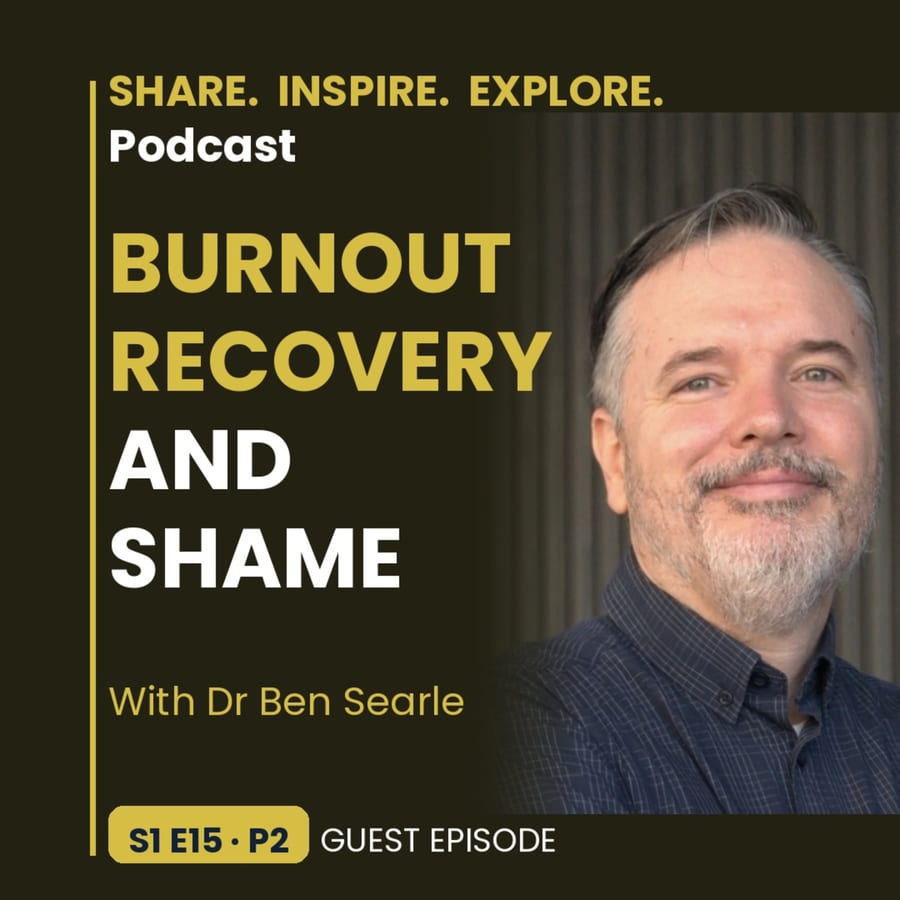
Obstacles of Burnout Recovery, Part 2 — Dr Ben Searle
Prefer to watch? This episode is on YouTube and the show is on Spotify.
About this episode
Burnout recovery is not only about getting better. It is about understanding what keeps standing in the way of staying well.
Chris Wilson and organisational psychologist Dr Ben Searle continue through the six obstacles that make recovery so complicated, taking the last four: shame, health, emotion, and the symptoms of burnout themselves. Shame keeps people quiet. Depression, anxiety and physical exhaustion overlap with burnout in ways that are genuinely hard to untangle. Grief and anger turn up, and so does the loss of who you used to be at work.
And the symptoms make the recovery harder to do.
Why shame keeps people silent, and what that silence costs How to tell when something underneath burnout is slowing recovery down Why small consistent changes do more than trying to fix yourself
Season 1, Episode 15
Part 1 covers the situational and knowledge obstacles.
Connect with Dr Ben Searle: https://mindonthejob.com/ben-j-searle/ and https://www.linkedin.com/in/ben-searle-3a0a1b1/
Share. Inspire. Explore. is the podcast from Where I'm At, honest conversations on burnout, career change, and what comes next for working professionals.
Join the Where I'm At Community, free to join: https://community.whereimatcommunity.com/store/product/membership Website: https://www.whereimatcommunity.com
Where I'm At is based on lived experience, reflection, and educational support. It is not therapy, counselling, crisis support, or professional advice. Please consult a qualified professional for individual medical, psychological, legal, financial, employment, or specialist support where relevant.
Read the full transcript4,208 words
Automatically transcribed, so it may contain errors and does not identify who is speaking. It follows the conversation in order.
Welcome back to Share, Inspire and Explore. I'm Chris Wilson and in part 2 of this episode with Dr. Ben Searle, we dive into more hidden obstacles that can stop recovery cold.
Ready to challenge what's holding you back and chart a stronger course? Your upgrade starts now. And Ben, what is the third obstacle you'd like to share with us today? The third obstacle is shame, Chris. Shame is a huge obstacle to recovery. It is an issue in a lot of conditions that have to do with the self and the mind.
It interferes in a couple of ways. It interferes with early identification of burnout because shame puts us into a denial space. I don't like what these symptoms could mean, so I won't pay close attention to them. They might mean something really bad.
Let's try not to think about that. I'm just going to try and push through. And because you are not identifying and acknowledging the problem, the problem is going to get a lot worse before you are ready to seek help. And that's their second one, is that shame interferes with help-seeking.
So, we tend to be silent of, oh, this is such an embarrassing thing. There's no way I can let anyone know what I'm going through. It makes me feel bad. It makes me look bad.
I'll just, I'll keep it to myself and maybe try and solve the problem all by myself. So, there's a whole lot of things going on in that. Part of it is about the stigma of mental illness, both the way the rest of society acts on it and our own internalization of that. There's also a bunch of cultural issues. So, in some countries, communities or organizations, it feels even worse than others. I don't think anyone has an easy ride of this, but in some places it can be even worse. What do we do as societies where we respect people who succeed? We admire people who persist in the face of obstacles.
Or burnout feels like we're failing to live up to these socially acceptable values. We're failing to meet the expectations of others. We're failing to cope with life's challenges. It can feel very much a humiliating and embarrassing and shameful set of failures.
But you're not a failure. You're not a failure. Absolutely. And you have to silence this inner critic. It's so important. It's very challenging to do. But there is nothing shameful about burning out. Let's have a think about this. Burnout happens to so many people, huge numbers of people all over the world.
Often the people who are burning out are the ones who are trying the hardest, or they're the people who are caring the most, or they're the people who are trying to do things in the right way, or the way that was more consistent with their values. They were people who were weighed down with loads that other people didn't need to carry, whether those are caring responsibilities or childhood traumas or whatever else.
Even if you aren't sure that any of those things applied to you, be aware that the modern world is not one for the faint-hearted. It is a very difficult situation that so many of us face. There isn't the sort of supports that used to exist. There isn't the tolerance of difficult times in our lives that used to exist. There isn't the level of community. So, a lot of people are going to be struggling under these situations.
Now, there are things you can do yourself to try to tackle these feelings of shame, and one of the best ways is to be talking to other people who've been through that experience and reminding yourself, oh, it isn't just me. Other people have been through this as well. Other people who can do things that I think are laudable, that are impressive.
There are things you can do that are good for self-compassion, which is a quality that is very valuable for overcoming shame. So, recognizing that you're a human. And what do we know about humans? Humans have limitations. Humans have imperfections. Humans make mistakes.
If a friend came to sit down with you and said, oh, Chris, I'm going through a really rough time at the moment, and they started to tell you some of the things that you're feeling ashamed about,
I think it's probable that you would try and be compassionate with that friend in a way that might be a little bit difficult to do to yourself. And so, it's important to try and think through,
oh, what are my double standards here that I'm applying to myself that I wouldn't apply to a friend? So true. Yeah, that's, you know, it's the things I used to say to myself.
Very harsh, very harsh. It goes without saying. Mental professionals are a very good source of support for managing shame. They do this stuff all the time. Great stuff. Ben, moving on from shame, what would the next obstacle be?
So, the next one is illness or health, if you want to look at it from the other way. There are a lot of physical and mental health complications that can mask burnout symptoms.
So, depression, anxiety, trauma, neurodiversity. Those are all things that make it harder for you to realize that burnout might be going on or for other people to identify that burnout is what they're seeing.
And that becomes a huge obstacle for some people in recognizing that this is, in fact, what's going on. It can be very difficult. Depression, in particular, has certain areas of overlap with burnout. And I think the consensus still generally is, from most of the experts, that they are different conditions.
But it can make it more difficult if you are experiencing both. If you have a history of depression before you burn out, it can make you more at risk of burnout.
So, being able to say, oh, actually, I need to shelve this problem and work a bit on this problem as well is an added complication to working on recovery.
But in addition to that, chronic stress can cause additional illnesses, particularly chronic illnesses, that can more directly get in the way of recovery. For example, one of the primary symptoms of burnout is exhaustion, right? But chronic stress can also absolutely disrupt your sleep.
It can impact the quality of sleep, the quantity of sleep. You can be waking up a lot at night because of the way that chronic stress gets in and screws up your nervous system.
So, while those sort of illnesses are playing havoc with your sleep, it's going to be difficult to get the rest that you need to start building a foundation of recovery.
So, it is very important as part of the recovery process to get solid and thorough medical and mental health assessment and support. It's particularly important to either rule out depression as another possibility because, you know, people can mistake depression for burnout. It is dangerous to assume that what you have is burnout and not depression. But you can have these things co-occurring and it is important to have the depression properly under control in order to make some headway towards recovery from burnout.
And similarly, with sleep difficulties and other medical problems, getting those under control is going to be important for making some headway with recovery. So, after that, a related one is emotion, which is an obstacle because burnout doesn't just impact our physical health. It can have a big impact on our emotional lives, a much bigger impact than is often acknowledged in a lot of publicly available information. It is increasingly being recognized that burnout influences, for instance, our emotional regulation. The way that we can control our display and experience of emotions becomes impaired when we start burning out.
And emotional factors can impact our recovery journey in a number of ways. Firstly, you know, and this is culturally dependent, of course, but emotionality in a lot of cultures can make people uncomfortable, which can go on to amplify other obstacles such as, you know, the support you're getting from other people or your feelings of shame.
Managing burnout, doing something to improve requires big decisions that become very much harder to make when you're experiencing strong emotions. Do I tell my co-workers that I'm starting to burn out? Do I push my boss to try and get some changes made, some work accommodations to my role? Do I quit my job? Do I give up the volunteering work that used to be really important to me, but is, you know, just another thing I have to carry?
And the result of that being difficult is that we tend to delay those decisions and taking the sort of action that could bring us some relief and maybe head off burnout before the symptoms get too severe. And the final one is that this was a big surprise to me, that escaping a bad situation doesn't necessarily bring you tranquility.
That I discovered as soon as I had left my job, and this was sort of in the few days before I left my job and I broke my arm,
that I felt dreadful. I was having this rollercoaster of emotions. I started to experience these uncomfortable feelings that I later realized were about grief, about, you know, the career I'd given up on, all of this doubt about decisions that I'd made. It was awful, and it did me absolutely no favors in terms of some of the things that I'd been thinking. Oh, when I stop working, I'll start doing these things, and I'll engage in these kinds of exercise, and I'll engage in these kinds of hobbies again. I felt just too dreadful to do a lot of those things. So, yes, emotion, the emotion that is associated with the burnout experience can get in the way of good recovery.
Absolutely. You mentioned grief. Yeah, it's a really tough time. If you look at your CV, then it amplifies it because this is who I was. My identity was in that role. What do I do now?
That's why I went into and did a coaching myself to find my purpose. It's also part of this channel, yeah? Did you also do something along those lines? Maybe a values audit?
I did that as part of the mental health professional I saw, took me through some of my values, and I found that that was very useful for me. Maybe I can catch up with you again some other time and talk about values.
But, yeah, I found that values were useful. I think if I had tried to look at those in the first few weeks after I left my job, that would have been too soon. But doing it sort of six months, nine months, I can't remember exactly now, after I left was a good time for me to say, oh, wait, maybe I can understand myself a bit better and maybe I can pursue a direction that is going to make me feel more whole and better aligned with what's important to me.
So, right at that point when you're experiencing the anger, that's a good time. That was a good time for me because it channels something more positive to fuel the new direction.
But, look, at the very least, it is important to have someone to talk to during some of these emotional periods because otherwise you don't really have anywhere to put it. You're either trying to squash the emotions down and they'll just pop up again, or you're trying to, you know, doing what I was doing, which was trying to intellectualize it. Oh, look, you know, I'm angry for these reasons and that's because of this. And that didn't really do anything to resolve them.
Whereas talking to other people about that, yes, I had a mental health professional to speak to, but, you know, I had friends and family members to speak to. I eventually wound up getting involved in a support group where I could talk.
And, you know, there are a number of ways that mental health professionals can help you manage that sort of turmoil, but it is something that does continue for quite a little while, as we've said, and developing some strategies to try to replace things that we were doing automatically a few years ago, that capacity to regulate those emotions and, oh, yeah, okay, these people did us wrong, but we can move on from that, was, you know, that was second nature to me. If anything, I was, you know, I was floored in that I found it too easy to brush things off and didn't get emotionally involved in things that I should have been more invested in.
And, you know, in some cases that was part of the problem, but I had to learn a whole bunch of new strategies. And let's talk about those strategies, shall we?
Sure, yeah. So one of those is about, you know, instead of trying to suppress emotions, instead of trying to intellectualize emotions, just teaching myself to be able to sit with the emotions, to first go, oh, actually, I'm feeling a strong emotion about something. I'm going to sit down and just attend to it, to give it my full attention rather than try to squish it somehow. And that was something I discovered, oh, I don't like that. And I am still learning, but several years in, I am a lot better at being able to sit with the emotion for a few minutes. You don't have to do it for very long because most of these strong emotions, they zoom upwards.
And then if you're actually saying, okay, I'm angry, okay, I can sit here and be angry. It's not a bad thing about me that I am experiencing anger. I am not anger.
Anger is an emotion that I am feeling, and I'll sit here and be angry as long as the anger needs to sit there. And then it starts coming down, and then once it started to come down, I think, okay, well, it's a bit like, I'm not a wine drinker myself, but it's a bit like being a wine connoisseur. So, what are some of the other flavors here with this anger? I'm getting notes of resentment, maybe a tang of frustration.
Oh, wait, now, that's probably because of these things. Is there a step that I can take today that will help me address my feelings about this in some way?
And then I'll do something. If I can just add, the situation might not be suitable to deal with that emotion of anger at the time. One strategy was given to me. You could say, okay, I have a dedicated slot in the evening. I'm going to process that at that slot. And you just build it up through the day, and by that time, it's maybe saturated, dissolved, realizing it was anger. I'm not angry, you know?
Yeah. Yeah, yeah. And last but not least, Ben, what would the sixth obstacle be for our listeners? So, this is going to sound a bit silly, Chris, but the sixth obstacle to recovering from burnout is the symptoms of burnout.
And to explain this, I need to talk to you about my background. I was a stress researcher, and I did some randomized controlled trial studies at one point in my career on stress management techniques. And in doing so, I looked up some of the research on mental health interventions, behavior change interventions, health interventions like stopping smoking or weight loss or things like that. And I looked at, here are some things that are sort of core requirements of an intervention for it to be effective. And there were three important things that jumped out at me. One of them is commitment, because behavior change is hard work. You need to be willing to try something new, to be able to keep at it, sometimes day after day for months.
You need to be motivated to invest that energy in self-improvement. So, if you have that commitment to an intervention, it is more likely to stick. The second one is trust.
If you found a box of pills on the road marked life improvement pills, most of us would be reluctant. To take them. Treatments need to be credible. People need to think, oh, actually, I can see why or I can believe that this is likely to work. If people don't believe that what they're doing is going to make a difference, they're not going to commit. The first sign of trouble, they're going to go, okay, well, I didn't really believe in this anyway. So, trust is very important.
And it's not just about trusting the process. You need to have some self-belief. When we're trying to overcome bad habits or learn new ways of thinking, you're going to encounter obstacles. You're going to encounter setbacks and even have relapses.
If we doubt ourselves, if we don't really believe that we can follow a treatment plan for a whole month, but we go, oh, I'll give it a try. If it starts getting hard on day three, we're going to go, oh, well, I never really believed I could stick it out anyway. So, I'm just going to give up at this point.
So, behavior change is more likely to work when people believe they have the capacity to achieve that. Now, let's have a think about the three primary symptoms of burnout.
One of them is exhaustion. Now, exhaustion strips you of energy and you need energy to commit to some kind of treatment. A second primary symptom of burnout is detachment or cynicism.
And if you're cynical, you're likely to doubt that a treatment, a recovery activity is going to do you any good. And a third primary symptom of burnout is a lack of self-efficacy, a belief that you can't achieve things that are worthwhile or you can't cope with stress.
And that's going to undermine the sort of self-belief that is important for sustaining some of these behavior change type things. So, what that means is the more burned out you get, the more severe those symptoms are, the harder recovery is going to be for you.
So, you need to take action early. Again, you know, the first time, the best time to do something about your burnout was a year or so ago. Second best time is today.
And there are, you know, a bunch of things I suggest in the book, but probably the simplest one that I can pull out here is start something small. Start something that seems achievable and try and stick with that until you get a sense of, well, is this working or would something else maybe work a little bit better?
Don't take on too much at once and maybe try and work to your strengths. Do what makes you happy. Yeah. Yeah, absolutely. Absolutely. Because it's so important to be able to embrace those aspects of yourself, those aspects of your life, the things that you enjoy, to be able to reconnect with things that have felt really dull and disconnected and unpleasant.
That's some fantastic points, Ben. But that doing the things that make you happy then fuel, give you the fuel to tackle those areas of your life where you need that energy. You've mentioned this exhaustion. That's so true. And it's important. These are, as I said before, experiment. Just experiment. That's why, that was why what drove one of the values, explore.
That's what's so important. And it's, and I say this in my book as well, because there's a lot of things that might help, but everyone is different. People have different needs. People have different strengths.
There are resources that some people have access to that other people don't. So it's not the case that if someone tells you, oh, here is the one thing that you need to do that is going to solve your burnout. It's not true. You do need to try things. You do need to experiment. And if the first thing you try doesn't work, that doesn't mean you throw everything in the bin and walk away and say, well, I'm never going to get better.
It is worth exploring and experimenting and seeing what is working for you. And as you say, if there are some of those things you go, oh, that looks like fun, start there.
That's a, that's a gimme. That's going to work really well. Low hanging fruit. Yes. So Ben, that list is so powerful. So to our listeners out there, recognizing this in themselves, can you maybe tell the listeners what's the first step they could take today to make recovery a little smoother?
If there was one step I would encourage people to take, it is understand you don't have to do this all yourself. Go and get support. Get support from medical and mental health professionals. Find other people who have been through burnout and ask what they found helpful.
And then start reaching out to people in your life and finding out who is going to be supportive and be willing to say, I might need some help. A lot of us who wind up burning out are people who were very reluctant to ask for help. I know I was.
And what I discovered was that there were a lot of people who thought quite highly of me who only were waiting to be asked. And I, you know, I was very appreciative when the topic came up and they said, oh, I'm willing to help. I'd have been willing to help you six months ago if you'd only asked.
You don't have to carry this yourself. It will be challenging. It is work. But there are a lot of people who can help you share that burden. Ben, so, so true. You're not alone. As we've mentioned many times in this podcast, you're not alone.
And if you are struggling or feel unsafe, please contact once more a local crisis line or emergency service and consider reaching out to the therapist, a doctor, a support group to guide your recovery.
Thank you so much, Ben. Those six obstacles and the support tools you've given us. So much time to reflect on. And it's been great having you on. And you're my first male and first international guest.
So thank you for joining me today. I really enjoyed it. It has been an honor and a pleasure, Chris. I am, yeah, this is something, as you said, that I am very passionate about.
And, yeah, I would like people to have more support, more resources to deal with this very widespread problem. Thank you. Thank you. And I'll put a link in the description for our listeners, how they can catch your podcast and discover your products and services.
Awesome. Well, thank you very much. Thank you. So there you have it. I hope this conversation reassures anyone listening that if your recovery feels hard, it's not because you're failing. It's because the system around burnout recovery is often stacked against you.
Until the next time, take care of yourself and remember, you don't have to walk this path alone. Thank you. Feeling lost in the aftermath of burnout? You're not alone.
Where I'm at is a new community, created for those in recovery, those at risk, and those supporting others. It will be a safe, evolving space to recognize, reset, and reinvent with live sessions, peer support, expert Q&As, and more.
It will be free to join in the beginning, and while not everything will be there from day one, this will be a community which is built by us and for us.
Click the link in the description to join and shape what's next. My name's Chris Wilson, and that's where I'm at. Thank you. That's it for today on the Share, Inspire, and Explore podcast.
I hope something resonated with you, a moment of clarity, encouragement, but just a reminder that you're not alone. If you found this helpful, share it with someone who might need it. Hit follow or subscribe to join us for future episodes.
If you're new here, please check the link in the description to join the community. Burnout is tough, but it's also a chance to heal and rediscover what matters. Thanks for being a part of this journey, and until next time, take care, keep exploring what's possible.
I'm Chris Wilson, and that's where I'm at. I'm Chris Wilson, and I'm Chris Wilson, and I'm Chris Wilson, and I'll see you next time on the show. I'm Chris Wilson, and I'll see you next time on the show. I'm Chris Wilson, and I'll see you next time on the show.